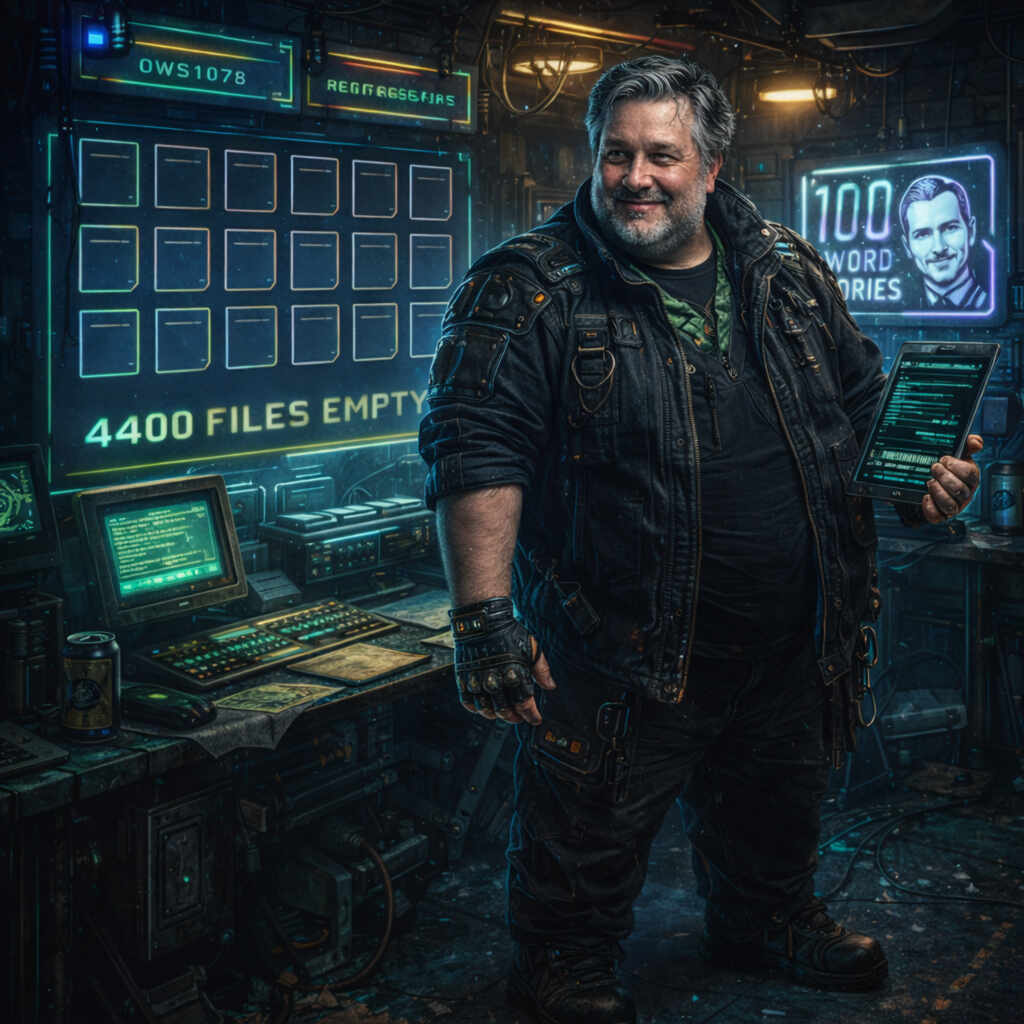
I haven’t stopped writing 100 Word Stories.
I’ve just run out of runway.
For a while, I had a comfortable buffer — stories written in advance, submitted early, neatly scheduled. That cushion is gone. Now I’m racing the weekly deadline again, sometimes writing at the last minute, trying to squeeze one hundred words into a narrow window between everything else.
Meanwhile, forty-four Google Docs sit quietly in my drive.
Each named like:
2026-12-20 OWS 1078 – Christmas Hotel (WIP)
Date. Episode number. Topic. Status.
That’s 4,400 words of commitment waiting for me.
The documents stay empty until I’m ready to draft. I don’t jot ideas inside them. I rely on the word counter to confirm that I’ve written exactly 100 words. Not ninety-eight. Not one hundred and two. Exactly one hundred.
Constraint is the point.
It’s Not Just 100 Words
Each story doesn’t end at the hundredth word.
Once the writing is done, production begins:
- Recording myself narrating it
- Selecting or layering background music
- Creating a featured image
- Writing reflections about the memory or process behind it
- Publishing and scheduling it to align with the official episode date
What began as microfiction has grown into a full creative release cycle.
The story is the core.
The reflections are the scaffolding.
The production is the polish.
I want the reader to see behind the curtain.
Where the idea came from.
What almost made the cut.
What memory I mined.
What technical or emotional obstacle did I encounter?
It’s transparent storytelling.
And because the AI integrated into my site reads those reflections and notes, it can use them to answer questions. The stories aren’t static posts — they become part of a searchable memory system.
The writing feeds the archive.
The archive feeds the conversation.
The Frame: From Swirly Poop to Cyberpunk CRT
The presentation layer has evolved just as much as the stories.
Originally, I had a thick brown frame surrounding each 100 Word Story — a nod to my old “Podcasting Is Full of Crap” era.
When I decided to improve the design, I initially leaned harder into the joke.
I created a seamless tiled background of swirly dog poop.
Technically, it was solid. Clean tile. Subtle shading. Playful. If you understood the reference, it landed.
But if you didn’t?
It risked saying something unintended about the writing itself.
So I pivoted.
Instead of humor as camouflage, I leaned into the aesthetic that already defines my site: cyberpunk archive meets draft-in-progress.
Building a CRT Draft Environment
Once I committed to that direction, I went all in.
I built a tiled scanline overlay where every fifth pixel darkened. Then I added noise to break up uniformity. Both layers were black with varying opacity so I could shift background colors while keeping the same CRT texture.

To make it feel retro-futuristic, I rotated the scanlines vertically — like a future imagined by someone who still grew up on tube monitors.
Then I layered in:
- An inner shadow to simulate curved screen edges
- Neon glows for bold, italic, and underlined text
- Flickering animation for bold text
- A pulsing arrow before italicized edits
- A glowing underline with a pixel tracer sweeping across
- A blinking cursor at the end of the story
Now I can use simple formatting — bold, italic, underline — and let the CSS handle the cyberpunk editing effects automatically.
The complexity was in the sites CSS.
The writing stayed clean.
That separation is a breakthrough.
AI-Generated Environments and Series Branding
The featured images evolved too.
Originally, I was just using a logo for the 100 Word Stories as the feature image. Clean. Simple. Functional.
But as I became more comfortable using AI to place my own photo into different cyberpunk environments, I realized something:
Why not extend the aesthetic into the logo, and then throughout the series itself?


Now, each new story includes an AI-generated image of me inside the environment of that week’s narrative — styled in the same cyberpunk tone as the rest of the site.
My face.
The 100 Word Stories logo.
A cohesive visual theme.
It keeps the series distinct from my other blog posts while reinforcing the brand identity. The logo anchors it. The environment gives it context. The repetition builds recognition.
It’s subtle — but intentional.


The Temptation to Overbuild
At one point, I experimented with clipping the corners of the story frame at 45-degree angles, inspired by Battlestar Galactica’s cut-paper aesthetic. I explored SVG borders and layered paths.
And then I stopped.
There is always a moment when improvement becomes overengineering.
The CRT effect communicates.
The glow communicates.
The cursor communicates.
There’s no need to cut corners here. Anything more would distract from the writing.
Which is ironic — because the entire 100 Word discipline is about restraint.
Building the Buffer Again
Right now, the immediate task is clear:
Rebuild the backlog.
Forty-four documents. Four thousand four hundred words. That’s the visible number.
The invisible number is the hours of narration, music layering, image generation, reflection writing, formatting, and scheduling that follow each one.
But the system is there now.
The CSS handles the aesthetic.
The AI supports the imagery.
The structure supports the cadence.
All that remains is the writing.
One hundred words at a time.
Not because it’s easy.
Because it’s measurable.