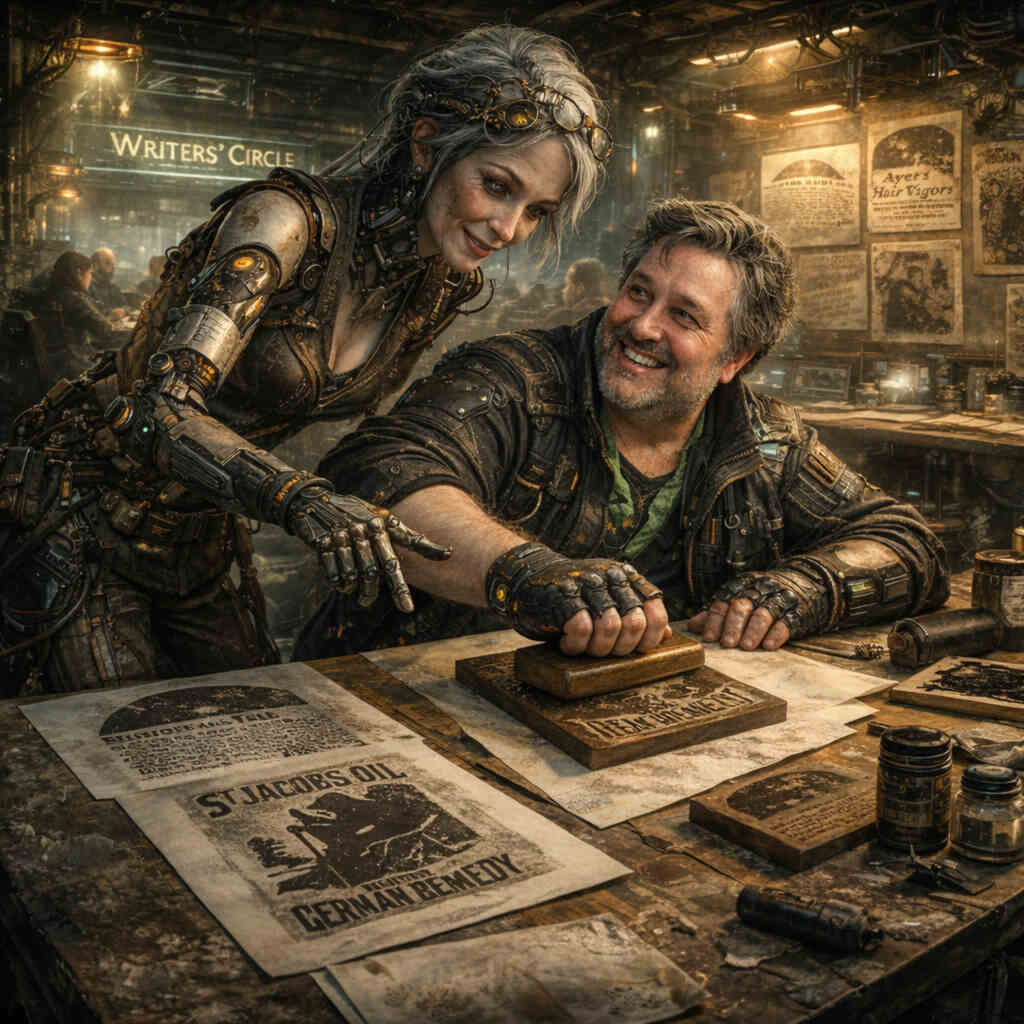
I’ve been working on a series of 1881 block art advertisements — resurrecting old newspaper ads into physical prints. Today became an unexpected convergence of ink, ritual, and words.
Early Morning: Bowls of Water
I arrived at church early to set up the sound booth and noticed something unusual: large punch bowls and water pitchers distributed around the sanctuary.
I asked what they were for.
“Feet and hand washing.”
That stopped me.
A little later, it was decided they were unnecessary — only Jesus washed feet. The bowls were put away. The water never poured.
During the service, two members were ordained as deacons. I had never seen that done in person before. All of my own ordinations happened online — paperwork and approvals, an administrative process. I was not part of a ceremony, just part of a system.
Today’s ordination was embodied. Public. Observed. There is something different about witnessing authority transferred in a room full of people rather than through a form submission.
Meanwhile, I was running audio levels and emailing the pastor about hearing-assist equipment needs.
Cheesesteak Intermission
After church, I stopped at Anthony’s Pizza for a cheesesteak sub — a necessary pause between liturgy and printmaking.
Then I headed to Stone Branch Center for the Arts for a Writers Saloon.
I arrived about an hour early because I wanted to check in with the director about the 1881 block prints we had been testing on 4×4 inch laser-engraved wood blocks.
She was busy working with Sashiko — a Japanese stitching tradition used historically by commoners. Laws once restricted them from wearing bold colors or extravagant clothing, so expression moved into the stitching itself. Constraint didn’t eliminate creativity; it redirected it.
That theme followed me all afternoon.
Testing the 1881 Blocks
We printed four of the advertisements I had left with her on Friday, after she tested them with pencil rubbings.
Some worked beautifully.
One did not.
The ad with dense, small lettering struggled to be seen in the center. I also noticed that an “O” was missing part of its curve — in exactly the same place across every impression. On closer inspection, a small piece of wood had chipped off the letterform.
It was a humbling moment. I had carefully separated each letter by a single pixel in the design phase, applying digital precision to 19th-century typography. But wood fibers do not respect pixels. Material reality overrides software intent.


Images from
The Warren Sentinel, 1881
courtesy of
The VirginiaChronicle.com
via
The Library of Virginia,
engraved at
Samuels Public Library,
printed at
Stone Branch Center for the Arts
Other issues surfaced:
- Ink pooling toward the ends while starving the center
- Horizontal engraving lines becoming visible in large white spaces
- Uneven pressure from hand pressing with a wooden baren
We discussed possibilities:
- Returning to etched acrylic for fine text durability
- Thinning the raised surface to better match traditional relief proportions
- Adjusting ink viscosity or roller type
- Building a frame around the block to prevent the roller from dipping into engraved areas
- Painting engraved recesses while leaving the adhesive backing on as a natural mask, then peeling it away
This is less about reproduction and more about rediscovery. The original printers in 1881 solved these problems without lasers or pixels. They were working from original plates and tooling. I’m learning their lessons the slow way.
Writers Saloon
By then, people had begun arriving for the Writers Saloon. It has been twenty-one years since I last attended a writing group — back in the NaNoWriMo days with the Cat Vacuum Society in 2004.
This group felt different.
The moderator was a staff member from our local library, and one of the Front Royal Lego Users Group members was also there. The conversation wasn’t just fiction versus nonfiction. It expanded into:
- Memoir writing
- Reports and speeches
- Emails as a form of narrative
- Ethical boundaries in storytelling
- Trauma and psychological cost
- Generational trauma in Front Royal stretching back to the Civil War
- Whether we may write from perspectives we do not personally inhabit
- The tension between perfection and publication
- The value of constructive peer review before public release versus instant negative feedback
One question lingered: when does telling a story heal, and when does it pass the wound forward?
There was also discussion of grief spaces — Death Cafés and the possibility of a grief monologue event. Some felt like outsiders, having worked through their stages of grief already. Others saw value in a structured space for processing.
It was thoughtful. Measured. Complex.
I found myself participating more actively than I did twenty-one years ago. Experience changes how you approach writing. Systems thinking has shaped me. Governance, policy, archives, and public comment have shaped me. Writing no longer feels abstract — it feels consequential.
After the Discussion
After the meeting ended, one of the writers joined the director and me to discuss the block prints further. Fresh eyes, new ideas.
Constraint again.
The wood may not tolerate tiny serif lettering the way acrylic does. Ink viscosity matters. Roller geometry matters. Pressure distribution matters. The adhesive masking idea may help. A supporting frame might stabilize ink application.
It’s all iterative.
A Day of Restraint
Looking back, the day carried three repeating images:
- Bowls of water that were never used
- Ink that pressed unevenly
- Words are carefully weighed before being shared
In church, restraint shaped ritual.
In printmaking, the material limited precision.
In writing, ethics constrain expression.
None of it felt restrictive in a negative sense. It felt clarifying.
Not every bowl needs to be poured.
Not every surface should receive ink.
Not every story should be told without thought.
Expression always meets resistance. Responsibility decides how we press it.
Today wasn’t just about block prints or a writing group. It was about understanding where expression meets responsibility — whether in wood, water, or words.