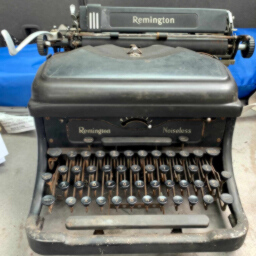
I purchased this typewriter from Happy Creek Antiques for $75. I had been keeping an eye out for older typewriters that resembled the one I grew up with. Talking with my dad on his birthday, he mentioned that the typewriter we had was purchased for $5 in a post office that was also combined with an antique shop where his mom worked as a clerk. My own mother suggested that I use it when filling out job applications, such as with Baltimore County Summer Jobs, to look professional, be easily legible, and get more attention than applications written by hand.

Happy Creek Antiques has had a smaller Smith-Corona Clipper typewriter for a couple of months, which came in its own carrying case, but I was looking for something older. When I had asked in the past, they would often say they would bring in a few more typewriters, but I never saw any additional typewriters. I decided to take a chance and see if they had anything “new” in stock. There on the floor sat an old typewriter. Not exactly what I grew up with, but old enough to make an impact statement.


I asked about the price and if I could try it out. It was only $75. They brought me some paper to type on, and I was able to type all the letters of the alphabet. Sometimes the keys would stay near the paper or get jammed up. It needed some love, but it showed plenty of promise. The shop owners were surprised that the ink on the ribbon still worked. For some reason, I just knew it would. The ink doesn’t evaporate, and it needs to be struck hard to transfer. It also helped that most of the spools were tightly wound and covered, preventing sunlight from reaching them. The ribbon itself wasn’t tattered or breaking up, which was my main concern.
The typewriter also had a clear vinyl cover that had also seen better days, so I brought it with me, uncertain whether I would need it.
I noticed some keys were laid out a bit oddly. The backspace key was on the left. The “1” key is intentionally missing (common with most older typewriters), so I needed to use a lower-case “L”, which looks like the number 1. The symbols above the numbers match only a few of the standard symbols we see on most keyboards. A mini space bar was at the top, returning the carriage to the home position. The appearance of the pound sterling symbol also hinted at a target audience that worked with British companies.

| c. 1938 | -> | “ 2 | # 3 | $ 4 | % 5 | _ 6 | & 7 | ‘ 8 | ( 9 | ) 0 | £ – | |||
| 2026 | ~ ` | ! 1 | @ 2 | # 3 | $ 4 | % 5 | ^ 6 | & 7 | * 8 | ( 9 | ) 0 | _ – | + = | Delete |

The main problem we had when trying to purchase the typewriter was finding a model number. Besides the words, “Remington Noiseless” on the front panel, all we could find was a serial number (X531679) by the right ribbon spool, and on the back, “Remington Rand Made in USA Manufactured Under Noiseless Patent 1,561,450. We looked at the bottom, the back, anywhere on the frame. We couldn’t find anything else to identify exactly what it was.

Regarding “Noiseless” – Yes! It does make noise. However, it’s quieter than the typewriter that I grew up with. I think that was the point. Not the lack of noise, but the reduction. The typewriter I grew up with had a loud snapping sound as I pressed each key. This one is fairly dampened.
When I got home, I started identifying what was unique about it to help narrow down the model and manufacturer date. It’s a desktop typewriter. The sides are enclosed with panels. The whole carriage raises when you press the shift key. The keys are painted plastic. It’s American-made. The ribbon spools are visible. The front just says “Remington” and “Remington Noiseless.” It’s not so much decorative as it has an industrial office-equipment appearance, with large, rounded corners rather than the boxy, sharp curves I grew up with. Above the number row, there are “Set” and “Clear” keys with a wide bar, which seem to be used to set tab stops – a sign of serious office and business work with invoices, accounting, forms, legal work, tables, and column formatting. The X in the serial number dates it no earlier than the mid-1930s. It’s likely a Remington Noiseless Standard Typewriter Model 10, made somewhere between 1938 and 1940.
Once I brought the typewriter inside, I started looking it over more closely and tried to type on some Rolodex cards. I wasn’t able to get the roller to grip the paper hard enough to keep it in place. There is a lever that seems to tighten it, but there is still too much of a gap.
Eventually, I realized that the nest of hammers only rises up sometimes, depending on which key is pressed. This typewriter is fairly unique in that the hammer striking the paper is controlled by two keys. There is an upper head and a lower head. Each head has two characters: upper- and lowercase, controlled by shift. For example, the number 2 (2 “) and letter A (a A) control the same hammer. As a result, there are fewer hammers than in typical typewriters that have hammers for every key with a single head.

The ribbon seemed to have a problem rising when the letters were pressed. Eventually, I pulled off the ribbon caps and found that I could wind the ribbon either way with a crank on the right, depending on whether it was pulled out or pushed in, along with a button on the opposite side of the typewriter. I also found that a lever on the front panel had a T-shaped groove. It was in the down position, which I came to understand was equivalent to disabling the ribbon while typing. Why would you want to do this? Carbon paper or some other transferable ink could be slid in its place. The right side gave me black ink from the top half of the ribbon, and the left side gave me red ink from the bottom.
Once I figured out the ribbon situation, I started typing away and found that the keys were getting stuck and sometimes wouldn’t return. I took off the cover and found that the keys had returned to their positions. I then started typing more quickly without any issues. I would have to put considerable effort into pressing the keys, unlike touch-typing on a modern keyboard. The back arrow allowed me to go back one space and strike the key again. In the end, I started using a typed-up Rolodex card that looked like it was meant for an office. A very, very dirty office. Now I had a working baseline. I now need to research how to clean an antique typewriter without damaging it. An instruction manual may help as well. There are far more levers than the typewriter I grew up with.