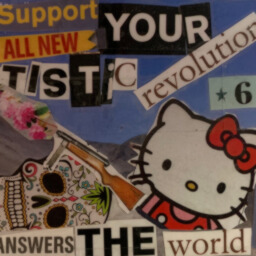
Artistic Revolution and Hello Kitty with a Rifle


I stopped back into Stone Branch Center for the Arts on Sunday to swap out the memory card for the telephone exhibit. I arrived fairly late in the day, with only about an hour left before closing, but the art supplies from the Art Cafe were still spread across the tables. That was enough encouragement for me to sit down and make another artist trading card.

Tilda Swinton
Part of our conversation from Friday’s Artist Trading Card, Starry Eyes, the original image I was working with was of Tilda Swinton, whom I mistook for Gwendoline Christie. They do look similar. The director mentioned that she often plays androgynous roles. I commented that she looked very similar to David Bowie, who also seemed to take on those roles and styles, and that he often redefined his style so frequently as a trendsetter that he seemed to pride himself on being undefinable. At that, the director said the two of them had posed together for a photoshoot, swapped roles, and then showed me a photo.
A Word, or Two
Onto the card – this time, it started with words instead of images.
I began cutting words out of magazines to create something that looked like an old ransom note. At first, I imagined it saying something like, “We stole your art and want money.” That quickly shifted into “We stole your artistic imagination,” as if it were something that could be stolen. Somewhere along the way, the message stopped sounding threatening and started sounding supportive.
Eventually the phrase evolved into:
“We support your artistic revolution; made your answers the world mission.”
The wording is strange, fragmented, and slightly surreal, but that is part of what I like about these cards. The sentences are assembled from scavenged pieces of language. Meaning emerges gradually as different words collide. In a few bad movies, the technique is often used to remain anonymous when asking for ransom money to return a child, wife, dog, or an object of financial or sentimental value, but it is easily foiled by uncaring recipients who ask you to make good on your threats with haste.
Bauhaus Cut-Up
The small pile of cut-up words started to remind me of a cut-up method that Bauhaus often used to write songs. From my understanding, they cut up a newspaper, let the words fall, and wrote the song as-is. Notable songs of this technique included: Terror Couple Kill Colonial, Slice of Life, The Fugitive, and Sanity Assassin.
Punk Estetic & Goth Music
Visually, the cut-up lettering reminded both the director and me of old black-and-white punk flyers. The director knew about my history in goth culture. I wasn’t the kind of person wearing PVC, fishnets – but more like black jeans and t-shirts, a black leather jacket, and long hair dyed black. Back then, my skin was unusually pale compared to most people. I rarely put on makeup unless the group was doing it for something like a midnight showing of the Rocky Horror Picture Show. The director started asking about the music I was listening to at the time. That led us into a long conversation about music from what feels like a completely different life for me. My college years at the Art Institute of Pittsburgh in the mid-90’s were defined by goth, industrial, darkwave, experimental, and punk music.

back row, second from the right

We discovered we both enjoyed bands like Dead Can Dance and Bauhaus. From there, the conversation spiraled into a flood of names and memories: Das Ich, Psychic TV, Switchblade Symphony, The Clash, This Mortal Coil, Christian Death, Trance to the Sun, London After Midnight, Black Tape for a Blue Girl, Faith and the Muse, Front 242, Test Dept, Kraftwerk, Sleep Chamber, and Underflowers.
I struggled to remember them all, but hearing those names again felt oddly nostalgic.
Going home, researching, finding videos, and listening to the music while creating this post brought back many memories.
List of music videos for the mentioned bands
Note: What’s weird today is looking up videos for the music I used to listen to. Back then, I didn’t have cable TV – and this kind of music wouldn’t be found on it. Video streaming was nearly impossible, except for very small, simple animated GIFs.
English: The Ego: God is dead
DJ Lewie, In the House
She recommended that I have a night of DJ’ing my old music. I wasn’t comfortable with that. In the past, my interests were so varied and on the fringe that no one knew about the kind of music I was listening to. I feel like playing music for others, based on what I listened to back in the day, would be lost on everyone. I’d probably feel awkward waiting to see everyone’s reactions, wondering if they are just being nice and bearing it, hoping for something better and more familiar to play. Perhaps people would dance. Perhaps they wouldn’t know how.
On top of that, there are laws regarding public broadcasting and live events, as well as laws in other countries from which some of my collection is imported. I’m not sure how to handle that.
Industrial Music, Industrial Job
A year after college, I had a coworker at WLR Foods who hung out at my apartment once and asked me to play the Das Ich album. The album itself was a bit different from typical CD albums of the time, and it caught his interest. He commented that it sounded like “Cat Killing Music.” I didn’t know what it was like to kill a cat, nor did I ever want to. Mind you, he and I killed chickens often in the middle of the night as part of our jobs on the Live Haul crew transporting chickens between growing houses and egg-laying houses. Apparently, industrial music doesn’t go well with industrial labor.
Lonely Behind the Curtain
There is something to be said that once you see what’s on the other side of the curtain of what everyone is spooked by, the magic is lost, and you appreciate the beauty and labor that goes into things. This goes for industrial labor, spooky music, the occult, and stage performances. You can’t get the magic back of being amazed or scared once you know the underlying mechanics. Ask anyone about a movie that covers a topic in their vocation, and they’ll probably talk about what the director got “wrong”. I had a girlfriend once who was an electrician, and she was always looking at how everyone ran conduit in the buildings we visited. If you start talking about things that seem “normal” to you, it can spook people or go over their heads. All that is left is the camaraderie of others who have pulled back the curtain as well – and they are in short supply.
Freeway With Connections
Another aspect of having many obscure backgrounds of knowledge is that I can sometimes make connections quickly, which often leads me to discuss unexpected topics. I’ve been called out on this a few times as changing the subject, or “where did that come from”, which ends up in a five-minute discussion performing backward propagation and mental gymnastics to show how I arrived at my next thought. After a while, I’ve learned to refrain from speaking about what I speak about. On rare occasions, I’ve seen others do this and noticed similar connections, and another person was lost. Rare, but happy to observe.
Jerry’s Records
Back in college, I worked at Subway as a certified “Sandwich Artist”, across the street from a used record store called Jerry’s Records, and I frequently bought albums based entirely on their cover art and appearance. They say “You can’t judge a book by its cover,” but I had no problem doing so and occasionally found some gems. I recall that the employee who often managed the store was named Dewey, which I found interesting because his name rhymed with my own, Lewie. We just needed to find Hewey before we could find our Uncle Scrooge McDuck.
Az Iz
I also spent time at an occult shop in Oakland, Pittsburgh, called Aziz, while walking home from work along Atwood Street. The smell of the place and the odd things in the window would draw just about anyone curious to come inside and look around. I would often browse the imported music, which would often fetch a higher price than albums in the US but had a unique sound. Sometimes I would hang out, sitting in the back as the owner played videos, talking about concerts he’d attended, his performances, and people he had met. I would hear obscure music playing in the background, hear his stories, and discover new artists through magazines like Carpe Noctem (Latin: Seize the Night. “Seize” can also be: gather, make use of, enjoy, pluck, or harvest), which had a thick cardstock cover compared to most magazines. That magazine introduced me to albums and bands I never would have found otherwise. One album I had ordered from Trance to the Sun, called “Bloom Flowers, Bloom!”, came with a packet of flower seeds.

Volume 1, Issue 1 (1994)

352 Atwood Street, Oakland

Volume 2, Issue 1 (1995)
I found that the owner, Bob Cascio, came across as unusual, as shown in this 1994 video. Most people called him “Aziz” after his shop’s name. He was often in experimental music. The necklace he’s wearing is for Psychic TV. Mind you, in ’94, low-budget video effects were fairly limited.
I would see people from all walks of life walk into the shop. The conversations and activities were something you might see in a few obscure movies. Some people had money like nobody’s business and wouldn’t blink at dropping $500 on a body-hugging vinyl (PVC) dress with a connecting top after Bob encouraged his girlfriend to try it on. (My rent was $120) For Bob, this was everyday life.
Obtaining Underground Music
In the 90’s, there was a mainstream music genre called “Alternative” on all the radio stations, which was a joke, as being on the radio meant that it was essentially “Mainstream”. Meanwhile, I was listening to stuff that almost no one had heard of.
Music discovery worked differently then. I would read about it, hear about it, watch a video, or hear about it in a movie. Natural Born Killers had a great soundtrack, and easy to get.
I would walk into a music store, ask for the catalog behind the counter, search for a band’s name, and manually special-order albums. Columbia House and BMG Music Service only had popular mainstream music to choose from. Buying music online or downloading it wasn’t really a thing yet, as a single song would take up maybe 10% of your hard drive as a WAV file before MP3s were used, and they wouldn’t fit on a floppy disc to exchange with your friends. Many people were still hesitant to read credit card numbers over the phone. I did not even have a debit or credit card capable of online purchases until sometime in the mid-2000s.
Coming Together
While all of this conversation was happening, I continued arranging words and images on the card.
I found an image that looked like a white desert landscape and arranged the words around the edges so the dunes remained visible. Then I found a starburst graphic containing several words, with “All New” in the center. That shifted the message again into an “All New Artistic Revolution.”
Center Focus
At that point, the center of the card still felt empty. I wanted some kind of medallion, symbol, or striking centerpiece to draw attention inward. I flipped through stacks of magazines searching for something meaningful, but nothing felt right.
Then I decided to stop taking it so seriously.
I found a Hello Kitty image and thought, “Why not?” She had an awkward shape that was difficult to cut cleanly, so I trimmed part of the image away and tucked her into the corner of the card instead.
From there, the card became increasingly absurd.
Trigger Happy Kitty
I added a rifle with a scope and magazine clip for Hello Kitty to hold. Immediately I realized it started leaning too heavily toward violence, so I decided the rifle should fire flowers instead. I began searching for tiny flower images that could fit onto the end of the barrel.
Somewhere during that search, I also found a sugar skull image and added that too, tilted sideways across the card.
Yes, it is technically dead imagery, but it is artistically dead with flair.
The director found some flower cutouts around the same time I did, and I ended up liking hers better than the ones I had found myself. One of those flowers became the muzzle bloom at the end of the rifle barrel.
Wrapping Up
I also added the number six with stars on either side for revolution number 6 (new and improved!)
By the end, the card had transformed into a strange collage of rebellion, surreal optimism, punk aesthetics, flowers, skulls, ransom-note typography, and Hello Kitty absurdity.
Once everything was in place, I signed and dated the back with my usual trademark symbol and website. This time I remembered to use the glue stick first before reinforcing the card with layers of tape, which made the construction process much easier than my previous attempt.
Like the first card, I never walked in with a finished concept.
The card simply evolved through conversation, music memories, strange imagery, found language, and experimentation. That unpredictability is becoming my favorite part of making these artist trading cards.