A Sunday of Sound, Story, and Felt
After church, I made my usual stop at the Stone Branch Center for the Arts. A writing-for-grief workshop had already begun earlier in the day, so I wandered into the gallery where one of the Writers Salon members was preparing for the open mic later that afternoon.
His music teacher was there too. She was the same person I’d met while she facilitated a previous Death Café session. I had heard snippets of one of his songs before, and I was curious whether I’d finally hear one of those pieces brought fully to life today.
While he practiced, I pulled out my clown egg and got back to work.
Felting Egg Worksop
I had taken a felting workshop a couple of weeks prior, and from the start, something felt off. The needles I was given didn’t behave like the others I saw in use. Mine had blunt, squared ends, while the examples shown on the instruction sheet clearly had barbs. Still, I pushed through it. My hands cramped, the wool resisted, and I wondered how everyone else seemed to move so quickly.
Near the end of that class, someone handed me a multi-needle tool with a wooden handle. Suddenly, everything worked. The wool shaped easily. It felt right.
That’s when we realized it. My original needles were broken. Likely set aside. And somehow, they ended up with me.
Given that I had arrived just as the class was setting up (an unexpected extra), it made sense. Still, it explained a lot.
I managed to form the base of the egg before time ran out, gathering bits of colored wool to finish it later. Today was that day.
I added blue eyes with black pupils, a black beard that left white space for the lips, thick eyebrows, brown hair, and a faint sunburn across the cheeks and nose. When I tried to make a hat, I ran out of black wool. The director stepped in with an elegant solution—thick black yarn, cut into short lengths. I folded and felted it into the brim, shaping it into a fedora. The gray flecks in the yarn gave it character, even if unintentionally.


By the time I finished, the open mic was about to begin.
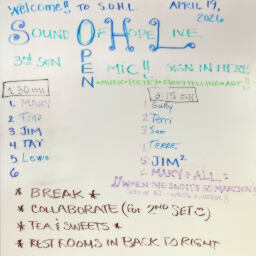
Sound of Hope Live (SoHL) Open Mic
I grabbed a more comfortable chair and settled in. I hadn’t participated in one of these before, and only caught glimpses in the past. There weren’t many names on the list, and I heard that poetry was common, so I added mine toward the end of the first set.

The performances were strong. Passionate. Personal.
One musician played an instrument I hadn’t seen before: a wooden box framed with washboard panels on each side, used for rhythm. The director offered me a small drum to tap along here and there.
Another performer shared original songs, one centered on the Earth itself. It was so compelling that the host asked if she could learn it for a future performance.
Later, I heard the Writers Salon member perform. The notes he had practiced earlier landed cleanly and confidently. It was rewarding to hear that transition from preparation to performance.
Then came a woman who spoke briefly about her love for her husband and her faith before playing music from her tablet and singing along. Her voice stood apart: trained, controlled, and powerful. It wasn’t just performance; it was presence. Earlier, she had even helped guide vocal warmups during rehearsal.
Following that felt… ambitious.
But it was my turn.
I stepped up and introduced my 100-word stories: how they started, the podcast, the weekly themes, and the invitation to participate. Then I read my first story, and then one shortly after in 2009:
Someone asked for something more recent, so I shared A Very Cultured Performance from last month. Being in an art gallery, surrounded by musicians and creators, that one seemed to resonate even more.
There was applause.
As I sat back down, I couldn’t help but notice something. Everyone else had brought something deeply personal: songs, stories, and pieces that carried real emotional weight. My 100-word stories felt different. They were shaped by constraints, built to fit a form, often written against a clock.
It made me wonder whether I had been focusing more on structure than substance, or maybe just speaking a different language altogether.
We broke for snacks and conversation before the second set.
For the finale, we were invited to join in on When the Saints Go Marching In. I slipped into the back room and grabbed my “new” red Chinese waist drum. This is the second time I’ve got to play it; the first was with a drum circle two weeks prior.


One performer introduced a song about her aunt, who had lived to 103. Her aunt had introduced her to “cat paws,” an Appalachian folk instrument made from wooden spoons. She started playing them: tapping her thigh, chest, and thigh again in a kind of rhythmic dance. The motion was expressive, almost theatrical, even if the sound itself stayed fairly consistent.
At one point, they paused to joke that her aunt’s favorite song ran long and that, during one performance, her brother couldn’t find the cat paws in time for her Aunt to join in.
Brother Louie
One of the director’s songs caught me off guard. The chorus kept repeating “Louie, Louie, Louie, Louie,” and while it sounded familiar, I couldn’t quite place it. As I listened closer, the story unfolded—about a white man bringing home a Black woman he called “brown sugar” to meet his parents.
One line stuck with me: “Ain’t no difference between black or white. Brothers, you know what I mean.” It carried a kind of clarity that felt bigger than the song itself. It made me think about how we each notice these things differently, shaped by what we’ve seen and experienced over time. Even decades later, some of those patterns don’t seem to have shifted as much as we might expect.
It struck a couple of chords for me. It reminded me of someone I had dated once. It wasn’t anything serious, but enough to recognize the tension in the story. It also brought back bits of family dynamics I’d seen growing up.
The room, of course, had a little fun with it being my name. That part didn’t go unnoticed.
Later that evening, I went down a bit of a rabbit hole. I tracked down the intro from Louie, then a cover by Stories, and finally the original version by Hot Chocolate.
That’s when I realized I hadn’t just missed the lyrics before—I had missed the context entirely. The original version carried more of the story, even including spoken parts that made the family tension unmistakable.
I also stumbled across another Brother Louie, which turned out to be a completely different take—a love story from the German pop duo Modern Talking, with no connection to the original. There was even a later version, Brother Louie ’98, featuring Eric Singleton stepping in as Brother Louie himself.
It was one of those moments where hearing something live made me actually go back and listen for real.
Comedian, Louis C. K.
Louie
Euro-disco
Euro-disco
Modern Talking ft. Eric Singleton
Flute Whisperer
Another musician joined later with handmade flutes. He explained that the flutes “tell him” which one to play. One piece used a single flute. Another layered sound using three, some with dual chambers, that created chord-like tones. The music evoked Indigenous traditions that are deep, grounded, and resonant.
He spoke about the craftsmanship too, on how difficult it was to carve the bass flute, and how he wouldn’t recommend it lightly. One of his pieces, carved with a figure in a canoe playing a flute, was especially striking.
The final song brought us all together in a circle.
We sang, passed verses around, and took turns improvising. Eventually, it shifted to percussion. The director and I tapped along, doing our best to keep rhythm. My drum has a personality of its own. You can hear the spring inside it rattling, and depending on where and how you strike it, it gives back different tones. Two main voices, really, but enough variation to play with.
I wasn’t perfect. But I was part of it. We carried the song forward.
It felt less like a performance and more like a shared moment. One where sound, story, and people all met in the same place.