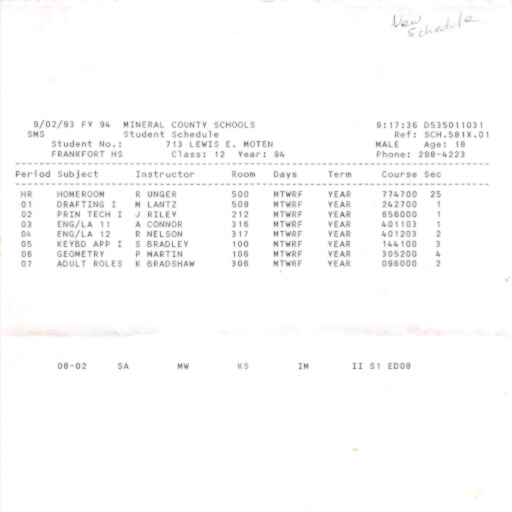
I found my senior high school schedule, issued on September 2, 1993. Just a few months earlier, at the end of May, I had turned 18—a legal adult heading into my final year at Frankfort High School in Mineral County, West Virginia. My student number was 713, a number I also used daily as my lunch code, with meals quietly billed to my parents at the end of each month.
| Period | Subject | Instructor | Room | Course |
|---|---|---|---|---|
| HR | Homeroom | R. Unger | 500 | 774700 |
| 1 | Drafting I | M. Lantz | 508 | 242700 |
| 2 | Principles of Technology I | J. Riley | 212 | 656000 |
| 3 | English 11 | A. Connor | 316 | 401103 |
| 4 | English 12 | R. Nelson | 317 | 401203 |
| 5 | Keyboard Applications I | S. Bradley | 100 | 144100 |
| 6 | Geometry | P. Martin | 106 | 305200 |
| 7 | Adult Roles | K. Bradshaw | 306 | 096000 |
Other than English and Geometry, my senior year was mostly full of elective classes. It felt like a cakewalk. Very easy and enjoyable compared to prior years, with no heavy stress during the school day.
Honor Roll
- November: Faculty 3.31 – 3.69 GPA
- February: Falcon 3.0 – 3.3 GPA
- April: Falcon 3.0 – 3.3 GPA
- May: unreported
Grades
| Subject | 1st | 2nd | 3rd | 4th | ~GPA |
|---|---|---|---|---|---|
| Drafting I | A | A | A | A | A 4.0 |
| Principles of Technology I | A | A | B | D | B 3.0 |
| English 11 | B | B | B | C+ | B- 2.83 |
| English 12 | B- | C | C | C | C 2.18 |
| Keyboard Applications I | A | A | A | B | A- 3.75 |
| Geometry | B | D | B | F | C- 1.75 |
| Adult Roles | A | C | B | B | B 3.0 |
| Semester ~GPA | B+ 3.53 | B- 2.86 | B 3.14 | C 2.19 | |
| Senior ~GPA | B 3.19 | B 3.18 | B- 2.93 |
The home room was a bit boring, but one of the guys often liked goofing off. The room itself was used for bands to play music, and was located near the gym, past the school office, into the back of the cafeteria, and then off to the left down a dark hallway. On one of the last days, I remember a Smashing Pumpkins music video was playing on a large-screen TV: “Today”. The music was pretty cool, and I hadn’t heard the song or seen the video before. Homeroom didn’t make much sense to me, as we just listened to announcements and the Pledge of Allegiance before heading to first period. One of my classmates in home room would sing to himself about having to go to the bathroom, squirming in his chair, singing about his eyeballs turning yellow.
I think this was the year one of my shoes always squeaked as I walked on uncarpeted halls, especially the one leading down to homeroom. Mom was pretty strict about clothes lasting the full year. I had a nice, expensive pair of tennis shoes, so there wasn’t going to be another. She always checked that her thumb could press into the toe, leaving room to grow. I was probably wearing a size 13 or 14 at the time, which made it difficult to find shoes.
Drafting was taught by the shop teacher, Mr. Lantz, in the shop class in the middle of the school. You went down a narrow, carpetless hallway to reach it. I had also taken drafting classes in middle school, and it was nice to get back into it. I knew how to use the boards, straight edges, triangles, and measuring devices. I can’t recall much about what was drafted. I believe I drew up plans for a workbench in the basement, a sewing table for mom, and possibly a computer desk for my brother.
Principles of Technology was taught by Mr. Riley in a science class across the hallway from the shop class. It was in an “H” section hallway that connected the two main hallways throughout the school together. I’m having a tough time recalling if there was a separate class for physical mechanics or if the two were the same class. The class went over gears, pulleys, levers, and ratios, then moved into a series of active labs to test different concepts in small groups. I remember it was interactive and fun.
Next was English 11, followed by English 12 on the far end of the school, past the library. I believe I had lunch between the two classes on the other side of the school near the office. In the prior year, English was difficult. I got lost fairly quickly, and without any way to get help, I just tuned it out. I remember something about prepositional phrases, but beyond that, I’m clueless about what was taught. I often put my head between my folded arms and rested through the class until the bell rang. In my senior year, I was able to take the easier class.
One thing I remember is that each room had TVs installed—mounted high up, out of reach—and they couldn’t be used for anything other than a program that played automatically at the end of Ms. Connor’s class each day. It was a nice break, watching TV in class, but we couldn’t leave for the next class or lunch. Everyone seemed to follow a ’15-minute rule’: no leaving during the first or last 15 minutes of class, even for the bathroom.
The broadcasts included short programs, commercials, and light news segments from Channel One News, often mentioning things like the “Information Super Highway”—a buzzword we now recognize as the early internet. Although I was already dialing into BBSs and using services like Prodigy, America Online, and Promenade, I didn’t actually experience the Internet itself until I went off to college. At the time, those larger services teased it as something just over the horizon. In our rural area, we were still dialing toll-free numbers to avoid long-distance charges and paying by the minute, timing our usage around cheaper evening rates just to connect to a BBS. If we connected too early, we would need to disconnect and call back once the evening rates kicked in to prevent being charged for daytime rates.
One vivid memory came at the end of one of the programs, with a camera drawing away from Earth as Louis Armstrong sang “What a Wonderful World”. It stuck with me for years to come, but he died in 1971. The program may have been playing the song as a tribute to someone who passed away recently, such as Audrey Hepburn, a remembrance of Ryan White, or a segment on the impact of Louis Armstrong and his music.
The broadcast covers rising US/Japan trade tensions, including backlash from American workers and growing concerns that economic conflict is fueling racist sentiment. It also highlights domestic issues, such as President Bush’s push for economic recovery and a successful Space Shuttle mission. The segment closes with a discussion among high school girls about independence, career goals, and the redefinition of expectations for women in modern society.
These broadcasts highlight the Senate impeachment trial of Bill Clinton and Michael Jordan’s retirement. It also features human-interest and educational stories, such as a coach prioritizing academics over sports, a student contributing to NASA’s Mars research, and reflections on the Civil Rights Movement tied to Martin Luther King Jr. Day. The program also covers everyday national issues, from postal rate increases to public health studies and aviation safety.
Keyboard Applications was the closest room to the school office, facing out into the cafeteria. It was fun. Mrs. Bradley was also in charge of the Students Against Drunk Driving (SADD) group. My brother had taken the class prior and could type quickly. I can’t recall, but he was somewhere between 100 and 120 words per minute (WPM). I found that I picked up touch typing much more quickly than the other students, but I was trailing far behind my brother, between 60-80 WPM, and making more mistakes as I sped up. We practiced on electric typewriters, which would start typing a complete line after you reached a certain point. The room was loud and noisy when everyone was typing at once. The typewriters slid under a desk so that you could sit up straight and rest your hands on the keys without looking at them. I learned about how to feel for the home keys “F” and “J” with the little bumps. One of the walls had a large layout of the keyboard keys, so you could look at it for reference and feel out where the keys were.
The advantage both my brother and I had was that we had been programming at home since the early 80’s. I would mostly peck at the keyboard with my index fingers, after I visually found the keys. Somehow, after using the computer for so long, my subconscious mind was already prepared. I learned that after every ending punctuation, you would always press the spacebar twice. Typewriters didn’t have built-in kerning, as many fonts do today for various glyph combinations, and only had what we would consider monospaced fonts. The presence of a double space at the end of a sentence is often a telltale sign of someone trained in touch typing, and it can suggest that the typist is older. One of my favorite activities was to make pictures with the typewriter. Many people would probably think of this as ASCII graphics on the internet today, but these were different. You could type over the same spot with different letters to fill in more complex patterns. The instructions were fairly simple as well.
Geometry was a little further up the hall from the Keyboard class. For some reason, I thought it was my last class of the day and would leave early to get to the parking lot, which I could see from the classroom windows. The schedule shows it was actually the sixth period. Normally, students took Geometry in ninth grade, so as a senior, I was sitting in class with a group of freshmen.
While the final quarter appears to be a drop, it was largely influenced by scheduling quirks related to early graduation rather than a reflection of my overall academic performance. Teachers often schedule major tests on the last day of school to encourage attendance, and this class was no exception. Seniors, however, finished a day or two earlier, and missing that final exam—despite having a passing average throughout the year—resulted in a failing grade for the quarter.
The situation that led to that was my parents’ move to West Virginia in November, during my first year of high school, when everyone had the week off. When I was registered with the school, I was told they didn’t have special education classes and couldn’t fit me into classes everywhere. As a result, one of my freshman classes was Study Hall. I was eventually able to break out and help set up tables and chairs for lunch in the cafeteria.
Adult Roles was held in the Home Economics class. We learned things like the cost of clothing and how the daily cost of clothes goes down the more often you wear them. It had quite a few topics on finances and economics, but I believe it covered other topics as well. I often took Home Economics classes, so I’m uncertain which years I baked a cake using Bisquick or made a drawstring bag with a sewing machine. In my period seven class, I was elected co-president, but I don’t recall us doing anything significant for FHA during class. I was also the FHA treasurer of the whole senior class. The other co-president and I went off to an FHA/HERO camp and were in the paper; I was in the paper again as treasurer for Christmas donations.


As a senior, I had the special privilege of leaving school 15 minutes early at 3:00 pm. All seniors would leave for the parking lot or their buses. My sister would come out afterward, and we would drive over to the new middle school next to the high school and pick up my youngest sister. My brother was also a senior, but he would get a ride with his girlfriend, whom he would later marry.
I got into a collision in October while coming home from school, which also made the papers. The person I collided with was one of my lab partners in Mr. Riley’s class, and I recall she had asked me for help with homework afterward. Looking at the grades on my report card, I can see how it had affected my grades. I didn’t have a job to pay the fine, or for the parts to repair the van.


My mom had both my brother and me get some senior photos taken to hand out to our friends. One of them was submitted to the local paper, where I appeared beside the weather and lottery numbers.


At the end of the year, we had to fill out surveys, and the local paper ran a story the day after my graduation about our goals after high school, listing mine as an industrial designer.