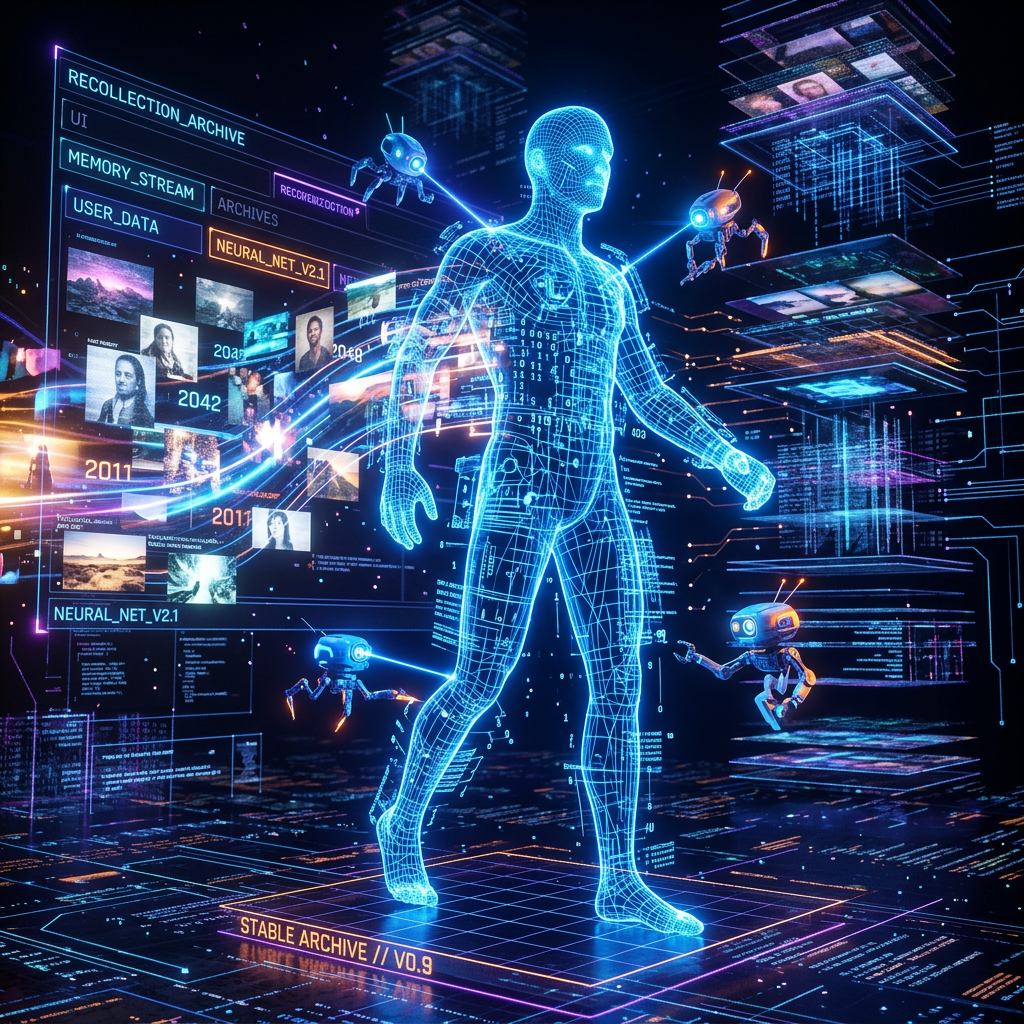
An AI-assisted, first-person draft built from the completed local lewismoten.com archive analysis using Hermes with ChatGPT 5.6-Terra and Ollama using Qwen3:8B. The prior partial self-portrait was from 18% of the processed archive, but this one was composed after all records were evaluated.
I did not set out to keep a conventional blog. I have used it as a place to put things I may need later: notes from a broken project, proof that a piece of work existed, a public comment, a recovered photo, an old web page, a workshop idea, a question that would otherwise disappear into a meeting packet. My About page calls it a chronological system log. That still feels closer to the truth than “portfolio.” A portfolio shows the finish line. This record keeps the false starts, the repair work, and the reasons something mattered enough to keep.[S01][S02]
After working through the whole local snapshot, I do not see a clean résumé narrative. I see a habit that keeps showing up in different forms: I find something that is hard to use, easy to lose, or poorly explained; I learn enough about it to understand the problem; then I try to leave it in better shape for the next person. Sometimes that produces code. Sometimes it produces an exhibit, a public-records request, a restored podcast, or a table conversation at the senior center. The results look scattered until the method comes into view.[S03][S04][S05]
I learn by making the thing real
I have always been more interested in a problem once it has edges. In 1998, I was building small web systems for people to use: a BBS-style community with message boards, mail, files, and central settings; a searchable site database where people could submit their own links and control what appeared in results. They were early projects, but the basic impulse is familiar. I was not content to talk about community or search in the abstract. I wanted a working place where people could log in, look for something, add something, or find each other.[S06][S07]
That same impulse later led to a project for sending data over audio. The initial goal was intentionally strange: move a small file without Wi-Fi, cellular, Bluetooth, NFC, or a cable. Once it worked at all, the interesting work began. I had to deal with corruption, error detection, recovery, packet sizes, and the fact that a clever trick is useless if it cannot survive the channel it travels through. I enjoy that moment when an idea stops being a novelty and starts having failure modes.[S08]
The archive is full of small versions of the same lesson. A 3D-modeling problem turns into a map between image coordinates, grid positions, and indices. A converter that changes a pixel or dithers a texture can corrupt the data embedded in it. A deployment process that depends on logging into the right folder and remembering each manual step needs a build path that can be repeated. A useful system needs a way to explain itself when it breaks.[S09][S10][S11]
I do not mean that every manual process should disappear. I like physical work and small, stubborn experiments. The archive puts sewing and 3D work beside software; it also records laser-cut puzzles and mazes, a felted clown egg, tiny books, and time spent figuring out how a rotary phone actually functions. What I resist is a fragile ritual that only works because one person remembers every unspoken detail.[S03][S12][S13][S14]
Code, craft, and old hardware all belong in the same room
My definition of creative work has always been broad. The Creativity page puts 3D models, graphics, sewing, software, and handmade experiments together. That is not branding. It describes how I tend to work. Code is a material. So is wool, a scanned image, an old phone, a laser cutter, a piece of audio, or a badly documented file format.[S03]
The rotary-phone exhibit at Stone Branch Center for the Arts is probably the clearest example. Someone had the idea that gallery visitors could dial old phones and hear poetry, music, or other audio through the receiver. I had already been curious about old telephones, but curiosity alone had not pushed the project very far. The gallery gave it a purpose. I had to learn enough about pulse dialing, analog telephone adapters, VoIP, Raspberry Pi hardware, and physical setup to let people pick up a phone and have the experience work. That is the version of nostalgia that interests me: not an object under glass, but an old thing doing something with people in the room.[S14]
The small projects matter too. A craft workshop can become a set of instructions that another person can follow. A miniature-book tool can become a way to turn a short piece of writing into a physical object. Even when I write about AI-assisted programming, I keep circling back to version history, reversibility, and whether the change actually happened. I am interested in tools, but I do not trust a tool merely because it makes a confident promise.[S12][S15]
Second Life was work, culture, and a place to grow
Second Life is too large a part of my story to file under “gaming.” It gave me a place to create, sell things, make media, lead people, and be visible. The archive includes virtual-world work that ranged from an Ultima Online tarot deck made with my wife to 3D objects, scripted products, manuals, videos, sales reporting, a daily creation log, and a podcast.[S16][S17]
The Gadget Shop was a real practice. I made and packaged products, ran in-world stores, wrote scripts, created tutorials, and reinvested money into the work. The record includes practical utilities, games, visual experiments, and tools for an unfamiliar virtual world. I was learning business, media, software, and community management at the same time.[S17]
Blue Hair grew out of that world. It was podcasting, but it was also a form of local media for people who happened to live in the same digital place. The restored material shows workshops, performances, community conversations, and the odd mix of creativity and technical improvisation that virtual worlds made possible. Recovering the show years later made the point even sharper. The episodes had been scattered across defunct platforms, broken feeds, dead links, old drives, and archived pages. Restoring them meant finding the files, cleaning the audio, rebuilding the context, and making the record usable again.[S18][S19]
The later Dedric Mauriac recovery work showed me that a digital identity can contain a lot more than a login. It can hold creative work, locations, collaborations, social connections, business history, and a record of how someone learned to participate in the world. Flickr metadata alone could not tell that story. It took exported files, static-site work, OCR, manual review, and memory to turn a pile of images into something navigable. I do not expect to recover everything. I do think the parts that remain deserve more than a folder full of files.[S20][S21]
I have become suspicious of information that can disappear
I have lost enough work, watched enough services change, and dealt with enough obsolete formats to take preservation personally. History of Data Loss starts with a large Google Takeout recovery and moves through water damage, corrupt disks, obsolete storage, failed drives, vanished platforms, and old Second Life material that was hard to retrieve. The plain lesson in that post is still right: a backup can fail, and an outside service may not be around when I finally need it.[S22]
That experience changed how I think about keeping things. I do not want to preserve an artifact only as a file that I own. I want it to be findable, understandable, and usable. That is why an old résumé CD became a way to recover early web work. It is why I brought late-1990s templates into the current site instead of leaving them in a private archive. It is why a Flickr export became a project to reconcile IDs, files, tags, comments, and missing pieces, then make the material visible again.[S23][S24][S25]
This extends beyond my own material. While working with the Warren Heritage Society, I helped examine what was available online and looked for ways to make 1876 newspapers accessible through Virginia Chronicle. A physical archive can be safe in a building and still be out of reach for the person trying to understand local history from home. I care about preservation because I care about access. The two are not the same thing.[S26]
That may be why I leave so much process behind. Restored templates, exported metadata, source links, recovery notes, and explanations of what went wrong can look excessive if all anyone wants is a finished product. I tend to want the next person, including future me, to have a fighting chance of knowing what the finished product is and how it got there.[S01][S19][S25]
Civic work starts with the record
Local civic work belongs in this portrait because it uses the same habits. I read agendas, attend meetings, compare what was said with what was documented, request records, and try to name the specific gap rather than make a vague complaint. The Warren County archive describes this well: questions at meetings, details in agenda packets, FOIA requests, and follow-up when something does not quite add up.[S04]
In a Front Royal comment about FOIA, I argued that released requests should be publicly searchable. A resident should not have to start a fresh request when the same record has already been requested and released. In a Warren County budget comment, I argued that people should be able to follow where a transfer came from, where it went, and how it related to the budget the public was shown. Neither idea is flashy. Both are about letting people see the route from a public decision to the evidence behind it.[S27][S28]
The same concern appears when I write about government social-media moderation. I want a published policy and training, not an improvised answer that changes with the person asking the question. People can disagree with my conclusions. They should still be able to see the rules, the records, and the steps that led to them.[S29]
Libraries are where many of these concerns meet. I have served as a trustee, worked on digital-literacy workshop ideas, reviewed financial history, and helped research the story of Samuels Public Library. The Tabard Inn project began with one small local clue, an early twentieth-century exchange station in a Main Street drugstore, and turned into a public presentation about how people found reading material before the modern library. I like that kind of discovery because it does not stay hidden in a note file. It becomes a story that someone else can encounter and carry forward.[S30][S31]
I also do not want the civic record to make me sound as if I only interact with institutions through documents. At the senior center, I show up early, help serve the meal, and move around the tables talking with people. Over time, that makes illness, loss, fixed incomes, and local problems feel less like an issue category and more like the lives of people I know. The work of a community is partly records and policy. It is also showing up often enough that a chair gets pulled out for you.[S05]
I am willing to be a beginner in public
The archive has plenty of professional material. It includes early graphic work, web development, and more than thirty years of technical experience. But the version of myself I find more credible is not the one who always knows what he is doing. It is the one who puts the broken needle, failed conversion, obsolete drive, awkward public appearance, and missing document into the record instead of quietly deleting the evidence.[S01][S13][S22][S32]
The first open-mic post is a small example. I was at the arts center finishing a felted clown egg and decided to put my name on the list. I was not there as the software person who had a technical answer. I was a person in a room where other people were sharing music and poetry, trying something unfamiliar. I want that part of the record to remain visible alongside the code and civic work.[S13]
Genealogy offers another useful check on my own storytelling. When a hoped-for family connection could not be documented, I did not get to keep it just because it made a better account of the family. The research had to pivot to a different, documented line. That is frustrating, but it is also the rule I want to apply elsewhere: a good story does not turn an absent record into proof.[S33]
What holds the pieces together
The full archive does not make me look like one thing. It makes me look like someone who moves among a few overlapping roles: developer, maker, archivist, local-history researcher, volunteer, public commenter, former virtual-world shopkeeper and broadcaster, and person who keeps trying unfamiliar things in public.
The common thread is not that every project is important. Most are small. Some are unfinished. Some were only useful to a few people. The thread is that I keep trying to make a path through something that was blocked or unclear: an old file, a missing public record, a technical constraint, a forgotten local story, a clumsy manual process, a place where somebody wants to learn but does not know how to begin.[S08][S14][S23][S27][S31]
I think that is why the blog has lasted. It gives me a way to connect facts with the work that produced them. It lets a 1998 web project sit beside a 2026 library presentation, a Second Life podcast beside a public-records proposal, and a lost résumé CD beside the recovery work that gave it context. The point is not to make those things look more coherent than life really is. The point is to keep them from being lost to context.[S02][S06][S18][S23]
I do not need the archive to prove that every detour had a hidden purpose. It has enough unfinished work, mistakes, and awkward edges to resist that kind of story. What it does show is a dependable tendency: I pay attention to how things work, how they fail, who gets left outside them, and what might make them easier to use or remember. That is a reasonable self-portrait, even if it remains incomplete.[S11][S21][S26][S05]
Scope and source note
The local WordPress snapshot contains 24,647 mixed records, including revisions, attachments, templates, and administrative rows. Analysis is complete for every source record: 24,647 latest analysis objects, zero handled-unresolved records, and zero retryable errors. This draft draws from the narrower group of 3,919 published posts/pages, including child pages, then checks each cited claim against the local wp_posts row. Some WordPress dates are retrospective. The portrait deliberately excludes drafts, attachment-only rows, and private or family material that needs more context than a public self-portrait can provide.
Source key
Citations identify the authoritative local source record. Reader-facing URLs are derived from the WordPress record and are included for navigation.
- [S01] About (2024-10-07)
- [S02] Chronicles (2024-04-15)
- [S03] Creativity (2024-04-13)
- [S04] Warren County (2026-06-27)
- [S05] Between Meals and Memories (2026-05-15)
- [S06] Community (1998-04-27)
- [S07] Web Search (1998-04-27)
- [S08] End of Sound (2024-05-18)
- [S09] Density Maps (2024-04-27)
- [S10] Sculpted Prim Data Coordinates (2024-04-29)
- [S11] Automated Deployments (2024-05-27)
- [S12] Maker, Personality, Faith, and Library (2025-01-28)
- [S13] My First Open Mic (2026-04-19)
- [S14] Restoring the Signal (2026-05-06)
- [S15] Tiny Pockets Press (2026-05-28)
- [S16] Stratics: The Ultima Online Tarot Cards (2003-02-07)
- [S17] Dedric Mauriac’s Gadget Shop: Owner (Second Life) (2005-11-28)
- [S18] Blue Hair #2: Podcamp, Poets, and Pixel Economics (2007-02-02)
- [S19] Restoring Blue Hair: A Digital Archaeology Project (2026-01-15)
- [S20] Restoring a Second Life Identity (2026-03-18)
- [S21] Teaching an Archive to Read Itself (2026-03-06)
- [S22] History of Data Loss (2024-11-03)
- [S23] Restoring the Beginning of All Dreams (2026-06-08)
- [S24] Template Revival (2026-02-27)
- [S25] Reclaiming Flickr: Owning My Photos Again (2026-02-27)
- [S26] The Digital Divide and 1876 Newspapers: Bridging the Gap in Warren County (2025-02-04)
- [S27] Making FOIA More Public (2026-06-22)
- [S28] Budget Transfers Need Sunlight (2026-06-02)
- [S29] Stop It: A Public Comment on Censorship and Accountability in Warren County (2026-09-01)
- [S30] Samuels Public Library: Trustee (2023-07-10)
- [S31] Nickel Books and Hidden Libraries: Front Royal’s Tabard Inn Library (2026-06-25)
- [S32] Freelance Graphic Artist (Dragon Software) (1995-04-01)
- [S33] When One Door Closes: A Major Pivot in My Genealogy Search (2024-06-05)