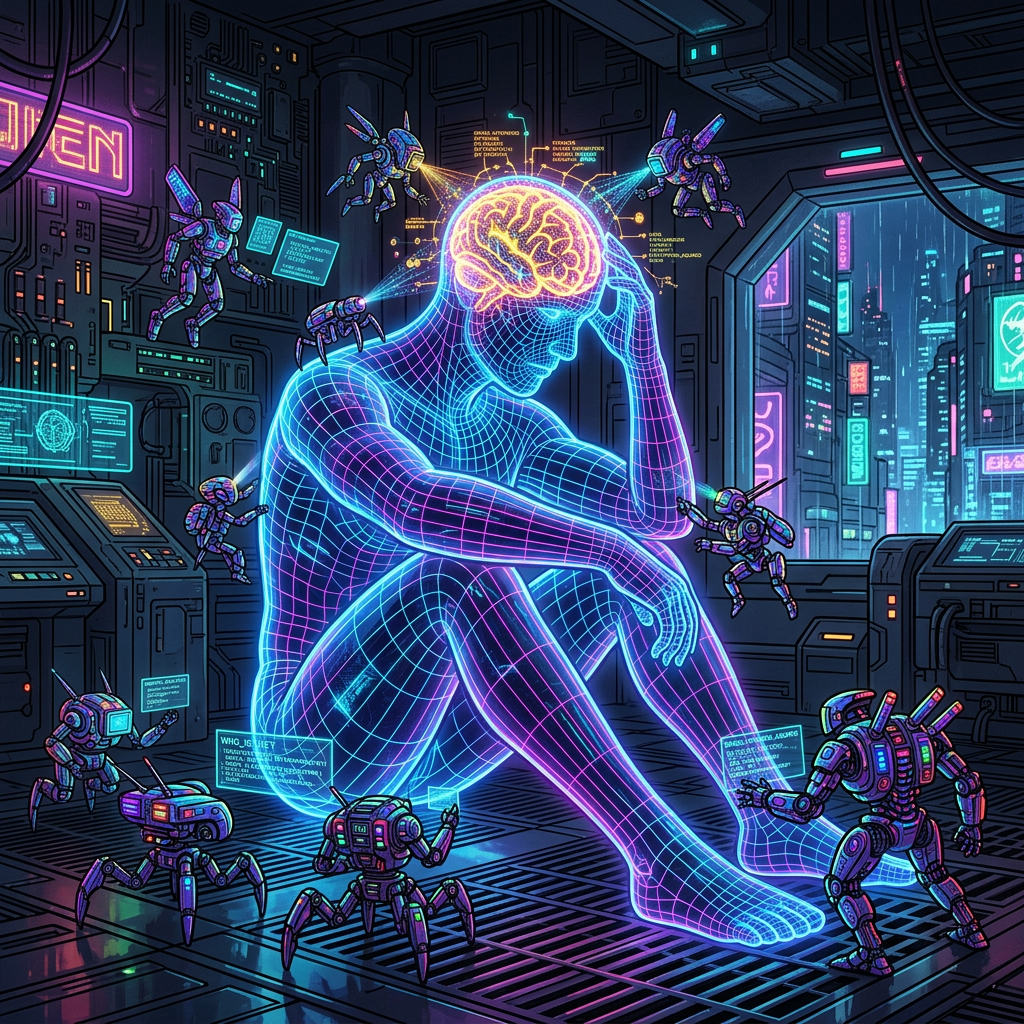
An AI-assisted reading of this blog, while the processing is still in progress.
I’ve been putting my WordPress history through a local AI process. At 01:36 UTC on September 4, 2026, it had processed 4,637 of 24,647 records: 18.81 percent.
That is not 18.81 percent of a neat stack of blog posts. A record can be a post, a revision, an attachment, or an odd bit of WordPress that has been sitting around for years. The linked posts below were checked directly against the local backup for this piece.
So far, the record says that I save the work, the mistakes, and the pieces I have not figured out what to do with yet. The rest may add context, reveal blind spots, or make this reading look too neat. A few patterns are persistent enough to say out loud anyway.
I learn by making things real
The blog has never kept a clean border between programming, art, craft, hardware, and historical curiosity [1][2]. The Creativity page puts 3D models, graphics, sewing, software, and handmade experiments in the same room because they are all ways of turning curiosity into something tangible [2].
I keep giving myself inconvenient technical problems. I took apart PC-speaker audio formats to learn what was inside them. I built tools for 3D models. I tried to move data through sound because cassette-loading computers and dial-up modems made me wonder whether a browser could do something similar now [4][5]. That experiment became packet sizing, compression tradeoffs, checks, recovery, and selective retransmission [5]. It was meant to move a small file between devices without Wi-Fi, cellular service, Bluetooth, NFC, or a wire [5].
The pattern may be that I follow an idea until it acquires failure modes. Possible is not enough. I want to know what happens when a packet starts one millisecond too early, a model coordinate flips, or an image editor quietly changes the data it was supposed to preserve [4][5][17].
I care about the parts of systems people do not see
A page loading, a model rendering, or a deployment succeeding is only the visible bit. The archive keeps pulling my attention toward the machinery behind those moments: file offsets, coordinate mappings, diagnostic tooltips, error logs, backup keys, secret stores, and recovery paths [4][7][8].
While working on a 3D authoring tool, I built diagnostics that mapped a grid index back to rows, columns, and source-image coordinates. That exposed a rotation and flip problem that could easily have looked like a vague rendering bug [4]. An image converter created a different kind of failure. It either resized a 64×64 texture or dithered its colors, corrupting sculpt data stored in the image; the conversion had to preserve the dimensions and color of every pixel [17]. Later, an error-logging project moved from raw PHP logs to parsing, database storage, and a searchable interface [8].
The same instinct turns up in security work. A post about keeping secrets asks what happens after an attacker reaches the database, where the keys live, and how a recovery path can become its own weak point [7]. I do not enjoy broken systems. I am wary of systems that look reliable only because no one has asked the uncomfortable questions yet [4][7][8].
There is a more personal context for that caution. History of Data Loss begins with a Google Takeout transfer and moves through water damage, corrupt disks, obsolete formats, services that changed or disappeared, drive failures, and hard-to-recover Second Life work [19]. The post ends with a plain rule: backups can fail, and cloud services cannot be assumed to last or stay compatible [19].
I prefer fewer fragile handoffs
Some manual work is worth doing by hand [6]. Repeating a fragile ritual because nobody has made the handoff visible is a different matter [6].
One deployment project began with a familiar routine: log in over FTP, find the right folder, delete old files, upload new files, and hope nothing was missed. I wanted repository changes to trigger a build-and-deploy process instead [6]. That preference shows up elsewhere in the archive: make the hidden steps observable, learn where they fail, then build a path that another person can inspect and repeat [4][6][8].
The work reaches beyond the screen
Technical curiosity has a habit of escaping the screen. Restoring the Signal began with old rotary telephones and became an exhibit at Stone Branch Center for the Arts, where visitors could dial a number and hear poetry, local music, or another audio experience through the receiver [12]. It needed old telephone knowledge, VoIP adapters, pulse dialing, physical equipment, a gallery, and people willing to pick up the phone [12].
The same move appears in the library and local-history work. Research into Samuels Public Library led to a presentation on Front Royal’s early Tabard Inn Library exchange station, a rotating bookcase in a Main Street business around 1903 [11]. The record becomes more useful when someone can encounter it, ask about it, and add it back to the local conversation [10][11].
Community means showing up and leaving a record
The community material does not read like a separate hobby. It has the same habits as the technical work: look closely, notice what is missing, learn the context, make the information easier to use, and show up in person [9][13][16].
The Warren County archive includes public comments, agenda reviews, FOIA work, budget notes, hearings, public-record research, and follow-up questions. It is an attempt to make county decisions easier for residents to follow [9]. In one budget comment, I argued that people should be able to see where public money came from, where it went, and how a transfer connected to the adopted budget [14]. In another, I argued that a public-records system should show material that had already been requested and released rather than making every resident start at zero [15].
The work is not all meetings and documents [13][16]. I have helped serve meals at the senior center, where showing up early and talking with people matters [13]. I have joined ribbon cuttings because a visible show of support can matter to people taking a risk on a new business or organization [16]. At Samuels, that has also meant trustee work, planned digital-literacy workshops, and a review of library financial history through Bibliostat and FOIA requests [18]. I keep returning to libraries as places where local history, public access, civic trust, and ordinary community life meet [10][11].
I have been keeping a system log alongside a portfolio
The title Chronicles makes more sense after reading the archive this way. It describes a record of civic participation, technical experiments, creative work, and local life alongside the things I notice, question, and contribute [3]. The About page calls it a chronological system log of debugging, strategy notes, and professional milestones [1].
That is closer to what I have been trying to keep here [1][3]. It is not a polished highlight reel [1][3]. It holds experiments that did not behave, notes from meetings, small discoveries, missed assumptions, tools that needed more work, and ordinary days where technical work and community life ran together [1][3][13].
The partial portrait is not especially tidy. I seem to be someone who wants to understand how things work, but does not want that understanding to stay private. The work keeps moving outward: into a tool people can use, a record people can consult, an exhibit they can touch, or a question that becomes easier to follow [3][9][12].
I’m still in the middle of it. There are a lot of records left, and I do not want to turn a partial pass into a neat story just because the tools can sort it. I’ll keep breaking the work into smaller pieces, checking the details, and putting the useful parts somewhere I can find them again. That is a better plan than pretending it is finished.
Sources
- [1] http://lewismoten.com/?page_id=1 — About
- [2] https://lewismoten.com/?page_id=219 — Creativity
- [3] https://lewismoten.com/?page_id=498 — Chronicles
- [4] https://lewismoten.com/?p=1395 — Density Maps
- [5] https://lewismoten.com/?p=2493 — End of Sound
- [6] https://lewismoten.com/?p=3383 — Automated Deployments
- [7] https://lewismoten.com/?p=3587 — Keeping Secrets
- [8] https://lewismoten.com/?p=4188 — PHP Error Database
- [9] https://lewismoten.com/?page_id=29509 — Warren County
- [10] https://lewismoten.com/?page_id=29532 — Libraries
- [11] https://lewismoten.com/?p=29088 — Nickel Books and Hidden Libraries: Front Royal’s Tabard Inn Library
- [12] https://lewismoten.com/?p=27871 — Restoring the Signal
- [13] https://lewismoten.com/?p=28319 — Between Meals and Memories
- [14] https://lewismoten.com/?p=29834 — Budget Transfers Need Sunlight
- [15] https://lewismoten.com/?p=29498 — Making FOIA More Public
- [16] https://lewismoten.com/?page_id=25315 — Ribbon Cuttings
- [17] https://lewismoten.com/?p=1583 — Sculpted Prim Data Coordinates
- [18] https://lewismoten.com/?p=12999 — Samuels Public Library: Trustee
- [19] https://lewismoten.com/?p=6732 — History of Data Loss
I composed the content above with GPT-5.6-terra using Max thinking, with the Hermes Agent helping it learn from my writing and experiences. The exported MariaDB dump was converted into SQLite, where multiple agents were spawned to parse each record using Ollama and the Qwen3:8b model.
One response to “A partial self-portrait from an unfinished archive”
[…] archive analysis using Hermes with ChatGPT 5.6-Terra and Ollama using Qwen3:8B. The prior partial self-portrait was from 18% of the processed archive, but this one was composed after all records were […]