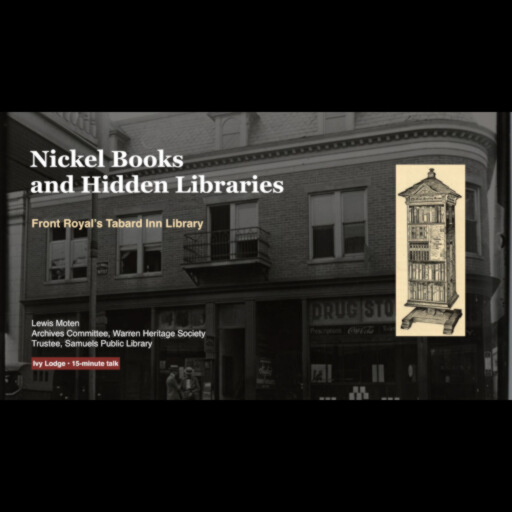
I gave a presentation for the Late Night Archives series on Thursday Nights at the Warren Heritage Society in Front Royal, Virginia. The topic was “Nickel Books and Hidden Libraries: Front Royal’s Tabard Inn Library.“
The short version is this: while helping with research on the history of Samuels Public Library, I stumbled upon a forgotten chapter in Front Royal’s reading history. Around 1903, Front Royal had a Tabard Inn Library exchange station at Trout & Turner, a drugstore on Main Street. It was not a public library building. It was a rotating bookcase in a business, part of a national subscription library system created by Seymour Eaton.
That discovery led me down a very large rabbit hole.
Watch the presentation
Enhanced Slides are also available as a Facebook Video.
The slides are also available as a PDF.
How I found the Tabard Inn Library
This research began while I was helping Colleen Snyder, author of In Search of Giants, with background research for her presentation on the history of Samuel’s Public Library. Her presentation, “Echoes of the Past,” was part of the revived Silver Tea tradition at Samuel’s Public Library.
While looking for details about the library’s past, I came across earlier efforts to bring books to Front Royal before the modern public library became established. Those efforts included the What-so-ever Circle of King’s Daughters and Sons, the Community House Library, and, unexpectedly, a Tabard Inn Library exchange station in Front Royal.
That one discovery connected Front Royal to a much larger national story about subscription libraries, book distribution, drugstores, rail lines, public literacy, and the changing ways people accessed books before radio, television, and modern public library systems.
Colleen Snyder’s “Echoes of the Past”
Colleen’s work helped frame the larger story of Samuels Public Library and the local people who kept library access alive in Front Royal.
Presentations
PDF Slides from her presentation:
Slide notes and discussion
Below are the slides from my presentation, along with a summary of the discussion around each one.

The title came from the five-cent exchange fee often associated with the Tabard Inn Library. These books were sometimes called “nickel books,” and the libraries were often hidden in plain sight inside stores, drugstores, offices, homes, train stations, and other everyday places.
The Front Royal station was not a grand library building. It was a library inside a bookcase.

I introduced myself as Lewis Edward Moten III, also known as Lewie. I serve on the Archives Committee at the Warren Heritage Society and as a Trustee at Samuels Public Library.

Before becoming a trustee, I was already involved in book access through my role as a Little Free Library steward. In 2023, I sponsored a Library Lovers Month and Day of Giving match for Samuels Public Library, which was reported by the Royal Examiner and The Valley Today. That personal thread matters because the whole presentation is about access: how people get books when a permanent public library is not yet available.
The Tabard Inn Library was a commercial system, but the deeper story is about access. Private libraries and subscription libraries were not equally available to everyone. A book exchange in a drugstore lowered the barrier.
That same access story continues through Samuels Public Library, Little Free Libraries, community archives, and public history work.

Colleen Snyder’s research into Samuels Public Library and the revived Silver Tea helped lead me into earlier library history. While following newspaper clippings and archive records, I found references to library efforts before Samuels had a stable permanent building.
That led to the discovery of the Tabard Inn Library in Front Royal.

The timeline places the Tabard Inn Library in context:
- 1799: Front Royal Librarian Society chartered
- 1836: Front Royal Library Society incorporated
- 1903: Tabard Inn Library station at Trout & Turner
- 1913: King’s Daughters opened a Chapter Room library
- 1921: Silver Tea fundraising tradition
- 1952: Dr. Bernard Samuels donated Ivy Lodge
- 1980: modern library opened on Villa Avenue
- 2009: current Samuels Public Library opened on East Criser Road
- 2023: My Day of Giving match and later library involvement
The point is not that Tabard became Samuels directly. The point is that Front Royal repeatedly found ways to keep books within reach.


The Tabard Inn Library was founded by Seymour Eaton in 1902. It used distinctive rotating wooden bookcases that could be placed inside existing businesses.
At its peak, the system claimed thousands of stations and more than one million members. Even if those figures should be understood as promotional claims, they show the scale of Eaton’s ambition.

I reached out to Oceanside Public Library in Oceanside, California, because they have a restored Tabard Inn Library exchange station. They kindly provided photographs.
This helped the audience understand what Front Royal’s station may have looked like. The exchange station was not just a shelf. It was a decorative, rotating bookcase with signs, subject labels, a brass ticket slot, and a motto wrapped around the top.

The Tabard system worked through memberships and book exchanges. A person could return a book, pay a small exchange fee or use a ticket, and take another book.
The unusual part is that the book itself could function as the membership. A person could travel, carry the book, and exchange it at another station.
That made the system especially interesting in a rail-connected town like Front Royal.

Front Royal’s Tabard Inn Library station was associated with Trout & Turner, a Main Street drugstore. Newspaper advertisements show memberships offered locally, including a $1.35 price in later ads.
The local notice stated that Front Royal would receive roughly 130 to 150 books each month to replace books that had already been read.

One of the most interesting local details is Mrs. B. M. Cone, who was described in the newspaper as a kindergarten teacher and thought at the time to be Virginia’s first public school kindergarten teacher.
That connects the Tabard Inn Library to early childhood education, women’s civic work, and the push for public learning in Front Royal.

Before Samuels Public Library had a stable permanent home, library access moved through ordinary places: drugstores, newspaper offices, civic rooms, private homes, and community spaces.
That is one of the most important parts of the story. The “library” was not always a building. Sometimes it was a relationship between a teacher, a shopkeeper, a civic circle, a volunteer, and a reader.

The What-so-ever Circle of King’s Daughters and Sons opened a library in its Chapter Room in 1913. Their minutes describe 40 new books and roughly the same number of donated books.
The King’s Daughters were a benevolent organization that visited the sick, provided baskets, supported hospitals, and served the community. Their library effort forms a bridge between the Tabard story and the later Community House and Samuel’s Public Library story.

I brought a physical Tabard Inn Library book to the presentation: The Tree of Knowledge, by “A Woman.” It contains a Tabard bookplate explaining the rules of the system.
The book also included a publisher’s summary advertising the book for purchase. That suggests these circulating books also served to promote private ownership.
One of my favorite discoveries was a penciled advertisement in the back of The Tree of Knowledge for “Brownie THE Bobber” and Brown’s Tonsorial Parlors.
The ad mentions services such as manicuring, massaging, mustachios waxed, beards trimmed, oils, powders, razors, chiropody, and mechano therapy.
It is a wonderful reminder that books passed through many hands. A book could be reading material, a membership token, a product advertisement, and a little traveling time capsule.

The Tabard Inn Library arrived at a time when literacy was rising because of public education. Millions of people wanted self-education and cheap entertainment.
Cheap hardback books flooded the market before radio became common and before films became long-form mass entertainment. Critics complained about “trash” fiction in much the same way some critics today complain about low-value AI-generated books flooding the market.
Every new media format seems to bring panic about quality, abundance, and taste.
Libraries also had practical reasons to use commercial circulating systems. They could make new books available quickly without having to purchase and process every title permanently.
Seymour Eaton later developed the Bodley Club Library, a related service aimed more directly at libraries. It helped solve a different problem: how public libraries could meet demand for new popular books without being stuck with unwanted inventory.

This slide returned to the main point: Front Royal has a long pattern of creating access to books.
The Tabard Inn Library was temporary. The King’s Daughters library was temporary. The Community House library moved from place to place. But the desire remained: people wanted books, learning, and a place for community life.


As part of the research, I began mapping known Tabard Inn Library locations. The maps show that Front Royal was not an isolated curiosity. It was part of a larger Mid-Atlantic and national network.
Rail lines, drugstores, newspapers, and subscription agents all helped the system spread.

The Bodley Club Library map helps show that Seymour Eaton was not just running one clever bookcase system. He was building an ecosystem of book access, book promotion, and book distribution.
The Tabard Inn Library, Booklovers’ Library, and Bodley Club Library were related parts of a larger publishing and library-service experiment.

This project pulled from many sources: the Warren Heritage Society, King’s Daughters Minutes, Colleen Snyder & Amy Hayes, Samuels Public Library, the Library of Virginia‘s Virginia Chronicle, Wikipedia, Wikimedia Commons, Internet Archive, Library of Congress, HathiTrust, Google Books, Library History Buff, the Wisconsin Library Association, The Questers, Oceanside Public Library, Chagrin Falls Historical Society & Museum, Kuenzig Books, Indiana State Library, Hoosier State Chronicles, Pennsylvania Newspaper Archive, and several newspaper archives.
Related Wikipedia articles
The research was scattered across many sources, and many bookplates and a few advertisements were already available on Wikimedia Commons. That is one reason I created and expanded Wikipedia pages, so others would not have to start from scratch.
As part of this research, I created or substantially expanded several Wikipedia pages:
I have also made edits to:
The goal was not just to document Front Royal’s small station, but to reconnect it to the larger history of commercial circulating libraries, public literacy, and early book distribution networks.
Visit Late Night Archives
If you enjoy local history, archives, old newspapers, lost buildings, hidden stories, or the way small discoveries connect to larger history, consider attending a Late Night Archives presentation at the Warren Heritage Society in Front Royal, Virginia, in the Laura Virginia Hale Archives behind the Ivy Lodge at 101 Chester Street.
The Warren Heritage Society and the Laura Virginia Hale Archives are full of stories waiting to be rediscovered. Sometimes those stories are in a box of minutes, a newspaper clipping, a photograph, a bookplate, or a single advertisement hidden in a century-old newspaper.
And sometimes, if you are lucky, they lead to a forgotten library in a drugstore.
Learn more: