Walking in Silence, Hearing Everything
Sunday began like any other.
I picked someone up for church, arrived early, and got the AV equipment running in the tech booth. It was routine—familiar, predictable. During service, the pastor invited everyone to join a Walk for Peace later that afternoon at the gazebo on Main Street. It sounded like one of those “if you have time” kind of things.

Pastor Michael Williams: Today at 2:00 p.m. at the gazebo. Please, if you want to have a nice little afternoon walk for a good reason, there’s going to be a peace walk at the gazebo led by Ado Lama, who visited with us several weeks ago. Wear comfortable clothing, and please bring your friends, your children, and your grandchildren, and let’s just love each other.
As it turns out, I had time.
After shutting everything down, grabbing a few snacks, and dropping my passenger back home, I found myself with an hour to spare. I wandered into the Stone Branch Center for the Arts and joined a workshop on making Pysanky Ukrainian eggs—delicate, intricate, and completely absorbing.


Then, just before 2:00 PM, we walked down to the gazebo.
A Different Kind of Gathering
About 80 people had gathered. Ambient sound filled the space—low, resonant tones that felt like a mix between a singing bowl and a steel tongue drum. It didn’t feel like background music so much as an atmosphere.
I saw familiar faces. Some I hadn’t seen in a while. I met up with my pastor.
And then there was the monk.
He stood out—not because he demanded attention, but because he didn’t. He was smiling, calm, present in a way that made everyone else seem just slightly out of sync by comparison. People treated him with a quiet kind of respect.
I learned that this was the same monk who had attended our Christmas service—alongside a Spanish congregation and a Jewish rabbi. That memory alone says something about the kind of community we’re building here.
What surprised me even more was learning about his wife—a neurosurgeon—who translated his teachings and explained the scientific side behind them. Together, they formed this unexpected bridge between spirituality and science.
That pairing stuck with me.
Teachings That Felt Familiar

The program began with Laura Ruby from Ruby Yoga—someone I’ve mostly known through local reporting and community meetings.
Then the Buddhist monk, Ado Lama, began to chant.
It wasn’t just a sound—it felt physical, like the vibration was coming from his whole body. Deep, resonant, intentional. When he finished, he simply said, “Thank you,” in a light voice.
He spoke mostly in Chinese, with occasional English phrases like “Walk for Peace.” His wife translated.
AI Assisted transcription & translation
Chanting: 我 一直 想 不 斷 地. 寧 願 每 一 天. 我 都 想 不 斷.
“I always want to continue without stopping…
I would rather, every single day,
keep going without interruption.”
Chanting: 地 便 當 當 完. 整 的 什麼 都 都. 不 斷 地 只 想. 不 斷 地 所以 他. 非常 非常 地 所有 的人.
“To keep going completely, without lacking anything…
to stay focused and continue…
That’s why he is very, very dedicated to everyone.”
Speaking: 非常 地 歡迎 我們 今天. 做 這個 walk for peace.
“We warmly welcome everyone today
to take part in this Walk for Peace.”
The message, though, was clear:
- Find strength within yourself
- Love your parents
- Show compassion, even to those who can’t express it
- Support each other
- Conflict isn’t necessary
- Life is lived one breath at a time
- Walk in mindfulness, without chatter
I couldn’t help but draw a parallel to the teachings of Jesus—love your neighbor, lead with compassion, choose peace. Different traditions, same core message.
It made me wonder what it must have been like for people hearing that message for the first time thousands of years ago.
But one part hit differently.
“Love your parents.”
That one didn’t sit easily with me.
Forgiveness was already a long road. Love feels like something else entirely—something I’m not sure I’ve figured out yet.
The Walk
We were given two options: meditate in the shade or walk a 1.5-mile route through town.
Everyone I knew chose to walk. So I walked.
We gathered at the pavilion. There was water—but not where I expected it. By the time I got there, I saw lemonade and iced tea set aside for the meditation group. I didn’t think much of it at the time.
Then we started.
Silence.
No talking. Just footsteps and the occasional breeze.

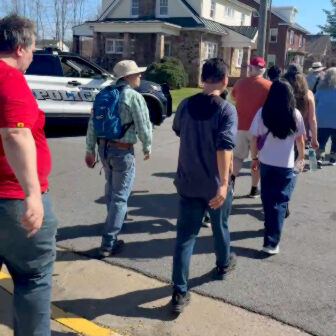
Police blocked intersections as we crossed. Drivers waved. A few honked. People on sidewalks took photos. I didn’t recognize anyone walking near me, so it felt like I was alone—surrounded, but alone.
And that’s when things started to shift.
Seeing What I Usually Miss

Walking changes things.
You notice buildings differently. Details stand out. Places you pass every day suddenly have character. Stories.
I saw someone I had met earlier at the arts center picking up trash along the route. That stuck with me—quiet service, unnoticed by most.
Then came the physical part.
I got hot. Thirsty. Sore. Impatient.
I didn’t know the route. I couldn’t see the front of the group. I didn’t know how much farther we had to go. That uncertainty started to wear on me.

At one point, we turned down a street that seemed to steer us away from one of the most visible signs of blight in town. I found that… interesting.
We stopped a few times with no explanation. Once, it looked like we were blocking a car trying to leave a gas station. I suggested making room, but someone noticed a camera—so we stayed put.
Even in silence, there were decisions being made.
The Breaking Point (and the Lesson)
Before we turned onto Main Street, I was done.
Dry throat. Overheated. In pain. Frustrated.
When we passed the Stone Branch Center again, I stepped out of the flow and into the shaded alcove. I waited, then we went inside and got water.
The full route was 1.56 miles.
I made it 1.42.
Close—but not complete.
And strangely, that felt like part of the lesson.
I realized something in that moment.
I was willing to finish the full 1.56 miles—if she had kept walking.
Not because I suddenly felt stronger, or less tired, or more committed. But because I wouldn’t have been doing it alone.
There’s a kind of strength that only shows up in community. The quiet encouragement of simply moving alongside someone else. No words, no pressure—just shared direction.
If she had continued, I would have followed.
But she turned inside.
And I turned inward.
Even if the doors had been locked, I still would have had to walk the rest of the way back. But somehow, that would have felt different—because I wouldn’t have been the only one carrying it.
Alone in a Crowd, But Not Alone

Later, I saw a video, “Harmony Hike” by Hike Kidz Foundation, taken during the walk.
She was narrating the event.
I hadn’t heard any of it.
I had been so deep in my own thoughts that the outside world had faded into the background.
For a walk that was supposed to be about mindfulness, I think that might have been the most honest moment of all.
What I’m Taking With Me
I didn’t finish the walk.
I struggled with parts of the message.
I got uncomfortable—physically and mentally.
But I also:
- Noticed things I normally ignore
- Reflected on ideas I usually avoid
- Felt what it’s like to be present… and also lost in thought
- Saw a community come together in a quiet, intentional way
And maybe that’s the point.
Not perfection. Not completion.
Just the act of showing up, walking, and paying attention—even when it’s uncomfortable.
Especially when it’s uncomfortable.
Further Research
I realized that while his wife provided the scientific and linguistic bridge in the moment, my own “bridge” was built later—through the quiet work of transcription and reflection.
I found a video and captured the audio of the Buddhist monk speaking. His wife was more difficult to hear clearly, and even with audio enhancement, AI tools struggled to accurately transcribe her English. Rather than rely on a partial or unreliable interpretation, I wanted to get closer to the source of what was being said.
I used Revoldiv to transcribe the monk’s speech into Chinese, and then used ChatGPT to translate it into English.
What I found helped resolve some of the internal conflict I felt during the event—especially around the phrase “love your parents.” In the translated version I heard live, that idea felt heavy and personal. But in the original message, the emphasis was more on gratitude, respect, and harmony with parents and elders.
That distinction mattered.
It also helped me better understand the role of the monk’s wife as a translator. She wasn’t translating word-for-word. She was interpreting—taking layered, repetitive, and culturally rooted ideas and reshaping them into something an English-speaking audience could follow in real time. In doing so, some nuance was inevitably simplified or shifted.
Seeing the original words alongside the interpreted message gave me a deeper appreciation for both perspectives—the one that was spoken, and the one that was shared.
Expand for full Chinese Speech and English Translation with AI assistance
Opening (Chant / Repetition)
在旅行肩胖的行 在旅行肩胖的行 在旅行肩胖的行
客廳等我們在這裡
Walking on this journey… continuing along the path…We gather here together
Walking and Awareness
走路,能夠讓大家收到所有的今天的天氣
天氣最好溫暖
我們每個人都喜歡溫暖
When we walk, we can feel everything around us—today’s weather. Warm weather is the best. Everyone likes warmth.
Happiness and Human Connection
這個地球我們這人格的信念
這個地球能夠每個人都是幸福快樂
如果可以互相幫助、互相尊重
需要幫助的我們要好好去幫助
On this Earth, this is our belief as people,
that everyone can be happy and joyful.
If we can help one another and respect one another, we should sincerely help those in need.
Harmony and Gratitude
這個天氣一樣的希望我們能夠舒服的
對上我們的父母可以同時和我們同步生活
要非常地感恩這個父母
我們非常地感恩所有的長輩們
Like this warm weather, we hope to live comfortably in harmony with our parents. We should be deeply grateful to our parents and grateful to all elders.
Gratitude for the World
我們要特別感恩這個世界
我們非常感恩所有的地球
這邊所有今天來的人
每個人都有這個善念
We should especially be grateful for this world. Grateful for everything on this Earth. Everyone who came here today carries kindness in their heart.
Facing an Uncertain World
這個世界現在有點空間或者說空懼
好像有點危險的當中
我們要心裡善念
Right now, the world feels a bit uncertain, maybe even a little empty or fearful – even a little dangerous. So we must hold kindness in our hearts.
Inner Compassion
我們每個人的內心裡面
來去送給所有需要的人
我們要好好去幫助
From within each of us, we can send compassion to those in need.We should sincerely help others
Helping the Weak
我沒有能力,我沒有力量
希望所有需要沒有能力的人
讓他們得到快樂,得到平安
Even if I feel I have no strength or power, I hope those who are weak can receive happiness and peace.
Responsibility for the World
我們這個世界的問題
還是自己每個人內心去做出來
The problems of this world come from within each person.
Unity Over Division
不要去鬥爭,不要去分裂
我們都是人,我們都是生命
我們需要快樂
Do not fight, do not divide. We are all human. We are all life. We all need happiness.
Collective Strength
如果有好的意念、好的想法、好的尊重彼此
互相這樣的話我們就整個力量
If we hold good intentions, good thoughts, and mutual respect, then together, we create great strength.
From Local to Global
從這裡,這個地區,到這個世界
整個生命都能夠慈悲開始出發
Starting from here, this place, this community, it can extend to the whole world. All life can begin from compassion.
Recognizing the People Present
在座的你們都是非常有智慧
我看到你們就非常感動
All of you here are very wise. When I see you, I feel deeply moved.
Hope and Joy
每個人都有希望
有自在的、有快樂的
所以每個人都一樣的
Everyone has hope – the ability to be free and joyful. We are all the same.
Closing Intention (Walk for Peace)
我們今天走路的時候
我們要發自內心的希望
天下所有的人和平、平安、健康
我們一步一步這樣走
As we walk today, we should make a sincere wish from our hearts, that all people in the world have peace, safety, and health.
Step by step, we walk with this intention.
I’m finding that, much like reading the Bible in different translations, there’s real value in going back to the source. When something has been translated multiple times—across languages, cultures, and contexts—some of the original meaning can shift or flatten. Looking at the monk’s words more directly helped me see concepts that don’t always map cleanly into English, and that gave me a clearer understanding of what was actually being shared.