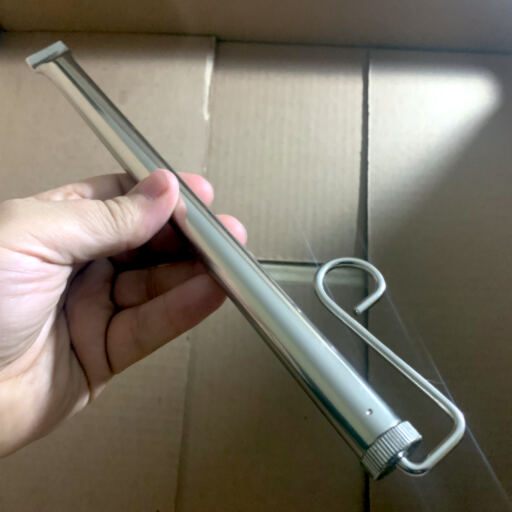
Name: American Song Whistle
Instrument: Slide Whistle (Variable-length Aerophone)
Orchestral Taxonomy: Woodwinds (Aerophone)
Manufacturer: American Plating & Mfg. Co.
Range: D4 – D6 (294 – 1046 Hz, measured)
Size: 12.6 in, 2 lbs
Material: Nickel-Plated Brass
UPC: 028375326211
Purchased: January 9, 2026
Price: $32.99
Location: Internet
Market: Amazon.com
Store: Woodstock Wind Chimes
Condition: Good, Opened
Status: In possession

I purchased the American Song Whistle after my dog, Gwinn, destroyed a couple of Schylling Toy Slide Whistles. The cost was adding up, the quality was low, and I needed something that would survive. Looking at what’s available online, this metal whistle stood out for its appearance; most others had numbers printed on them to indicate the note.

I was pleasantly surprised at the full range of notes and the stability of the full sweep compared to the toy slide whistle. I was able to adapt fairly quickly and play Yankee Doodle. A few things I noticed are that the plunger catches a little as I slide it, and the cap on the tube spins but does not disconnect for cleaning.
The problem is that the comic whistle is so distinct that playing any song on them other than for sound effects is sure to sabotage the original emotional connection to the artist, and they may file a restraining order. The comic whistle is so culturally coded as a joke that playing emotional music on it almost feels illegal. While Careless Whispers is often used in romantic scenes in movies, covering it with a slide whistle screams “comical romance.” It seems the only way to make the slide whistles sound pleasant is to use advanced techniques to avoid their distinct sound, starting with a jiggling of the piston when playing notes.
Where the slide whistle often shines is when it makes a strong effort to be serious. It is sure to get laughs at the mere mention of trying to pull it off with deep concentration and confidence. This is often done with classical music from long ago. If you can pull it off well, the room will surely applaud your rendition and carry the memory with them to the ends of time.

I analyzed the full range of notes emitted with a spectrogram. I found that I could produce stable frequencies between about 300 and 1050 Hz, corresponding to notes between D4 (294 Hz) and C6 (1046 Hz). Having a span of almost two octaves qualifies as a melodic instrument. I may be able to reach up to F#6 (1400 Hz) with some practice, as that seems to be the upper limit advertised.
In the spectrogram, many bands were present, with the brightest at the lowest frequency corresponding to the fundamental pitch I can hear. It sweeps smoothly as I move from side to side. Above the lowest band are many harmonic bands, revealing a real vibrating air column that behaves properly, producing stable notes and predictable tuning.
When comparing frequencies to a Schylling Make-a-Melody Slide Whistle, I observed that the toy whistle had a shorter range, produced poor harmonics with unstable notes, and could not produce a smooth sweep. One of my reasons for purchasing The American Song Whistle was its potential quality compared to something picked up in a toy store, and the spectrogram is evidence of the quality it produces.

For a while, I was interested in building my own grinder organ using slide whistles to avoid making the sounding tubes. However, my luck is that I wouldn’t be able to keep them in space and would have to keep tuning them. In addition, toy sliding whistles have a limited range unless you find a way to extend the tubes.
One small note: the box has a warning label, similar to those on cigarette packs. This one (Prop 65) warns that the product can expose you to chemicals, including nickel, which is known in the State of California to cause cancer and birth defects, or other reproductive harm. The conditions that trigger the requirement to put this label on products are so low that most people assume it’s safe even if it hasn’t been pulled from the market. The labels appear on just about everything, including a cup of coffee, without any meaningful context for the product, which becomes noise.