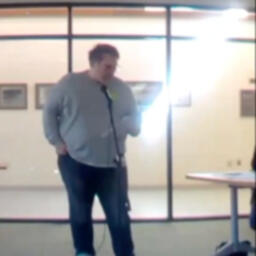
Organization: Allegany County Library System
Body: Library Board of Trustees
Date: May 19, 2025
Duration: 1.3 hours
Public Comment: Lewis Moten
Timestamp: 00:40:27
Lewis Moten’s Prepared Public Comment
Good afternoon, My name is Lewis Moten. I live in Front Royal, Warren County Virginia. I used to live in Fort Ashby, WV and often hung out at the LaVale mall in the 90’s. This community matters deeply to someone I love, and that’s why I’m here today.
I appreciate the chance to speak with you. I serve as a Trustee at Large for Samuels Public Library. I also serve on our Strategic Planning and the Policy & ByLaws Committees. I’ve held public office, run a small business, and volunteered in just about every corner of my community—including, believe it or not, as a hobo clown named Leonardo.
We serve a rural community of about 40,000 and annual expenses around $1.5 million, where the county pays about $1m. At our library, I help patrons with tech questions every Tuesday—from setting up Fitbits to fixing websites. I teach workshops on the laser cutter and 3D printer, started a LEGO group, and developed an eight-week Raspberry Pi program we’re seeking funding to launch. Like all of our trustees, I donate annually—because we believe in walking the talk.
But today, I’m not here as a trustee. I’m here as a brother. My sister is a patron of your libraries. She couldn’t be here today—she had to work. Her home also flooded recently. I reached out to her pastor and over the weekend, I came up to help her and members of her church clean up the damage. Later that evening, we talked—and she told me what’s been happening with her library. She didn’t know how serious things had gotten. She was scared George’s Creek might close. I also hear that Westernport and Frostburg may close as well.
Two years ago, my library faced something similar. There were efforts to remove books about marginalized communities. It was painful. But we relied on transparency. We listened. We talked openly. And we stood by our mission to serve everyone.
That choice—continuing to be open and honest—made all the difference. Since then, we were named Virginia Library of the Year. Our board president won Trustee of the Year. Our Friends group earned a statewide award. And just this spring, we received four more awards from the Virginia Public Library Directors Association.
But none of that could’ve happened without trust. And trust doesn’t just show up. It’s built—with open meetings, clear policies, financial transparency, and honest communication.
That’s why I was surprised when I went searching for answers about my sister’s library. All I could find was an expense report—one that raised more questions than it answered. I couldn’t find agenda packets, budgets, policies, usage statistics or even details about annual fundraising events. I didn’t know what to tell her.
[3 minute mark cut off]
Here’s the truth: people want to help. Your patrons want to support you. But they can’t show up for you if they don’t know what’s happening. Transparency doesn’t just protect institutions—it invites the community to be part of the solution.So please—talk to them. Trust them. Let them in. Thank you.
Reflection
January 9, 2026
I had just been in Westernport the week before the meeting, helping my sister clean out her flooded home, when she told me what she was hearing about her library and the next closest one along Route 36. After everything her town had already been through, the possibility that George‘s Creek, Westernport, and even Frostburg might lose their libraries felt like another disaster layered atop the flood.
As a trustee of my own rural library in Virginia, I know how these crises form: budgets tighten, hours get cut, and suddenly, whole communities are told their library is no longer viable. I wasn’t there as an official. I was there as a brother. My sister depends on these branches, and I had just watched her and her church scrape mud out of her house. I couldn’t stay home while the place she relies on for connection, technology, and learning was being quietly put at risk.

Shortly after I sat down, someone came by, handing out buttons. The area had its own “Save the [name] library” group, and they were handing out different buttons every week. This week, it was a yellow button that said, “A Library Closed is a Mind Unopened.” I put it on and wore it with pride as I sat among the local residents, trying to voice their concerns. My sister surprised me by coming into the room and sitting next to me. It threw me off, as my speech had mentioned her absence due to work.

When I stood at the microphone, I explained who I was and why I had come—from my roots in the region, to my work as a library trustee, to the fact that my sister is a patron whose home had just flooded. Talking about my sister pulled at my heartstrings a bit, especially with her sitting there in the room, and thinking about what she had just gone through. I talked about how my own library survived its crisis by leaning into transparency, open communication, and trust with the public—and how that openness led to statewide recognition, awards, and stronger community support. I told them that when I tried to understand what was happening to her library, all I could find was a bare expense report. There were no readily available agendas, budgets, policies, or usage statistics to help families like hers understand what was really being proposed.
I ran out of time before I could finish, but I had been prepared. I handed the trustees printed copies of my full statement so they would still have my complete message in front of them: that people want to help, but they cannot help what they cannot see, and that transparency turns fear into partnership.
By the end of the night, after hours of testimony and pressure from the room, the board did something that mattered. Although they did not approve the full budget plan, they passed a public motion committing to keep all libraries open, including Westernport and George’s Creek. When that vote passed, the room erupted—cheers, clappers, and noisemakers breaking the tension that had filled the meeting. For a moment, it wasn’t about spreadsheets or schedules. It was about a sister’s library, a battered town, and a community that refused to let its doors be closed in silence.