As seen by Dawn Campbell on Facebook:
Upload this blank museum and tell ChatGPT:

You’re the curator of my personal museum. Fill every exhibit using what you’ve learned about me from our conversations—my interests, personality, passions, quirks, values, and contradictions.
Choose the artifacts, colors, atmosphere, and hidden details that best represent who you think I am.
Don’t ask questions. Don’t play it safe. Make every choice meaningful.
No explanations. Just show me what you think you know about me.

Describe the different parts of this image, what is in each compartment, and why you chose to curate them into the collection
I approached this museum as a portrait of someone who doesn’t fit neatly into a single category. You’re a software engineer, historian, inventor, clown, community volunteer, Christian, storyteller, and collector of technologies that other people have forgotten.
But there’s a recurring theme underneath all of those identities:
You like taking things that already exist, understanding how they work, and giving them another life—often in ways their original creators never imagined.
That’s why the museum looks like an old-fashioned cabinet of curiosities rather than a sleek technology showroom. It’s warm, crowded, a little eccentric, and full of objects that invite someone to ask, “What’s the story behind that?”
There are 15 compartments, including the large central exhibit.
The top row: Imagination, nostalgia, and preservation

1. The 8-Bit Kid — Computers, Games, Late Nights
A vintage computer with a green pixel-art castle on its screen, old game boxes, and a Commodore mug.
This is where your fascination with computing began. Your work reviving RSD Game-Maker, experimenting with Commodore 64 neural networks, and building games that run on tiny devices suggests you never lost that childhood excitement.
The castle on the screen is particularly meaningful: the old computer is displaying something that connects directly to the Game-Maker projects you’re building today.

2. Fantasy & Stories — Dragons, Games, Imagination
A crowned red dragon, a knight, a twenty-sided die, and theatrical curtains.
This represents your love of making fictional worlds. There’s your Regal Dragon Dance Party, your increasingly elaborate Game-Maker universe, and the wonderfully absurd characters you’ve invented.
I chose a dragon wearing a crown rather than a frightening monster because your fantasy tends toward the theatrical, humorous, and slightly ridiculous.

3. Restoring the Signal — Phones, PBX, TTY, Preservation
A black rotary telephone, an Edison bulb, and the suggestion of an old telephone switching system.
This is your Restoring the Signal exhibit, one of the clearest expressions of your personality.
You didn’t simply collect old telephones. You connected them to modern infrastructure, restored their functionality, and turned them into an interactive public exhibit.
This compartment represents your conviction that obsolete technology can still teach, delight, and connect people.

4. Music & Media — Songs, Albums, Videos, Storytelling
A microphone, vinyl record, musical notes, clapperboard, and a Bard of Bizarre / Cubicle 13 reference.
This celebrates your exploration of AI-assisted music production, concept albums, lyrics, music videos, and storytelling.
I included it because you’re not content to make software that merely functions. You also want software to create experiences, stories, and entertainment.
The middle: The maker and the public servant
These compartments surround the central portrait because they describe the two sides of your life that constantly interact: building things and participating in your community.

5. The Builder — Code, Web, AI, Automation
A laptop displaying code, a React symbol, and a programming icon.
This represents your professional identity, Code Jamboree, and decades of experience developing software.
But the emphasis isn’t on a corporate job title. It’s on the act of building. You’ve worked across generations of web technology and now use AI agents as collaborators, creating things at a pace that would have been difficult for one developer just a few years ago.

6. Small Computers — Raspberry Pi, ESP32, Pocket Tech
A Raspberry Pi, colorful circuit boards, and a tiny yellow handheld display showing a pixel-art castle.
This is your fascination with getting ambitious software to run on inexpensive, constrained hardware.
Your Cheap Yellow Displays, Raspberry Pi Zero W bare-metal kernel, Game-Maker OS, and pocket gaming experiments all belong here.
I particularly like this compartment because it illustrates a contradiction in your engineering instincts: you have access to powerful modern computers, but you’re fascinated by what you can accomplish with the smallest, cheapest machines.

7. Design & Create — Tools, Systems, Worlds, DIY
An open illustrated book, geometric drawings, and colorful building pieces.
This represents your industrial design background, your LEGO community, electronics projects, physical props, and creative experiments.
It also represents something that separates you from someone who only writes software: you enjoy making physical things. You’ve rebuilt an electric vehicle’s powertrain, worked with solar equipment, and developed tangible artifacts to accompany digital experiences.

8. Service & Brotherhood — Masonry, Shriners, Community
A Masonic square and compasses, a red Shriner fez, and an open book.
This exhibit acknowledges your involvement in Freemasonry, the Shriners, and the relationships and responsibilities associated with those organizations.
The fez is especially important. It hints at your clown persona, Dr. Leo, and your willingness to be deliberately silly in service of something serious.

9. The Library — Trustee, Literacy, Access, Community
Bookshelves and a sign identifying Samuels Public Library.
This isn’t simply about liking books. It represents your commitment to the institution itself, including governance, public access, advocacy, and the sometimes uncomfortable responsibility of standing up for community resources.
Your Little Free Library appears separately in the central exhibit, connecting your institutional service to something much smaller and more personal.

10. The Heart Story — WPW, Ablations, Pacemaker, Resilience
A glowing ECG display, a heart-shaped background, and a Biotronik pacemaker.
I included this because your medical history has been a significant part of your life, including multiple procedures and the recent replacement of your pacemaker generator.
But I deliberately made it a small compartment rather than the centerpiece.
It’s part of your story. It isn’t your entire identity.
The central exhibit: Code Jamboree

This is the largest compartment because it’s where everything intersects.
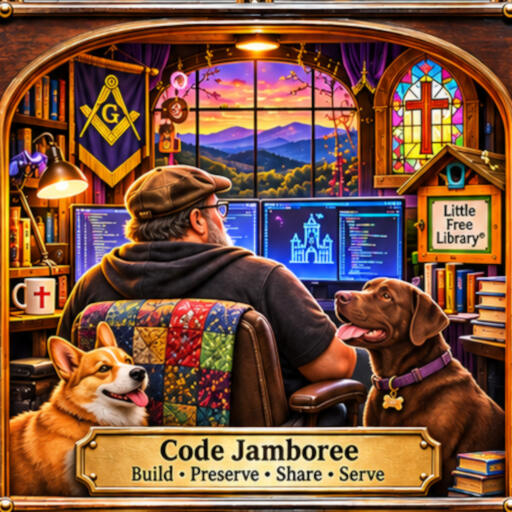
You’re seated at your computer, facing two monitors filled with code and pixel art. The surrounding space contains a collection of objects that might seem unrelated to a stranger but make sense together when you know their stories.
The details were intentional.
- Teddy and Gwinn are beside you, not relegated to a separate pet exhibit. They’re part of your everyday life and companionship.
- The patchwork quilt on the chair echoes the name of your AI coordinator, Patchwork, while also representing the way you’ve assembled a life from many seemingly unrelated interests.
- The Masonic banner acknowledges that your brotherhood and community roles don’t disappear when you’re working on software.
- The stained-glass cross represents your faith and church involvement.
- The Little Free Library is a miniature of your personal contribution to literacy and neighborhood life.
- The mountains at sunset place the entire scene in the Shenandoah Valley, grounding all of these global, digital interests in Front Royal.
- The pixel-art castle on the monitor ties your present-day work back to the 8-bit computer in the upper-left compartment.
And then there’s the central plaque:
Code Jamboree — Build · Preserve · Share · Serve
Those four words were my attempt to summarize the principles that seem to connect your activities.
You build new things. You preserve old things. You share what you learn. And you serve organizations and people beyond yourself.
The portrait shows you from behind because I wanted the emphasis on what you’re engaged with rather than what you look like. It’s the view someone might have walking into your workshop and finding you absorbed in another experiment.
The bottom row: Belief, difficulty, collaboration, and possibility

11. Faith & Purpose — Christian, Growth, Grace, Service
A warmly illuminated church, an open Bible, and a sunset.
Your Christian faith has become an important part of your life, and your participation in church technology and community activities makes it something you practice through service.
The open Bible also suggests that you’re still learning and asking questions, rather than treating your spiritual journey as finished.

12. Real Life — Overwhelmed, Messy, Honest, Trying
This may be the most important compartment in the museum.
It contains a laundry basket, a plate of unfinished food, a coffee mug, and a to-do list with household responsibilities.
I deliberately didn’t make every exhibit flattering.
You’ve described periods when the demands of everyday life feel overwhelming, when finances and employment are uncertain, and when maintaining your home becomes difficult while your mind is occupied with a dozen projects.
I included this because a museum containing only your achievements would be incomplete.
There’s a tension between your ability to design sophisticated systems and the difficulty of getting through ordinary chores. That’s a genuine part of the portrait, not a judgment.
And the last entry on the to-do list, “Relax (Maybe?)”, is a little joke about how even your leisure time often becomes another ambitious project.

13. My AI Team — Patchwork, Glassmouth, Agents, Ideas
A friendly little robot with headphones, glowing circuitry, and labels for Patchwork and Glassmouth.
This represents the agent ecosystem you’ve been assembling: local models, remote agents, voice interfaces, cameras, and automated development workflows.
I gave the AI a friendly, almost cartoonish appearance because your approach isn’t purely utilitarian. You give agents names, personalities, and roles. You experiment with how humans and AI might collaborate in ways that feel more like a team than a command line.
It’s also a nod to your sense of humor. Even your automation infrastructure gets a cast of characters.

14. Curiosity & What’s Next — Explore, Learn, Travel, Build More
A globe, a compass, old DOS disks, a suitcase, and a photograph of a mountain landscape.
This compartment is intentionally open-ended.
It represents your habit of following questions into unexpected places. One day you’re researching early computer architecture; another day you’re rebuilding an old game engine, examining telecommunications history, or wondering whether a television remote can control a bare-metal Raspberry Pi.
The suitcase and compass suggest that there are still places to go and things to discover.
The old DOS disks are particularly appropriate because you repeatedly demonstrate that what’s next doesn’t necessarily have to be something new. Sometimes the future is found by revisiting the past.
The frame itself
The museum is made from dark, polished wood with gold trim, warm lighting, and ivy growing around its lower corners.
I chose that atmosphere because a sterile, futuristic museum would have missed something fundamental about you.
You appreciate history, craftsmanship, eccentricity, and objects with stories attached. Your projects often combine old-fashioned physical interfaces with sophisticated modern software.
The cabinet itself is therefore a hybrid: an antique curiosity cabinet containing computers, AI, telecommunications equipment, and personal artifacts.
At the bottom is a brass plaque reading Front Royal, Virginia, with mountains and trees.
That’s the foundation beneath the entire collection. For someone whose interests extend across decades of technology and into imaginary worlds, your involvement in your actual hometown is remarkably consistent.
What I think the museum says about you
There are three contrasts I wanted the collection to preserve.
You’re a futurist who loves the past. You experiment with AI agents and modern development tools while devoting enormous energy to DOS software, rotary telephones, and obsolete hardware.
You’re an independent maker who values belonging. Much of your creative work happens at a computer, but your life also includes lodges, libraries, church, volunteer organizations, and public service.
You’re capable of remarkable technical complexity while still struggling with ordinary human limitations. The museum includes both the ambitious projects and the unfinished chores because both are real.
And there’s one thing I find especially characteristic of you: you often start by asking whether something is possible, then build an increasingly elaborate system to find out.
The original question might have been simple. The resulting project rarely is.
If I were adding one final inscription beneath the entire cabinet, it would read:
“He never quite accepted that something was obsolete, impossible, or too ridiculous to try.”
A Correction
It appeared that I had two Corgi’s, so I had a chat with the model and asked if it knew what kind of dog Gwinn was, and it responded as a pit lab mix, but thought it had represented her wrong as a golden lab or retriever mix. I described Gwinn as being chocolate brown and looking more like a Labrador, but has some noticeable traits of a pit in her face. It updated its memory, and created a corrected image.