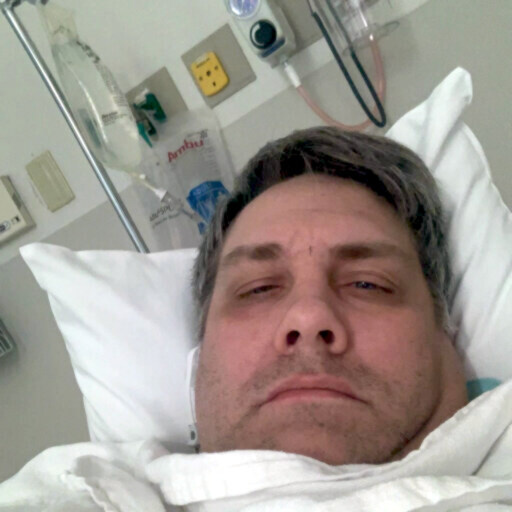
Yesterday, I went to the hospital to have my pacemaker generator replaced. After more than twelve years, it was time for a new device. Fortunately, the existing leads were still working well and could stay.
We arrived and checked in around 8:30 a.m. The first surprise was financial: they asked for about $10,000 instead of the original $1,000 deposit. I explained that my financial assistance application was under appeal, and they let me proceed without collecting anything. The procedure could move forward, but the finances still need to be sorted out.
Then the nurses started preparing me. One tried to get an IV into my hand but couldn’t find a suitable vein. Another used my forearm, which I was more comfortable with anyway.
They asked whether I had dentures and whether I could remove my teeth. I told them I’d have to see a dentist to remove them.
Several people came through, including the doctor, a device technician, and an anesthesiologist who was fighting with a computer system that had him listed as an obstetrician. Modern technology may have advanced, but I was pretty sure I hadn’t needed an obstetrician in about 51 years.
The doctor marked a line along my existing scar to show where he would make the incision. My leads tested well, so this would just be a generator replacement. They expected the procedure itself to take about an hour.
The device technician also gave me some good news for my electronics hobby: I could keep my old bedside monitor and salvage it for parts. A rechargeable battery, LCD screen, and charger sounded like a nice little consolation prize.
Our conversation about the battery was less straightforward. He was surprised that I was having the replacement only a week after what he understood to be the elective replacement indicator, or ERI. He described it as being like an empty gas tank warning and said I would have roughly two to five months.
That was his explanation, but it added to the conflicting information I’ve received about both when ERI occurred and how much time remained. He mentioned that different offices may have different policies, while he was talking specifically about the manufacturer’s signal. I wish those distinctions had been explained more clearly along the way.
He also explained that the phone calls about my bedside monitor being disconnected happen when data hasn’t been collected for three days. I mentioned the poor cellular reception at my house and my habit of staying up late, sometimes away from my bed until 5 a.m. That seemed like useful context for a device meant to communicate while I’m nearby.
Before the procedure, I told several people about what had happened during preparation the last time. This time, they put me under before strapping me down.
The procedure room was huge. They kept asking whether I had metal in my hips or joints. Just the dental implants.
They placed pads on my back and confirmed that those could be used to shock me if needed. There were tracks on the ceiling, and someone moved a giant monitor into position so it could face the doctor. Between the equipment, the moving screen, and the size of the room, it felt like a science-fiction movie.
The anesthesiologist started working with the saline bag, so I asked him to add strawberry flavoring. He mentioned that his medication looked like a milkshake. I told him to avoid using a McDonald’s shake machine, since those always seem to be broken.
They gave me a warm blanket. The last thing I remember was him saying he was adding an antibiotic, explaining that it was for the procedure and that I wouldn’t need to take antibiotics at home.

Then it was time to wake up.
I came around slowly. I started telling the staff that I had someone waiting for me and tried to get myself moving, but they told me to relax. A nurse brought me apple juice.
My throat felt sore when I breathed, which made me suspect they had used a breathing tube during the procedure. I tried using my phone, but it ended up on the floor, where it stayed until it was time to leave.
I still had various things attached to me, including something taped to my ear. The little oxygen monitor on my finger could be disconnected so I could use the bathroom.


Because I’d had a skin reaction to adhesive after my previous procedure twelve years ago, they used skin glue at the incision this time. There was also blue dye left on my skin.
I shared a photo on Facebook just as I was coming out of anesthesia. Our local sheriff was the first to comment, wishing me a quick recovery. More messages followed from friends, family, church, Masons, elected officials, neighbors, family friends, past coworkers, and people around the community.

They kept me in recovery for about an hour, and we were heading out around 1:15 p.m. The wheelchair looked more like a regular chair, but it got me where I needed to go.
Later, I added a comment to the photo: “Alert. Almost home. I got another tin heart.”
That brought a Wizard of Oz GIF and more wishes for a speedy recovery. Some people were surprised to learn I had a pacemaker at all. It’s been part of my life for more than twelve years, but it doesn’t come up in every conversation.

My nephew checked in. A friend reminded me to take care of myself because the community needed me. A local business owner said I now had another story to tell when I do the rounds. There was even an offer of root beers at the Virginia Beer Museum. I often drink root “beer” while my friends enjoy their beers there, so the museum usually keeps some on hand for me.
At home, I made it up the front steps on my own. Teddy and Gwinn wanted to come outside, although they were initially unsure about the friend who had driven me home. With a little encouragement, they came out to greet us.
A few phone calls followed. Then sleep.
Later that night, I posted the full account of the day. Along with more encouragement, there was a hopeful development on the financial side: The master of the lodge said some Grand Lodge assistance had been made available and asked me to follow up with him and our district deputy. I still need to find out the details, but that gives me another avenue to explore.
Another conversation was about remote monitoring. The first person I met in Front Royal was a realtor, and he shared that his Medtronic pacemaker works with a phone app, letting him travel without bringing a separate bedside monitor. I had asked about an app too, but the staff described problems with an earlier app setup they had tried. My new Biotronik came with another bedside monitor, so that’s what I’ll be using.
The electronics hobbyist in me would love access to heart-rate data I could export or bring into a health app, and a straightforward way to check the battery. For now, those are things I’d like to have.

The doctor also told me the new generator is MRI compatible. Whether my complete system qualifies still depends on confirming the combination with the existing leads. That’s something I’m looking forward to getting clarified.
Friends sent prayers, encouragement, and wishes for a comfortable recovery. Melissa pointed out that the hospital socks, and perhaps a big drink cup, make the best souvenirs.
The new generator is in, the old leads are still doing their job, and the financial questions remain unfinished business. I’m home, a little sore, and grateful to everyone who checked on me… and to the friend who got me there and back again.
And yes, I got to keep the extra-large grippy socks.