Government: Warren County, Virginia
Body: Board of Supervisors
Date: October 6, 2026, 1:00 PM
Location: Warren County Government Center
Type: Regular Meeting
Timestamp: 00:28:52
Duration: 3:03
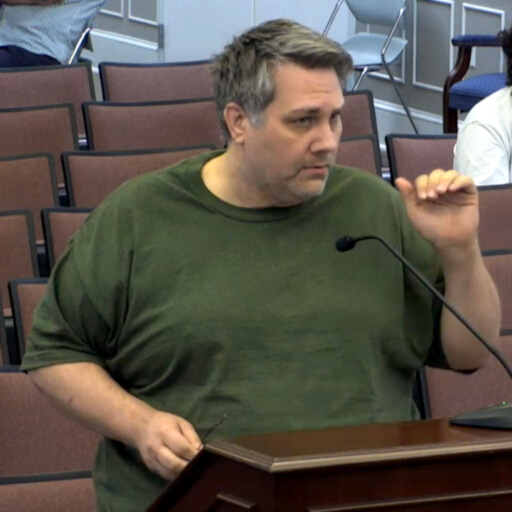
At the October 6, 2026, Warren County Board of Supervisors meeting, I used my public-comment time to raise two very different issues: privacy and security concerns involving Flock automated license plate readers, and some practical problems surrounding the closure of E. Wilson Morrison Elementary School.
Three minutes is enough time to identify a problem, but not always enough to explain what I am actually asking for. Some of my thoughts also changed or became more specific after hearing Sheriff Crystal Cline’s Flock presentation later in the meeting.
Flock: I wanted answers more than reassurance
Before the meeting, I sent Sheriff Cline and the supervisors a longer set of questions and references concerning Warren County’s use of Flock automated license plate readers. I also brought printed copies with me because the email had gone out later than I would have liked.
My concern wasn’t simply that cameras exist.
I’m a programmer, and one thing that changes how I look at systems like this is knowing how inexpensive computing, radios, networking hardware and open-source software have become. Capabilities that once required specialized equipment or large organizations can increasingly be experimented with by individuals.
That makes me interested in questions beyond what an ALPR is supposed to do. What information exists on or around the equipment? Where does it travel? Who can access it? What happens if credentials are compromised? What gets logged? How long does the information remain useful to someone who should not have it?
During my public comment, I also mentioned other Virginia localities reconsidering their use of Flock or shortening retention periods. My interest in those examples isn’t that Warren County necessarily has to make the same decision. Different communities may reasonably reach different conclusions. What interests me is why they reached those conclusions and whether any of the same reasoning applies here.
Sheriff Cline’s presentation later that afternoon answered quite a few of my questions. She said Warren County’s current equipment does not collect phone, Bluetooth, Wi-Fi, MAC-address or similar radio-frequency identifiers, does not use facial recognition, and has individual user accounts and audit records. She also addressed encryption, access controls and misuse directly.
That was useful information to get into the public record.
Seven days or 21?
One question I think deserves more attention is retention.
Warren County keeps ordinary Flock records for 21 days. Sheriff Cline explained that crimes are not always discovered immediately and that missing or endangered people may not be reported right away. In those situations, deleting everything after seven days could mean an observation is already gone when investigators realize they need it.
I understand that argument.
What I would like to know eventually is whether we can measure it locally.
How many useful Warren County searches actually depend on records that are more than seven days old? Of searches that produced a meaningful investigative lead, how many depended specifically on days 8 through 21?
That would give us something better than a hypothetical argument.
If Warren County can show that the additional two weeks have repeatedly helped solve crimes or locate people, that is useful evidence for keeping 21 days. If almost every useful search occurs within seven days, that is also useful evidence when weighing the privacy cost of retaining everybody else’s vehicle observations longer.
I don’t think asking that question presupposes the answer.
E. Wilson: some immediate problems are much simpler
The second half of my comment concerned E. Wilson Morrison Elementary School.
The school was closed after structural concerns were discovered in August, and students and staff were moved into temporary space elsewhere in the school division. (Royal Examiner: Missing Bricks Led to Discovery of Structural Concerns at E. Wilson Morrison) Engineers subsequently reported significant problems with portions of the exterior wall system while continuing to investigate the building. (Royal Examiner: Engineers Find Façade Failure at E. Wilson Morrison, Main Structural System Shows No Visible Distress)
Some of what I brought up wasn’t about the eventual multimillion-dollar question of repairing or replacing a school. It was much more immediate.
I had heard from teachers who still had supplies in the building but could not get to them. If there are portions of the school that can safely be entered under supervision, it seems worth considering a scheduled day when staff can retrieve what they need.
I’m not suggesting anyone should be sent into an area engineers consider unsafe. I was suggesting that, where access can be safely managed, there may be a difference between closing a building to normal occupancy and preventing teachers from retrieving materials they now have to replace elsewhere.
That seems like something worth solving if it can be done safely.
The fence and the parking lot
I also mentioned the fencing around the property.
E. Wilson sits in an area where parking matters beyond the school itself, particularly when downtown events bring more people into Front Royal. With events such as the Festival of Leaves and Merry Market approaching, I wondered whether fencing could eventually be pulled back from portions of the parking area that are not needed to maintain the safety perimeter.
Again, that depends entirely on what engineers and the school division determine is safe.
My point was that an emergency closure tends to freeze everything in the configuration needed during the emergency. Once the immediate crisis has passed, it can be worth looking again at the perimeter and asking whether every restriction is still necessary.
Where did everybody go?
The larger school question may be more complicated.
Students and staff from E. Wilson had to be distributed among other Warren County schools very quickly. Royal Examiner reported that the sudden move required classrooms to be relocated and spaces shared at Warren County High School and elsewhere. (Royal Examiner: Warren County High School Welcomes E. Wilson Morrison Students After Emergency Closure)
During public comment, I said I had heard that the way students were divided among buildings might not be optimized.
I probably need to make my actual question more precise.
Rather than guessing about which school should hold which students, I’d like to see the underlying numbers:
- What is the practical capacity of each affected building?
- How many students are now using each one?
- How much classroom space was available before E. Wilson closed?
- Where were the displaced grades and teachers placed?
- Are some buildings carrying substantially more of the disruption than others?
- Could a different temporary distribution reduce crowding without creating transportation or instructional problems somewhere else?
There may be very good reasons for the current arrangement. It was put together under emergency conditions, and moving students around again also has costs.
But an emergency solution does not automatically have to become the solution for the entire school year without another look.
Why I brought a school issue to the supervisors
I mentioned at the podium that Warren County School Board meetings fall on Wednesday evenings, when I generally cannot attend, so I was bringing the issue to the supervisors instead.
I ended somewhat jokingly with, “You hold the purse.”
I don’t mean that the Board of Supervisors decides where individual students or teachers should be assigned. Those are school-division responsibilities.
But when the discussion turns to major repairs, replacement buildings, temporary facilities or other significant costs, the County and Board of Supervisors inevitably become part of the financial conversation. E. Wilson is therefore not something that exists entirely on one side of a governmental boundary.
That’s also why I think it is useful for residents to bring practical observations forward even when we don’t have the solution.
Sometimes the most useful public-comment question isn’t “Why haven’t you fixed this?”
It is simply:
“Has somebody looked at this?”
Video guide
0:00 — Introduction
0:08 — Flock questions provided to the Sheriff and supervisors
0:20 — Privacy and decisions by other Virginia localities
0:43 — Cybersecurity and access to camera data
1:18 — E. Wilson Morrison conditions
1:41 — Teacher access to classroom supplies
2:04 — Fencing, parking and upcoming events
2:29 — School capacity and distribution of students
2:52 — Why I brought the issue to the Board of Supervisors
You can watch my comment in the County meeting video at 28:52 and the full meeting through Warren County’s video archive.
Transcript (automated)
Chapter 1: Introduction
0:01
1 secondGood afternoon, supervisors. My name is Lewis Moot from the North River District. I have a few things. I I know
Chapter 2: Flock ALPR questions sent to supervisors and Sheriff
0:08
8 secondsI was very late on sending you an email about Flock and my conversation with the sheriff. Um and and this is just a print
0:16
16 secondsoff that email. So, so if you want to hard copy, it’s there. Um I just have concerns mainly about privacy, what
Chapter 3: Privacy and what other Virginia localities are doing
0:25
25 secondsother municipalities are doing in Virginia. So, I have a lot of news articles how they’re either uh discontinuing their contracts or
0:34
34 secondsreducing it down to just a 7-day um recording or or log auditing or logs or whatnot. Um there’s also other things
Chapter 4: Cybersecurity and access to camera data
0:43
43 secondsthat I’m also aware of. I’m a tech guy, so I’m very much aware of how people are actually hacking these systems. I haven’t tried it myself, but it’s like I
0:51
51 secondsunderstand what’s going on. So, there is concern. I don’t know what model or what air stuff uses here, but it is a
1:00
1 minutelegitimate concern that my information is on those cameras. I don’t know what people have access to outside the
1:09
1 minute, 9 secondssheriff’s office if they just stand near a c a camera and technology has become very cheap and open source. Um, so
Chapter 5: E. Wilson school conditions and teacher access
1:18
1 minute, 18 secondsthat’s another issue. Uh so the so to trans transition to another topic with E
1:25
1 minute, 25 secondsWilson. The place looks abandoned, rundown, overgrown grass. You’ve got the fences up and I I’m hearing from some of
1:34
1 minute, 34 secondsthe teachers that they’ve got stuff there. They’re not even allowed inside areas that are nowhere near stuff. They
Chapter 6: Helping teachers retrieve classroom supplies
1:41
1 minute, 41 secondsneed their supplies. And I’m recommending, you know, have a day where you have somebody there that can make
1:49
1 minute, 49 secondssure they don’t go in the the the bad areas, get their supplies so they don’t have to spend their money on stuff
1:56
1 minute, 56 secondsalready for their kids that they that they need. Um because some of them are very upset and frustrated over this. Um
Chapter 7: Fencing, parking and upcoming downtown events
2:04
2 minutes, 4 secondsthe other thing is we have fences up and a lot of parking very far away from the building. So, it’d be nice if some of
2:12
2 minutes, 12 secondsthat fencing could be pushed back and open up some of the parking spots because we do have a lot of things coming like Festival of Leaves is coming
2:20
2 minutes, 20 secondsup. Uh, I know the Merry Market’s coming up. I think uh what it looks like is that building is going to be closed for the rest of the year.
Chapter 8: School overcrowding and student distribution
2:29
2 minutes, 29 secondsAnd from what I’m hearing, the the way that the students are brought divided up between the schools is not really
2:36
2 minutes, 36 secondsoptimized before all this happened between the the high school and the middle schools. And that’s what’s causing a lot of the overcrowding. So, I
2:44
2 minutes, 44 secondsdon’t know if somebody needs to look and see if we can shift things around of what schools are used for what. maybe
Chapter 9: Asking the Board of Supervisors to look at the issue
2:52
2 minutes, 52 secondsmore schools for high school or or middle school depending on what’s going on. I can’t go to those meetings for the school board because they’re on Wednesday nights. So, I’m coming to you.
3:02
3 minutes, 2 secondsYou hold the purse. Thank you.