Government: Warren County, Virginia
Body: Electoral Board
Date: May 21, 2026, 10:00 AM
Location: Office of Elections & Voter Registration
Type: Regular Meeting
Timestamp: n/a
Duration: 1:30
There are certain meetings in Warren County that I attend regularly enough that the rhythm has become familiar.
The Board of Supervisors chambers at the Government Center. Thick agenda packets uploaded to CivicClerk. Staff reports, PowerPoint presentations, public hearings, motions, amendments, and lengthy discussions that sometimes stretch late into the evening. The Planning Commission follows a similar pattern, often with maps, diagrams, applications, and debates over land use that can shape the future of neighborhoods for years.
Sometimes those Board of Supervisors agenda packets are hundreds of pages long. On rarer occasions, they even cross the thousand-page threshold. Reviewing them can feel less like casually checking an agenda and more like preparing for a college research assignment.
Occasionally, while browsing CivicClerk to review agenda packets for upcoming meetings, I notice another board or committee listed that I know little about. Sometimes curiosity wins, and I decide to go see what happens behind those unfamiliar titles.
That was how I found myself attending my first Warren County Electoral Board meeting.
Unlike most meetings I attend, this one was not held at the Government Center. Instead, it took place at the Health and Human Services Complex. It is the same building where I vote during elections. Ironically, getting there always reminds me of a quirk of our local districts. Because of the way the river divides portions of the county, I drive past another polling place entirely in order to reach my assigned one.

Before attending, I searched CivicClerk for an agenda packet. Nothing appeared beyond the meeting notice itself. That immediately stood out to me because I am accustomed to seeing supporting documentation uploaded in advance for most public bodies.
When I arrived, I was greeted by a familiar face from the staff who asked whether I planned to speak during public comment.
The meeting room itself immediately felt different from the larger public chambers I was accustomed to attending. Four tables had been pushed together into a rectangular loop. The setup felt practical and informal rather than ceremonial.
The Vice-Chair sat with his back toward the entrance. Across from him sat the staff member I recognized. The Chair sat to the right of the entrance, and I eventually took a seat directly across from her.
The room itself seemed oversized for the number of people present. Aside from the board members, the staff member, and myself, nobody else attended the meeting.

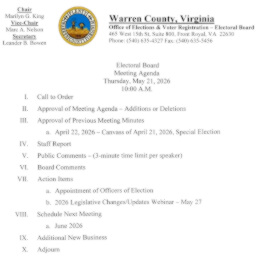
I admitted that I had not seen an agenda online, so I did not even know what topics were being discussed. The staff member pointed toward a stack of printed agendas near the entrance.
Inside the room, the Electoral Board members introduced themselves. Chair Marilyn King and Vice-Chair Marc Nelson were present, while Secretary Leander Bowen was absent from the meeting. Because of that, the Vice-Chair also stepped into the role of acting secretary during portions of the meeting.
Another detail that stood out to me was realizing how closely election administration and party structures are intertwined under Virginia law. I later found myself reflecting on the relationship between a board member and the chair of a local political party. I had only spoken to them once before, roughly a year ago, and did not recognize them at first. In many other areas of local government, that connection might initially seem surprising, but election administration in Virginia is already structured around formal party representation and appointments. It was another reminder that I was stepping into a part of government that operates very differently from the boards and commissions I usually attend.
The agenda itself was sparse and procedural, though several items caught my attention:
- Approval of previous meeting minutes for the April 22, 2026 canvass of the April 21 special election
- Appointment of Officers of Election
- 2026 Legislative Changes and Updates Webinar scheduled for May 27
The special election immediately raised questions for me, particularly because of the recent court ruling surrounding the process. I decided I would speak.
Nearby was a sign-up sheet for public comment. Even that felt slightly different from what I was accustomed to. At Board of Supervisors meetings, I normally provide my name and district. Here, the form requested a district or address and asked whether I represented myself or an organization.
That distinction made sense after thinking about it for a moment. Elections are deeply tied to party representation, candidates, and organizations in ways that other local boards are not.
As I approached the sign-up sheet, I realized I did not have a pen. Before I could even ask, one was quickly handed to me.
The meeting began promptly at 10:00 AM.
The discussion moved at an astonishing pace.
One of the agenda items involved new state legislation (Senate Bill 438) requiring five hours of early voting on the second and third Sunday before all elections beginning July 1, 2026. When I later reviewed the legislative history, the vote appeared to fall largely along party lines, with Democrats supporting the measure and Republicans opposing it.
By the time the issue reached the Electoral Board, however, the political debate itself was already over. The focus in the room was not ideological, but operational: selecting voting hours, balancing staffing needs, complying with the new law, and determining how to implement the changes locally. What I witnessed was less a debate over policy and more the quiet administrative work that follows once legislation becomes law.
The staff report explained that the board was choosing the later voting window of 12 PM to 5 PM rather than 11 AM to 4 PM so the county could utilize the full five hours while still ending at the close of normal business operations.
Then public comment began.
I spoke in support of the later Sunday voting hours, noting that many people, myself included, attend church in the morning, and that beginning at noon provided additional flexibility afterward to vote.
As I spoke, the Chair quietly started the three-minute timer used for public comments.
I also mentioned that I frequently review meetings on CivicClerk and was surprised by the lack of agendas and supporting documents compared to other boards and commissions. Finally, I raised concerns about the cost burden on taxpayers of funding a special election process that the Virginia Supreme Court (Scott v. McDougle, Record No. 260127) later determined had not followed proper procedures.
About a minute and a half later, I was done.
The board moved immediately onward.
At one point during the meeting, my phone alarm suddenly sounded.
10:05 AM.
My “wake up” alarm.
Oops.
Fortunately, it was brief, though the timing felt unintentionally comedic, given how quickly the meeting was unfolding. I should have been just now waking up.
The board then reviewed two applications for Officers of Election. Acting as secretary for the meeting, the Vice-Chair reviewed documents in a folder, though little detail was discussed in the room itself, other than the applications themselves, which were proof of their interest alone. The applicants were approved without extended debate.
Next came mention of the May 27 legislative webinar and training updates.
I kept glancing at the clock, increasingly amused by how fast everything was moving. By that point, it genuinely seemed possible the entire meeting would conclude within ten minutes.
Then came a brief moment of confusion when the board realized they had accidentally skipped over Board Comments immediately after public comment. They circled back, though nobody appeared to have much additional discussion.
No further new business was raised.
The meeting adjourned at 10:10 AM.
Even including public comment, it may have been the shortest fully conducted public meeting I have ever attended outside of situations where a quorum was not met.
Afterward, I spoke briefly with the staff member, who mentioned that efforts were underway to recover some of the funds associated with the special election costs.
He also encouraged me to attend another upcoming session in June. I admitted I was uncertain whether I would return. I had come to the realization that I had spent more time driving to the meeting than attending it.
He then mentioned what sounded like “Element” or perhaps “LVA,” explaining that it involved election training and demonstrations of how the voting machines operate. That immediately caught my interest.
However, he explained that attendance generally required representing either a political party or an independent candidate.
I laughed and, given all the PACs formed in the past couple of years, floated the idea of simply creating my own political party so I could attend.
He smiled and essentially warned that doing so opened “a whole can of worms.”
I jokingly suggested the local BEER Party, only to learn that despite the name being familiar locally, it was not considered an officially recognized party within the county’s election structure. Apparently, a PAC and a political party are two very different things. Upon further research, I learned that it had been registered with the Virginia Department of Elections Campaign Finance system as PAC 18-00405, though that is not the same as being recognized for election representation, observer access, or formal participation in election administration. Ironically, the party itself had originally been founded on objections to party representation in local elections.
That alone taught me something new.
What struck me most about the entire experience was how different this branch of local government felt from the others I regularly observe.
The Board of Supervisors and Planning Commission often operate in highly visible, highly documented environments with recordings, livestreams, packed chambers, and extensive public debate.
This meeting felt almost invisible by comparison.
- No livestream.
- No microphones.
- No audio recording setup.
- No cameras.
- No thick packet of public documentation.
Just a handful of people gathered quietly in a room conducting the procedural machinery of elections before heading back out into the day.
And perhaps that is what fascinated me most.
Not every part of government operates under bright lights and public controversy. Some of it happens quietly, efficiently, and almost unnoticed unless someone intentionally chooses to walk through the door and observe it for themselves.
As I left the building, heavy rain was pouring across the parking lot, and I’d be soaked without an umbrella before I could reach it. I folded up the agenda and placed it in my pocket to keep it somewhat protected, yet a pointless act, as I had already photographed it with my phone when I first acquired it.
The meeting had lasted only ten minutes.
What I learned may last a lifetime.
The drive there had taken longer, but I still left having learned something entirely new about how another small corner of local government works.