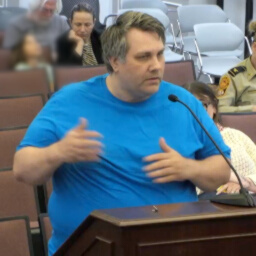
Government: Warren County, Virginia
Body: Board of Supervisors
Date: May 19, 2026, 6:00 PM
Location: Warren County Government Center
Type: Regular Meeting
Timestamp: 00:11:44
Duration: 2:41
Last Friday, while volunteering at the senior center, I found myself sitting at a table where the conversation had unexpectedly shifted toward property taxes, inflation, fixed incomes, and uncertainty about the future. Normally, the seniors there avoid politics almost entirely. Most would rather talk about what’s going on in their lives, their friends, their grandchildren, and more.
But this time felt different.
I arrived with cards circulating around the room for two seniors who had recently passed away. Near the end of the day, I was told that several additional seniors who were hoping to join the meal program could not be admitted due to limited resources and capacity. The contrast of those moments lingered with me throughout the weekend.
A few of the seniors encouraged me to speak publicly about those concerns, since I had previously advocated for issues affecting the center, particularly the flooring hazards last year. At the time, sections of new flooring throughout the county-owned building had been rising unevenly enough that even I occasionally stumbled over them. Since falls can be especially dangerous for older adults, many at the center worried constantly about someone getting seriously hurt. After months of taped-off areas and delays in determining responsibility, I raised the issue publicly during Board of Supervisors meetings, starting in September, and repairs were scheduled and completed in November. Thankfully, the flooring repairs appear to be holding up well today, with no signs of the earlier installation problems returning.
The conversations last Friday also reminded me of comments made during the Fiscal Year 2027 Budget Hearing on April 14, 2026. During that meeting, Supervisor Hugh Henry publicly described portions of Warren County’s elderly tax relief structure as outdated and expressed interest in exploring possible improvements alongside the Commissioner of the Revenue, within state guidelines.
That discussion stayed with me because the concerns voiced at the senior center closely mirrored those that had already surfaced during budget discussions weeks earlier. Many retirees no longer have the ability to simply work more hours or increase their income to keep pace with inflation. At the same time, property values, healthcare costs, utilities, insurance, and everyday living expenses have continued climbing.
The current tax relief ordinance was originally adopted in 1991 and later amended in 2004. One detail that stood out to me while researching the ordinance was the $300,000 net worth qualification threshold. Adjusted for inflation, $300,000 in 1991 would represent well over $700,000 in today’s dollars. That comparison alone demonstrates how dramatically the economic landscape has changed since the ordinance was originally written.
On the morning of the meeting, I sent a lengthy email to the Board of Supervisors and the Commissioner of the Revenue outlining many of the concerns seniors had raised with me, along with several ideas to help modernize portions of the ordinance over time. My intent was not to demand immediate changes, but to contribute ideas that could assist future discussions already beginning to emerge publicly.
Email to Supervisors & the Commissioner of Revenue
Created At: Tuesday, May 19, 2026, 9:13 AM
From: Lewis Moten <lewismoten>
To: Zachary Henderson <ZHenderson> (Deputy Clerk to the Board)
CC: Cheryl Cullers <Ccullers> (County Supervisor),
John Stanmeyer <JStanmeyer> (County Supervisor),
Richard Jamieson <RJamieson> (County Supervisor),
Hugh Henry <HHenry> (County Supervisor),
Tony Carter <TCarter> (County Supervisor),
Sherry Sours <SSours> (The Commissioner of Revenue)
Subject: Concerns Regarding Elderly Tax Relief, Senior Services, and Aging in Warren County
Dear Members of the Warren County Board of Supervisors and the Commissioner of the Revenue,
Background and Community Conversations
I’m sharing several concerns recently raised in conversations with seniors regarding affordability, fixed incomes, and the current structure of elderly tax relief in Warren County.
Normally, the seniors do not spend much time discussing politics. However, the recent increases in property taxes led many of them to openly talk amongst themselves about affordability and their concerns for the future, which eventually brought me into the conversation when I visited their table this past Friday at the Warren County Senior Center. I encouraged them to write, email, call, or speak directly with members of the Board of Supervisors about their concerns. At the same time, I recognize that civic engagement often requires far more effort than simply discussing frustrations privately, especially for elderly residents who may struggle with mobility, technology, health issues, or a lack of confidence that their voices will truly be heard.
Many of the seniors I spoke with expressed anxiety over rising assessments, increasing living costs, and uncertainty about whether they will be able to comfortably remain in their homes long term. Several voiced concerns that even modest increases in taxes or household expenses disproportionately affect retirees living on Social Security, pensions, or retirement savings that are not keeping pace with inflation.
These concerns reminded me of comments by Supervisor Hugh Henry during the April 14 FY 2026–2027 budget hearing (timestamp 01:47:52), in which he described the county’s current senior tax relief structure as “incredibly outdated.” He noted that many homes in Warren County now exceed values that once represented substantial wealth, while seniors on fixed incomes often have little practical ability to increase earnings to keep pace with inflation and rising costs.
Concerns Regarding Current Tax Relief Qualifications
After reviewing Article VI of the Warren County Code regarding exemptions for elderly or disabled residents, I believe there are several areas that may deserve further discussion and modernization.
The current ordinance still relies on fixed thresholds that may no longer accurately reflect present-day economic conditions. Median home values in Warren County have risen substantially over the years, while many seniors purchased their homes decades ago and now find themselves “asset rich but income poor” on paper. Tying eligibility thresholds to inflation or periodically reviewing them against the county’s median assessed home value could help keep the program aligned with current realities, rather than requiring infrequent legislative adjustments years later.
The current $300,000 net-worth limit also appears increasingly unrealistic when viewed against modern retirement realities. While $300,000 may sound substantial at first glance, many retirees must stretch those savings across potentially 15 to 25 remaining years of life expectancy while facing rising healthcare costs, inflation, home maintenance, insurance, transportation, and long-term care expenses. Even without catastrophic medical events, $300,000 in liquid savings may realistically only support modest living expenses for a limited number of years, particularly for residents living alone after the loss of a spouse. A person may appear financially secure on paper while still facing genuine long-term financial vulnerability in practice.
For additional perspective, the current $300,000 net worth limitation represented substantially different purchasing power when the ordinance was originally adopted in 1991 and later amended in 2004. Adjusted for inflation, $300,000 in 1991 would be well over $700,000 today, while $300,000 in 2004 would still be over $500,000 today. This further illustrates how the current threshold may no longer reflect modern retirement realities, housing values, healthcare costs, or long-term financial sustainability for aging residents.
Real-World Retirement and Caregiving Challenges
I’d like to share a personal example that shaped some of my concerns about the current structure of these qualifications.
My father, who is retired and in his 70s, lives outside of this area with his wife, who is in her 90s, suffers from Alzheimer’s disease, and is bound to a wheelchair. He serves as her full-time caretaker. Because she becomes frightened when left alone, he is often unable to leave the house for more than brief periods, even to tend to daily responsibilities.
Although they live on over 70 acres of land, much of their day-to-day survival comes from the food he grows in his own garden and from what people bring when they stop by to visit. Occasionally, he must visit a grocery store 20 miles away to supplement what they cannot provide themselves. While their property and assets may appear substantial on paper, the practical realities of their situation are very different. Had they been residents of Warren County, they likely would not have qualified for elderly tax relief under the current structure despite clearly facing many of the financial, physical, and caregiving burdens that these programs are intended to help address.
Situations like this demonstrate how asset and combined income calculations can sometimes fail to fully reflect the lived realities of aging residents and caretakers.
Caregiving and Household Income Concerns
I also believe the county should reconsider how caregiver households are treated within the combined household income calculations. Under the current ordinance, adult children or family members who move into a home to assist an aging parent may unintentionally jeopardize eligibility for relief. At a time when many elderly residents are facing Alzheimer’s disease, dementia, mobility limitations, or increased medical needs, multigenerational caregiving arrangements are becoming increasingly common and often help seniors remain safely in their homes longer.
In many cases, these caregiving arrangements reduce broader social and healthcare burdens by delaying or preventing the need for institutional care. It may be worth considering whether bona fide caretakers and caregiving family members should be excluded entirely from combined income calculations, or whether additional protections should exist for elderly residents over a certain age threshold, such as 80 and above.
Another concern worth considering is that the current combined household income structure may unintentionally penalize seniors who choose to marry later in life or move in together for companionship, support, or financial survival. Two elderly individuals living separately may each qualify independently, yet lose eligibility or receive reduced relief once their combined income is calculated within a shared household. In some cases, this could unintentionally discourage companionship, caregiving, or shared living arrangements that otherwise help reduce isolation, improve quality of life, and lower overall living expenses for aging residents.
Senior Services and Funding Concerns
I also wanted to mention concerns related to senior services funding and capacity. Although the Shenandoah Area Agency on Aging was approved for the same funding amount as in the previous two years, many seniors see firsthand how inflation continues to affect daily life. The cost of groceries, utilities, transportation, medications, and other necessities continues to rise while many remain on fixed incomes.
One comment that particularly stayed with me was hearing that there was not enough funding available to bring on three additional seniors in a single day, while at the same time, two cards had been signed that very same day for seniors who had recently passed away. That moment deeply reflected both the emotional and financial realities surrounding aging within our community.
Recommendations for Long-Term Sustainability
I recognize that the Commissioner of the Revenue’s office is responsible for administering the ordinance as written, and many of these concerns are ultimately matters of policy for the Board’s consideration. I would like to offer a few recommendations for consideration that may provide a more sustainable, long-term approach to elderly tax relief while allowing the program to adapt naturally over time instead of becoming outdated:
- Tie income eligibility thresholds to inflation and annual cost-of-living adjustments so the program automatically adapts to changing economic conditions.
- Consider excluding or partially excluding Social Security income from gross combined income calculations, recognizing that these benefits are intended to provide baseline retirement security rather than indicate financial wealth.
- Evaluate retirement accounts, pensions, and investments based not solely on total balance, but on estimated annual withdrawal capacity divided across remaining life expectancy. Many seniors may possess retirement savings that appear substantial on paper but are intended to support decades of remaining life, healthcare costs, and inflation.
- Periodically review eligibility thresholds against median fair market residential values using county GIS and assessment data so that ordinary longtime homeowners are not unintentionally classified as financially wealthy due solely to regional housing inflation.
- Consider additional relief tiers or protections for residents over the age of 80 who may face increased medical, mobility, caregiving, and cognitive challenges.
- Exclude bona fide caretaker income from combined household income calculations when adult children or family members move into a residence specifically to provide caregiving assistance.
- Reevaluate the current five-acre limitation for rural elderly residents whose land may not represent practical or liquid wealth.
- Consider adjustments to combined household income calculations for seniors who marry later in life or share housing arrangements for companionship, caregiving, or financial stability.
I believe recommendations such as these would be more likely to stand the test of time by creating a system that evolves alongside inflation, demographic shifts, and housing values, rather than requiring periodic major revisions years later.
Encouraging Community Engagement
I also recommend a simple approach to strengthen understanding and communication between county leadership and the senior community.
In past years, I occasionally saw former Supervisor Vicky Cook visit the senior center, especially around the holidays. I would often encourage her to come back because many of the seniors regularly asked about her and appreciated her taking the time to stop in and speak with them.
Given the issues involving the floors at the senior center last year, I believe it would be beneficial if each member of the Board of Supervisors made an effort to visit the senior center at least once a year on separate occasions. Doing so would provide an opportunity not only to see the building’s condition firsthand but also to better understand how seniors experience it daily.
More importantly, it would allow supervisors to simply spend time talking with the seniors themselves. It does not take much to brighten someone’s day there. Ask how they are doing. Ask whether they have children or grandchildren. Ask about their weekend plans, what occupations they once held, or stories from their past experiences. Most genuinely appreciate the company, and a few would probably be more than grateful if someone from the Board volunteered to read off bingo numbers for a while.
Closing Thoughts
I understand the Board must balance compassion with fiscal responsibility, and I recognize that any changes to tax relief programs or senior services carry budget implications that must be carefully evaluated. However, I believe these concerns deserve serious discussion as part of the county’s long-term planning, especially as Warren County’s senior population continues to grow.
Thank you all for your time, service, and consideration of these concerns. I appreciate the work involved in balancing the county’s financial obligations while also ensuring that longtime residents can age in place with dignity, stability, and a continued sense of connection to the community they helped build.
Sincerely,
Lewis Edward Moten III
North River District
Front Royal, Virginia
Some of the suggestions included exploring whether income thresholds could eventually be tied to inflation or cost-of-living adjustments instead of relying entirely on static numbers that slowly lose meaning over decades. I also suggested reviewing whether Social Security income should continue being treated the same as traditional earned income, along with whether retirement savings should be evaluated differently when those funds may need to support someone across twenty or more remaining years of life expectancy.
Other concerns involved caregiving realities that many families now face. In some situations, adult children move back into a home to care for aging parents dealing with Alzheimer’s disease, dementia, mobility limitations, or other health issues. Yet under combined household income calculations, those arrangements could unintentionally reduce or eliminate eligibility for relief. I also found myself thinking about seniors who remarry later in life or move in together for companionship and support, only to potentially lose relief because their combined income exceeds thresholds they previously met individually.
While researching these issues, I could not help but think about my own father and stepmother, who live outside this area. My father is retired and in his seventies, while my stepmother is in her nineties, bound to a wheelchair, and suffers from Alzheimer’s disease. He serves as her caretaker and often cannot leave her alone for more than a few minutes because she becomes frightened. Although they live on a large rural property and grow much of their own food, their practical day-to-day reality looks very different from what asset values alone might suggest on paper.
That night, I attended the board of supervisors meeting and spoke at the podium. I often have a public comment prepared. I prefer to speak directly with supervisors rather than reading from a script. However, to help keep things flexible, I also have key phrases highlighted to help me stay on track with what I want to speak about or give me an easy path to start reading verbatim. I also print at 16pt with very tight borders, and target a 1.5-minute speech to give me breathing room to naturally talk at my own pace, or add on additional details. Usually, a full sheet of paper in this format is a good constraint to keep within that time limit.
Prepared Public Comment
Good evening. My name is Lewis Moten from the North River District.
Last Friday, while volunteering at the senior center, I sat with several seniors who normally avoid discussing politics entirely. But this time, the recent increase in property taxes had many of them openly talking about affordability, fixed incomes, and concerns about their future.
As we sat there, cards were being passed around for two seniors who had recently passed away. At the same time, I was told that additional seniors hoping to join the meal program could not be brought in due to limited resources. That contrast stayed with me.
Many of the seniors spoke about rising grocery costs, medications, utilities, transportation, and property taxes. Some have lived in their homes for decades and now feel uncertain about whether they will realistically be able to remain there long term.
During the Fiscal Year 2027 Budget Hearing last month, Supervisor Hugh Henry described portions of the current senior tax relief structure as outdated, and I believe many residents would agree. The ordinance was adopted in 1991, and a $300,000 net worth threshold from 1991 would equate to well over $700,000 today after inflation.
I recently sent members of the Board and the Commissioner of the Revenue a more detailed email containing observations and recommendations intended to help bring portions of the ordinance more in line with present-day economic realities and caregiving challenges facing seniors.
I also want to thank the Board and county staff for addressing the flooring issues at the senior center last year. The repairs appear to still be holding well, and I know many seniors appreciate seeing those concerns resolved.
I am not here tonight demanding immediate answers. I simply hope the Board will continue exploring whether these policies still reflect the realities many seniors face today.
Sometimes local issues stop feeling abstract when you are sitting across the table from the people affected by them.
Thank you.
One thing I have learned from attending local meetings over the years is that change tends to move slowly. Several supervisors acknowledged as much during their responses that evening. But even slow discussions have to begin somewhere.
I also appreciated hearing acknowledgment from members of the Board regarding both the concerns themselves and the recommendations submitted in the email. Supervisor John Stanmeyer noted that some of the ideas, particularly tying thresholds to inflation, deserved consideration even if certain portions would likely require time and coordination to address under state law. He also mentioned that encouraging supervisors to spend more time visiting and speaking with seniors at the center was a worthwhile suggestion that “costs no one anything.”
That statement probably stayed with me the most.
Because sometimes local government issues stop feeling abstract once you are sitting across the table from the people affected by them.
Sometimes it is not about partisan politics or ideological debates. Sometimes it is simply about listening to people who quietly carried communities for decades and now worry about whether those same communities still have room for them as they age.
And sometimes, simply showing up, listening, and speaking when asked matters more than people realize.
Transcript (auto-generated)
Seniors Speak Up
Good evening, supervisors. My name is Lewis Moten from the North River District. I volunteer at the senior center quite often. I sent you an extensive email today, but I’ll summarize. Basically, our seniors are having difficulty and they have concerns about affordability, fixed incomes, and concerns about their future. We sat there Friday while cards were being passed around for two seniors that had passed and they were telling me that they had to turn away three people that day because they can’t afford assisting more seniors with two passing. They have limited resources available to them. The seniors are talking about rising grocery costs, medications, utilities, transportation and property taxes mostly. They’ve lived in their homes for decades and now feel uncertain about if they can remain there. During the fiscal hearing for the 2027 budget, Supervisor Hugh Henry described portions of the structure of senior tax relief are outdated.
Hugh Henry on Tax Relief
The other thing that I’ve reached out to the county administrator for was the tax relief for the senior citizens. I did get a quick chance to glance through that policy. It looks incredibly outdated. I know there’s some state rules in there that where we don’t have as much flexibility, but when I campaigned and door knocked, that was a big cry is the fear of have finally had made it to retirement and those retirement plans and social securities do not go up with the rate of inflation. So they don’t have the opportunity to work a few more hours or get a second job or try to improve themselves any other way. Their career is over and after a lifetime of taxes, I’m going to work very hard with the commissioner revenue in that policy to see if it can be – I mean it was like if your house was worth over $300,000 it didn’t qualify when I first read through it there. I don’t know that there is many houses in Warren County that are less than $300,000. So obviously and then net income of 60 thousand. So I do want to do something to protect the seniors in the middle of this budget process. But we’re still working on what the rules and what the state land allows. But we’ll be working very hard to try to make some improvements.
Outdated Qualifications
Being there’s a $300,000 threshold. I think from ’91 or ’95 and today that’s equivalent to about $795,000 today of spending power. So we are asking our seniors to be able to qualify with less spending power than what they would have a few decades ago. I basically… we have some economic realities that are affecting them. I sent you quite a few of things that might help to keep up with the trends instead of having to keep going back and putting in hard-coded numbers.
Maybe using GIS for fair market value and uh maybe use uh inflation numbers as well or social security in some way to keep up with how much they can bring in with income as well as figure out what their life expectancy is, or an average for how much they can have in the retirement accounts. Thank you for addressing the floor issues last year,
Flooring Concerns
…but there’s also the senior center flooring and now their flooring has had an issue for months now.
Fall Risks
I’ve experienced them going through emergencies before while I’m there and I don’t want somebody to fall and trip and hurt themselves.
Delayed Repairs
This floor issue needs to be addressed now. Actually last month, two months, four months ago.
Appreciation for Repairs
They are very happy. They’re still moving around. Um, but this is a bit of a concern. So, that’s why they brought to my attention. They asked me to bring it up to you. I did tell them to contact you, write, email, call, or show up here, but they they are reluctant, and I think we’ve all realized that a lot of people are reluctant to come up here and speak. So, thank you for your time.
Stanmeyer Responds
Thank you regarding Mr. Moten’s comment on the senior center. I was actually, I’ve got a reply to your email that’s in in draft, but I I want to thank you for bringing up those concerns um and uh particularly the heartfelt story, but but also the the concrete suggestions um which are all good uh particularly tying thresholds to inflation. some of that is not necessarily within our control. but I am sympathetic to it and I’ve actually worked a little bit trying to get elderly relief in the county in relation to sanitary district fees and I’ll just point out that it is hard and a slow pace to affect change at on a program like that. So it’s not a reason to set concerns aside, but I just want to set realistic expectations that if we do try to act on this, it will take a lot of time. I do think your suggestion for board members to visit and talk to the seniors is well taken. That costs no one anything.
Carter Responds
Just to follow up what Mr. Stanmeyer said as far as Mr. Moten, I did get your email. I read it. I saw you did copy the commissioner of revenue. I think she was out today. But some of those things while they have some merit, we just may not be able to do some of those things. I think we increase the… I think we did the parameters for people. I think it comes into a percentage and all those things. So that is something worth looking into.
Again, some of those things we may not be able to do because it’s ruled by the state. They give us the go-ahead with that.