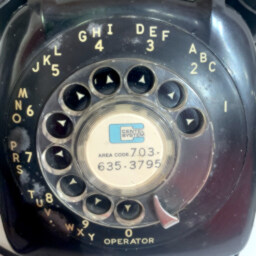
Sometimes projects begin because of nostalgia. Other times, they begin because someone casually says, “Wouldn’t it be neat if…”
The phone exhibit at Stone Branch Center for the Arts started with one of those moments.

One day, the director and I sat down talking about ideas for interactive exhibits. She mentioned something she had been imagining for a while: visitors dialing numbers on old rotary phones and hearing poetry readings, local music, or audio experiences play back through the receiver. The concept fascinated me immediately because years earlier I had already wandered down a similar rabbit hole myself.
Back then, I became obsessed with learning how old telephones actually worked. The deeper I researched, the stranger it became. Analog phones were not just simple speakers and microphones. They relied on specific electrical conditions to function correctly, including a surprisingly high AC voltage used to ring the bell. Once I reached that point about four years ago, I backed away from the project. It felt too specialized, too technical, and honestly a little intimidating.
But now there was a reason to continue.
There was interest. There was physical gallery space. There was an actual artistic purpose behind it.
So I went home and picked up where I had left off.
This time, however, I discovered modern Analog Telephone Adapters (ATAs). These devices allow traditional analog phones to operate over Voice over IP systems. Even better, they supported pulse dialing, which meant rotary phones could still function naturally.

Pulse dialing itself is wonderfully primitive. A rotary phone does not send tones like a touch-tone phone. Instead, it rapidly disconnects and reconnects the line a number of times corresponding to the number dialed. Dialing “5” means interrupting the line five times in rapid succession. Zero becomes ten pulses. In a way, it is essentially a controlled series of extremely fast hang-ups.
Long before rotary dials existed, people even improvised this manually on crank wall phones by repeatedly tapping the hook switch. Crude, unreliable, but technically functional. If the rotary on your phone is giving you problems, you can still dial by tapping the “hook” in the same way.
The first ATA I purchased was a Grandstream HT802 from eBay for around fifty dollars. It was a small two-line adapter powered entirely by USB. Combined with a five-way phone splitter, I was suddenly able to connect multiple telephones together on the same line like an old household extension setup or even a primitive party line.
To manage the system itself, I added a Raspberry Pi computer.
The Raspberry Pi is one of my favorite pieces of modern computing philosophy. It is a tiny inexpensive computer roughly the size of a credit card that uses a microSD card as its primary storage. The idea behind it was accessibility and affordability. If someone could not afford the computer itself, they could still own their work on a microSD card and move between available devices. Depending on the operating system loaded onto the card, the same Raspberry Pi could become a gaming console, media server, workstation, kiosk, or web server.
For this project, mine became a private telephone exchange (PBX).
I installed Asterisk, a free open-source PBX platform capable of routing calls, assigning extensions, managing voicemail, and triggering audio playback. Suddenly the exhibit was no longer just old phones sitting on a table. It became a functional communications system.
I could assign phone numbers to poetry recordings. Visitors could call extension numbers and hear audio clips. I could create voicemail boxes where patrons could leave recordings and become part of the exhibit themselves.
Then things escalated.
Later, I acquired two used Grandstream HT818 units. These eight-port adapters dramatically expanded what the system could eventually become. They required separate 12-volt power supplies, extensive configuration work, and frustrating troubleshooting because they attempted to provision themselves automatically from remote servers at boot. Preventing them from “phoning home” became a technical challenge in itself.
Still, the additional ports meant possibilities.
More simultaneous phones. More interactive spaces. A better testing environment at home. Greater flexibility during events and gallery traffic.
Last week, the director and I finally discussed setting up the first public version of the exhibit. We wanted it operational before both Family Fun Day on May 9 and the upcoming Wine & Craft Festival on May 14 to take advantage of increased downtown foot traffic.
She wisely suggested starting small.
Two phones.

In the morning, at home, I updated the exhibit website with a printable phone directory listing all active extensions so visitors would know which numbers to dial. I struggled to get the larger eight-port ATA devices visible on my home network and had to temporarily fall back to the smaller two-port adapter. Unfortunately, technology always finds ways to remain humble.
I brought in two rotary phones donated by the local Masonic lodge, along with a touch-tone speakerphone, to simplify setup and troubleshooting. Everything assembled surprisingly quickly. One of the first questions from the director was whether people could dial from each phone individually or if everyone would have to listen at the same time, like a party line. I answered that they were their own lines, but I could bring in a splitter since she also expressed interest in allowing one person to do the dialing, while others could listen in on the other phones for a teaching moment.

Black Phones
Rotary Dial
Then we discovered that the black rotary phone had inconsistent dialing behavior. I am guessing this is why the lodge had two phones, as the tan rotary phone seemed like a modern replacement for the other with detachable cables. The speakerphone worked perfectly, while the second rotary phone operated smoothly with almost flawless dial return action.
The exhibit technically worked.
But human behavior introduced a new problem.
Naturally, nearly everyone gravitated toward the disconnected black rotary phone first because it looked the most visually inviting. When it failed to function properly, some visitors assumed the entire exhibit was broken. By Saturday, I had swapped it out for an antique candlestick phone. It was a decision that unexpectedly improved both reliability and visual curiosity.
The director was fascinated watching people interact with the phones. One patron commented that it had been so long since they last heard a genuine dial tone that the sound alone triggered memories.
We also experimented with accessibility features. I demonstrated the Ultratec Miniprint 425, a TTY machine, by placing a rotary handset onto the acoustic coupler and dialing the TTY extension listed in the directory. The machine’s glowing blue vacuum fluorescent display lit up with text while the thermal paper slowly printed messages onto the reel.

Part of the exhibit was setting up a Rolodex. I got one that was fairly modern that had blank cards. I spent about half an hour writing titles for each entry in the directory: the phone number, the TTY number, the audio type, and the author. My hand was starting to cramp up. I was tempted to write in cursive for some of them, to really trip up people who didn’t know how to read it, and give an additional “antique” feeling to the exhibit, but it just didn’t feel right in a Rolodex.
Somewhere between telecommunications history, accessibility technology, interactive art, and retro-futurism, the exhibit began finding its identity.
We discussed a local reporter expressing interest in interviewing us about the installation sometime early the following week. Around that same evening, one of the gallery patrons asked a simple question:
“What’s the name of the exhibit?”
I froze for a moment.

I had spent so much time focused on wiring, servers, adapters, dial pulses, voicemail routing, TTY compatibility, and keeping old phones alive that I had not fully stopped to think about the artistic framing of it all.
Until then, it was just “the phone project.”
But standing there in the gallery, listening to rotary dials clicking and bells occasionally ringing through the room, the answer finally surfaced:
Restoring the Signal.