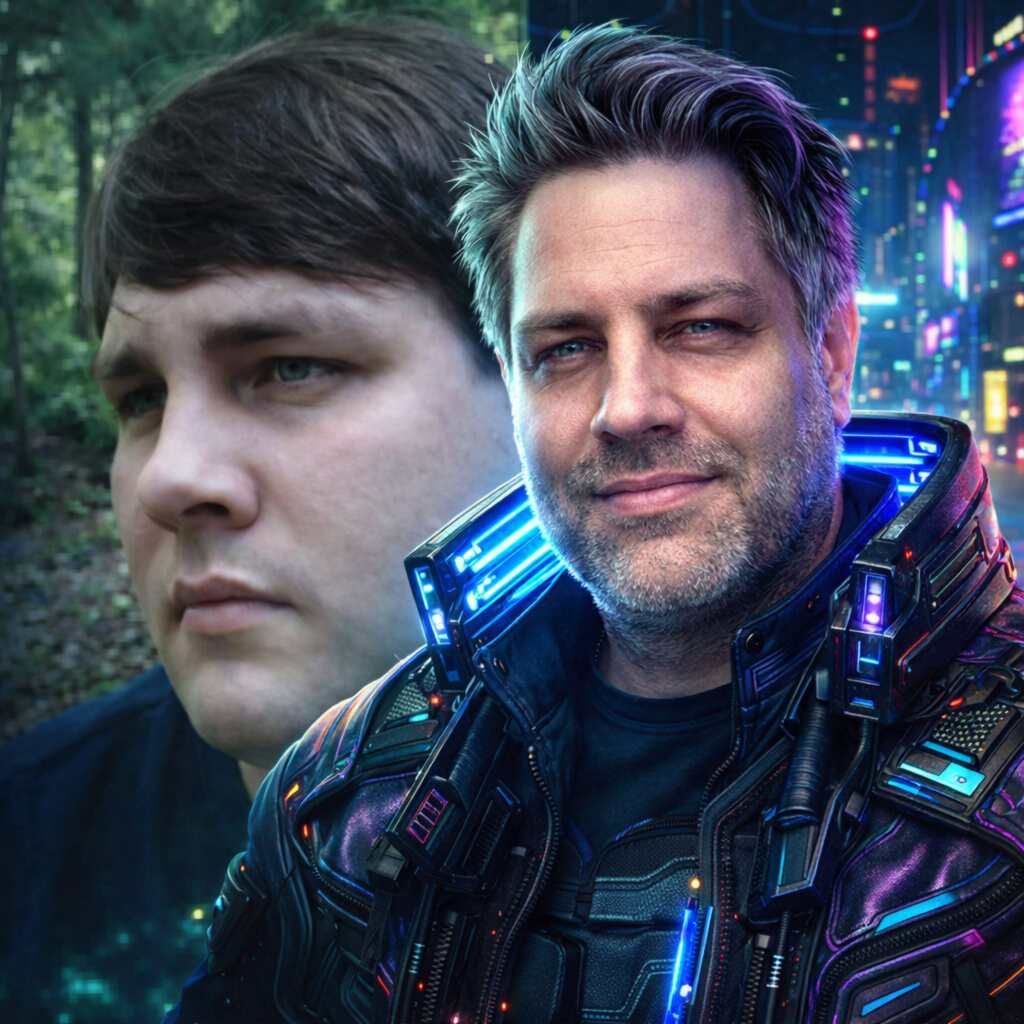
Rediscovered Tapes: Woods, Family, and the Things We Leave Behind
There are moments in life that you don’t realize you’ve preserved.
Not intentionally. Not carefully cataloged. Just… recorded, stored away, and forgotten.
That’s what I found when I finally sat down to digitize a stack of old MiniDV tapes at the library on Monday.

The Woods That Aren’t There Anymore
One of those tapes became a short film—a quiet walk through the woods behind my old home in Woodbridge, Virginia. At the time, around 2008, I had no script. I was experimenting. I had been creating machinima and wanted to try filming something in the real world.
So I took a tripod, a camcorder, and walked into the woods.
I tried things that felt clever at the time—like hoisting the camera into the trees with kite string, only to learn quickly that gravity and rotation had other plans. That shot made it into the final edit, but only for a few seconds.
The rest was simple: walking, observing, sitting down, pulling out a journal with dragons on the cover, and writing.
I don’t remember what I wrote.
What I do remember now is that those woods are gone.
Where there were trees, there are now houses. Streets where paths used to be. The place still exists on a map, but not in the way it did then. Rather than a large forest with paths, there are now roads and houses. It was somewhere near or on Eagle Feather Drive (GPS: 38.60752, -77.30215) between Donald Curtis Drive and Powells Creek.
The footage became something I didn’t expect—a record of a place that no longer exists, captured by someone I used to be.
I’ve edited video clips in the past, often to document my public comments or put together memories. I’ve also made little machinima videos. However, I hadn’t made a short film with a narrative story other than a machinima based on my 100-word story: Duplicate Daughters, Divided Dad (aka Peas in a Pod).
Later that night, I assembled a short film from the old footage.
Eighteen years later, a quiet idea had finally taken shape—with me as the subject.
When I attended the Art Institute of Pittsburgh, I was enrolled in Industrial Design Technology (IDT). The Music Video Design (MVD) courses were held in the basement alongside IDT, and I had a few roommates in that program.
Watching this video brought back one of their projects—a silent black-and-white film that told a story entirely through visuals. His short film followed someone asking for food while living on the streets.
Looking at what I created here, I see a similar approach. There’s no speech, but the story is still there—told through movement, moments, and the way the scenes come together.
Thanksgiving on the Farm (2008)
Not everything on the tapes was unfamiliar.
The Thanksgiving footage felt different—I had seen it before.
Years ago, not long after it was recorded, I had already digitized those clips and uploaded them to YouTube almost a year later (September 17, 2009). I marked them as private at the time. Having them—and knowing where they were—helped keep my grandmother alive in my memory long after she passed.
Still, sitting in the Memory Lab, I fast-forwarded through the full tape again.
Part of that was practical. I only had a two-hour block reserved, and each clip on those tapes ran close to ten minutes. There wasn’t time to carefully digitize everything again, so I scanned through—making sure nothing had been missed, nothing left behind that I might want to come back for later.
But part of it was something else.
Recognition.
Thanksgiving at my aunt’s farm came back in fragments I already knew, but now with a different perspective.
My uncle walking us through the greenhouse—banana plants and desert plants thriving against the odds in the cold season. It felt like stepping into a different climate entirely, something carefully maintained and quietly impressive.
Outside, we carried apples to the horses. As I fed Willy an apple, I made a joke that I had an “Apple Cam”.

I miss Willy.
A Clydesdale—massive and gentle. My uncle once said he needed extra care for his hooves. Seeing him again on video brought back something older—a lenticular postcard I had as a kid, the Budweiser wagon pulled by those same towering horses. Willy made that image real.
Inside, the house was full of sound.
My nephew and his friends crowded around video game instruments—guitar, drums, and a microphone. Later, he moved to the piano in another room and played, just as naturally.
There were clips of food, movement, conversation—small pieces of a day that felt ordinary at the time.
And then there was my grandmother.
Still speaking. Still herself.
Even though I had seen this footage before, that moment landed differently this time.
Thanksgiving on the farm was special to me.
As a child, we would sometimes visit my grandmother for Thanksgiving—though we weren’t really supposed to, given our family’s religious beliefs at the time. After moving to West Virginia in 1990, my family and I stopped attending Thanksgiving altogether.
That changed in 2000. After spending two weeks in the ICU, I went directly to my aunt’s family Thanksgiving—where my grandmother would be—and made it a tradition to return every year until she moved to Florida. I even got to sit with the adults.
Later on, my aunt and uncle retired to Florida and brought my grandmother with them. I didn’t see her again until her funeral.
Birthdays, Rockets, and Small Moments
Another tape held my nephew’s first birthday.
At the time, I didn’t think much of recording it. Now, it feels like something far more fragile—a moment that can’t be recreated, only revisited.
There were other small pieces scattered across the tapes:
- Teaching my other nephew how to build a model rocket
- The bright personality of my niece
- Clips of pets, including a dog named Libby we were watching for a short time
None of these were meant to be important. But they are.
Losing that relationship with my nephew and niece was one of the hardest parts of the divorce.
They’re the kinds of moments that quietly become everything later.
The Complicated Parts of Memory
Watching these tapes wasn’t all easy.
The first tape started in a strange way—shot sideways on the floor—that took me a moment to recognize. It looked like my old house in Woodbridge. In the background, I could hear a conversation with the police about a neighbor causing trouble.
It was my ex-wife. And I was there too—my voice in the background, describing what had been happening.
There had been ongoing tension with the neighbors—cars driving past, air horns, and waving at the house. The kind of thing that builds over time until it becomes something bigger than it should be. She had tried to confront them and called the police afterward.
The officers talked through it calmly, explaining how quickly a situation like that could cross a line. The neighbor agreed to stop.
Watching it now, it felt distant. Not just in time, but in perspective. At one point, something like that felt immediate and consuming. Now it plays back like a fragment—real, but disconnected.
I never did find the video she mentioned during that conversation—the one that was supposed to show what had been happening. Maybe it’s on another tape. Maybe it’s gone.
Some things stay unresolved.
Later, after I moved, I heard things from other neighbors about that same person—stories about trouble with the law, stolen vehicles, even one that ended up burned in a next-door neighbor’s driveway while the house was vacant. I never looked into it myself, and I don’t know how much of it was true.
But it added a different layer to what I was seeing on the tape.
At the time, it felt like an isolated incident. Looking back, it feels more like a fragment of something larger—something I only partially understood.
Woodbridge had a reputation—sometimes called “Hoodbridge.” Back then, it felt like I was living on the boundary between two worlds: the hood and the woods.
That boundary doesn’t exist anymore.
The woods are gone.
The Question of What to Do With What You Find
One of the hardest thoughts that came out of this process was about my nephew’s first birthday.
He is an adult now.
He may not know these videos exist. He might appreciate them—seeing himself as a child, hearing familiar voices, revisiting moments that shaped him in ways he may not remember.
But life isn’t that simple.
During my divorce, I had to draw hard boundaries. I blocked everyone to protect myself. There are old wounds there—ones I don’t want to reopen lightly.
And even if I wanted to reach out, I wouldn’t know how to find him. He was very young when I last saw him, and he may have no memory of me.
So the footage exists in a kind of limbo—meaningful, personal, but not easily shared with the people who might value it most.
What These Tapes Became
What started as a simple attempt to digitize old media turned into something else entirely.
A personal archive.
Not curated. Not planned. Just uncovered.
Pieces of:
- A place that no longer exists
- People who have changed, grown, or passed on
- A version of myself that was experimenting, learning, and creating without knowing why
There’s something strange about watching your past and beginning to remember—while still not remembering everything. There’s something just as strange about watching someone else’s past, knowing they may never see it—or even know it exists.
It’s like finding a journal—or even a biography—you don’t recall writing, and realizing it still says something true.
Closing Thought
I went to the library expecting to recover memories from my childhood in the ’90s.
Instead, I found moments I didn’t know I had saved from the years that followed.
And in some cases, moments that no longer exist anywhere else.