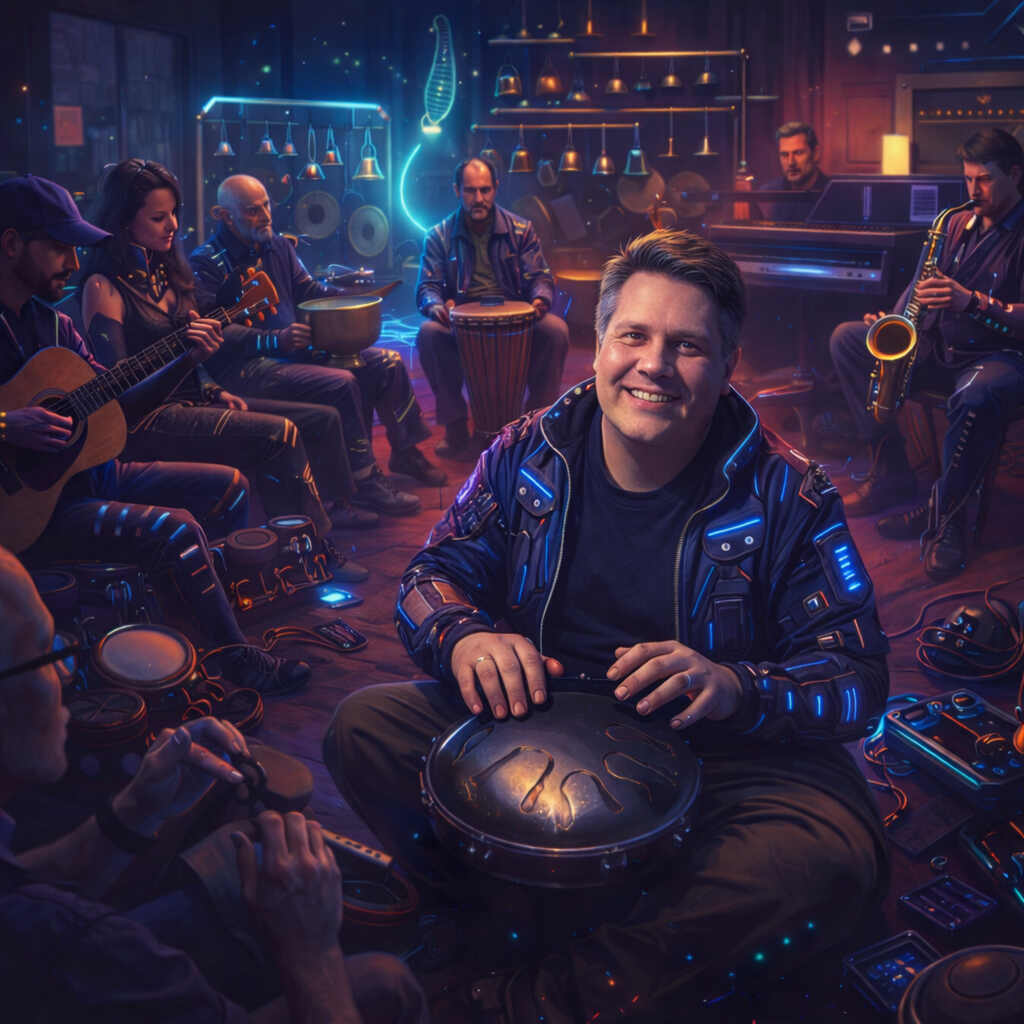
Exploratory Music Jam at Stone Branch
I found out about the Exploratory Music Jam through the Stone Branch Center for the Arts Facebook page. The description immediately caught my attention: bring an instrument, bring an open mind, and see where the music goes.
That sounded promising.
I’ve always been more interested in exploring sound than playing traditional music. A structured jam session can sometimes feel intimidating when you’re not a trained musician. But experimentation? Random sounds? Odd instruments? That’s much closer to my comfort zone.
So I packed a briefcase.
Packing the Briefcase
I have a surprising number of small and strange instruments scattered around the house. Many of them double as props for clowning, since unusual sounds tend to attract curiosity and laughter.
Into the briefcase went:


Then I brought two larger items separately:


In hindsight, I should have brought a recording device. It never crossed my mind at the time. I may ask the director in the future whether recording or even streaming a session might be something the center would consider.
But in the end, maybe it was better this way.
The Room
The jam was held in the back performance space—what I believe is called the Marigold Room. When you enter, a grand piano is already waiting near the back of the room.
Meanwhile, in front of the building, another group was rehearsing a play—12 Angry Men. They looked cheerful about it, though from what I overheard, they may still need a bit more practice being angry.
When the session began, there were eight of us. A ninth person joined later.
The host had brought an entire suitcase of instruments: drums, bells, odd percussion pieces, even an old-school handbell. Along one wall he set up stands filled with triangles and various bells, inviting anyone to pick up whatever they felt drawn to.
I mentioned that I wasn’t much of a musician and mostly experimented with sounds at home.
“That’s perfect,” he said.
Good start.
Setting the Tone
Before we played a single note, we stood in a circle, held hands, and spent a quiet moment breathing together.
Just silence.
Relaxing.
Preparing.
The host explained that this wasn’t a jazz jam or a traditional session. The goal was exploration.
Then the music began.
Finding a Place in the Sound
It started with a single instrument.
Then another joined.
Then another.
Two participants settled into unique hand drums. Two others brought guitars and small amplifiers, and one occasionally moved to the piano.
I set a small cluster of instruments beside my chair and began feeling out where I fit.
Most of the time I gravitated toward percussion. The frog güiro and dumroo drum became favorites. Sometimes I struck them with the mallet from my tongue drum to produce different textures. At one point I even used my wooden train whistle as a striking block instead of blowing it.
The evening was full of little experiments like that.
What happens if you hit this instead of shaking it?
What if the rhythm slows down here?
What if this sound answers that one?
Leading the Group
After a few sessions of collective playing, the host asked if I would start the next piece using my steel tongue drum.
That caught me off guard.
I quickly explained that I usually just play randomly at home.
He smiled and said that was exactly the point.
So I started.
The tongue drum has a long, resonant tone, and even playing multiple tongues together tends to sound harmonious. Still, leading a room full of musicians for the first time felt strange. I was nervous, slowly searching for the next note while the room listened.
Then, gradually, other instruments joined.
It was subtle and beautiful—the moment when the group quietly grows around the sound you started.
The director of the center was sitting nearby and occasionally reached for instruments from the small collection I had laid out. At one point I handed her a mallet to make it easier to strike the drum cleanly.
She also had a large singing bowl whose resonance filled the room.
My tiny bowl, by comparison, felt more like a novelty.
But that’s okay. Most of my instruments exist to spark curiosity.
The Theremin Intermission
During a break, I demonstrated a theremin that I had brought along.
Both the director and the host had heard of them but never played one. They spent a few minutes experimenting with the invisible pitch and volume fields.
Unfortunately, the theremin required plugging into the wall, which placed it away from the group. Once the break ended, I packed it up and returned to the circle.
Adjusting to the Ensemble
At one point, the host suggested that the piano be played in the key of D so it would align with my tongue drum’s tuning.
It worked musically, but the amplified guitars and piano were powerful enough that the drum’s long resonance struggled to keep up with the tempo.
So I adapted.
Out came the frog again.
And the dumroo.
And at one point Teddy’s dog clicker.
I even held four small trinket bells together to simulate a tambourine or jingle stick, playing them in a slow rhythm.
A lot of my time was spent experimenting with different ways to strike, scrape, or shake things to create new textures.
Moments That Stood Out
Several small moments stuck with me.
The director commented on how loud the little plastic frog güiro was for such a small instrument. Most versions people see are larger and carved from wood.
Another moment came near the end.
The host was playing saxophone when another guest quietly entered from behind him and began playing a second saxophone. For a brief moment he didn’t even realize it had happened.
The music itself was completely free-form. No songs. No recognizable melodies. Just evolving sound.
Sometimes pieces ended naturally and suddenly, as if the room collectively agreed it was time. Other times someone would drift into a near-solo before the rest of us slowly rebuilt the sound around them.
The Final Piece
By the time the last piece began, three people had already left.
The two saxophones and the piano were playing with a lot of energy, filling the room with sound. Even my trusty frog couldn’t compete with that volume.
So I did something else.
I stopped playing.
The director and I simply listened while the three musicians carried the final wave of sound through the room.
And that was perfectly fine.
Music That Exists Only Once
I spend a lot of time archiving my creative work—saving files, preserving projects, documenting experiences.
But this was different.
No recordings.
No transcripts.
No artifacts.
The music we created tonight will never be heard again.
It existed only in that room, for those two hours, shared among nine people exploring sound together.
And maybe that’s exactly what made it special.
Not everything needs to be preserved.
Some experiences are meant to live only in memory—moments of creativity, curiosity, and joy that belong to the people who shared them.
Until Next Time
I’ll probably go again.
Part of me wishes I knew music well enough to confidently join the melodic side of things—guitar, piano, structured harmony. I can play a few songs here and there, but I still consider myself very much a novice.
For now, experimentation suits me just fine.
At the end of the night, before leaving, I helped line the chairs back up along the walls.
Then I packed the briefcase of strange little instruments and headed home.
And somewhere in that briefcase, the frog is probably still proud of itself.