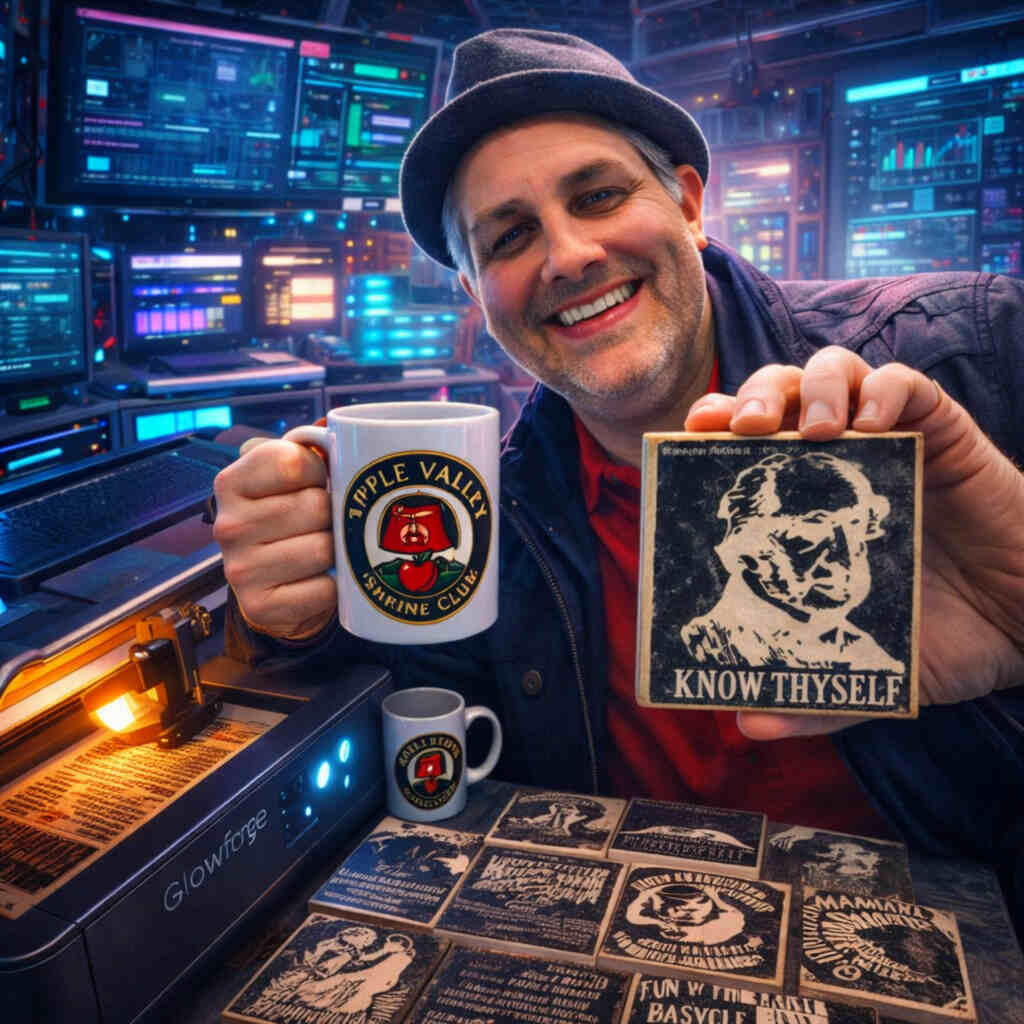
Today I returned to Studio 330 at the library to pick up exactly where I left off last week — and this time, everything clicked.
Because I’m using the laser equipment, I schedule the Makerspace for solo work instead of attending the Thursday walk-ins. To make the most of the reservation, I tend to run multiple machines at once. Last Wednesday I printed all of my sublimation transfers and cut them down so that today could be pure execution: eight remaining 11oz mugs ready for heat.
A few months ago I learned how to produce custom sublimation mugs. I bought a pack of twelve for $27.99 with a simple goal — help our new nonprofit, the Apple Valley Shrine Club, raise some early funds. We typically sell Kena Shriners mugs, but this felt like an opportunity to create something unique and club-specific.
Between my first test mug and now, the library worked through some heat press issues. The difference is dramatic. The blacks are deep and pure now — bold and beautiful. My original test piece suddenly looks washed out by comparison. It’s encouraging to see how small technical adjustments can unlock the full potential of a process.

While the mugs were being heated, I shifted back to another project that has been quietly evolving: 1881 block prints from Warren Sentinel advertisements preserved in the Virginia Chronicle at the Library of Virginia.
Back in September, I worked with the director at the Stone Branch Center for the Arts to learn how to use laser etchings to create inkable printing blocks. During the Clown Lounge Art Revue — where I won an award for “most inner-clown energy” while dressed as Doc Leo — she suggested something practical: focus on 4×4 prints. Large enough for legible text. Small enough to sell, collect, or admire to raise funds for the Warren Heritage Society.
That advice stuck.
Last Wednesday I etched three panels. Today I completed five more using the Glowforge. These take time. The laser has to traverse the entire surface area, and precision matters. I’ve learned that not every historical clipping fits perfectly into a 4×4 square, so some require resizing or redesign.


Original images courtesy of Library of Virginia via The Virginia Chronicle, Warren Sentinel, 1881
These aren’t direct reproductions. Some are rearranged for clarity and composition — the corset advertisement, for instance, benefits from a cleaner layout. Phrases like “Read: Save Thyself” and “Know Thyself” were only fragments of much larger ads, but they stand beautifully on their own.
The workflow is meticulous:
- Crop to a 1:1 ratio.
- Scale to 4×4 inches at 600 DPI.
- Apply threshold filtering until only black and white pixels remain.
- Manually clean noise, ink overflow, and bubble artifacts.
- Carefully refine typography so it remains legible in print.
- Copy & Paste typography when clearer artifacts exist on the same ad
It’s pixel-level restoration work. Slow, deliberate, oddly satisfying.
The director also gave me a brief introduction to screen printing, which opens another door. With transparency film, these same designs could become posters — extending their usefulness beyond block impressions. I’m working on a full-page circus poster from 1881 for screen printing, but it needs significant cleanup.
And then there’s the larger experiment.
The 4×4 prints tie directly into my card game project, Catalog of Modern Miracles, which leans heavily on Victorian advertising optimism and theatrical confidence. It starts out with “A Proper Introduction to the Well-Educated Reader.” The instruction manual embraces bold claims, exaggerated authority, and playful disclaimers — including entirely unnecessary denials of secret organizations (which of course do not exist).
I may even introduce a hidden alternate way to play.
So while I’m standing in the Makerspace waiting on lasers and heat cycles, I’m not just making objects. I’m deciding which historical claims deserve new life. Which phrases deserve bold ink again. Which “modern miracles” should be reframed for contemporary amusement.
Mugs for fundraising.
Block prints for preservation.
Posters for experimentation.
Cards for playful persuasion.
It’s a lot of work — but it feels like momentum. Heat, pressure, ink, and optimism working together.
Enthusiasm survives.