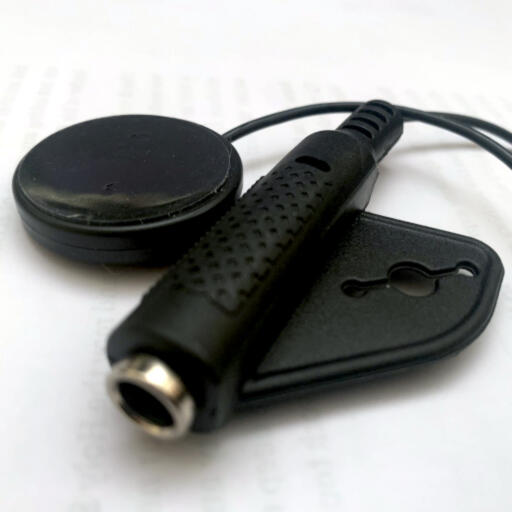
Name: Randon Piezo Contact Pickup (MP20)
Instrument: Piezo Contact Pickup (Vibration Transducer)
Orchestral Taxonomy: Electroacoustic Accessory / Experimental Percussion
Manufacturer: Randon
Model: MP20 (Sold as Pair in RP-30 Listing)
Pickup Type: Piezoelectric Contact Transducer (PZT)
Material: Piezo Ceramic Disc, Plastic Enclosure, Metal Jack
Cable Length: Approx. 9.65 inches
Hornbostel–Sachs: 53 – Electrophone (Electromechanical Contact Transducer)
ASIN: B09L8NZVQQ
Purchased: January 10, 2026
Price: $16.99
Location: Internet
Market: Amazon.com
Store: Randon Store
Condition: New, Opened
Status: In possession
Included Components: Piezo Pickups (2), Velcro Tape, Adhesive Sticker
Primary Use: Acoustic Instrument Amplification, Experimental Sound
Compatible Instruments: Guitar, Ukulele, Kalimba, Banjo, Violin, Mandolin, Harp
Any hobbyist who loves playing with electronics quickly learns how to convert vibration into electrical pulses using transducers. The first introduction to this is often with thin piezo discs, which are usually used to produce buzzer sounds at a low volume. However, they can also be used as microphones to record audio. Inside each piezo disc is a piezoelectric ceramic element (PZT). When it vibrates, it generates electrical signals, which can then be amplified. Quartz crystals are also piezoelectric, but are generally more expensive.
Pre-wired Enclosure

I purchased a couple of pre-wired piezo discs so I could plug a standard ¼-inch audio plug into a socket attached to them (Figure 1). These pickups are commonly used on acoustic guitars. However, as you start experimenting with sound, you’ll realize that they can be placed on almost any musical instrument with a flat, resonant body. I have many instruments that I would like to electrify, including a Kalimba, Ukulele, Rain Drum, and more.
Pringles Experiment
In my little experiment, I started talking directly to the pickup in my hand, and then grabbed a nearby Pringles can. After some trial and error, I realized the real magic was holding the pickup against the bottom of the can and singing into the top — instantly turning snack packaging into a resonant chamber (Figure 2).

Permanent Solutions

The kit came with two of these durable pickups enclosed in plastic, but if you want a more permanent solution, it may be optimal to purchase the piezo discs themselves and solder them in place. They often come prewired with about a foot of wire leads (Figure 3). Some include screw terminal modules, making them easy to use in breadboard projects, while others may have a bare-bones ¼-inch output jack connected to the piezo pickup without a plastic enclosure, meant to be permanently installed inside of guitar bodies or other musical instruments.
Future Projects
I have a couple of projects I would like to do: creating a noise box and a diddly bow (often seen as a Spamjo with a can of SPAM). For those projects, I’ll use permanent pickups soldered and screwed into place.
A Final Note
I also have a kit to build my own electric guitar that has six small dots (Figure 4). Electric guitars use something different to detect sound. Rather than vibration through a resonant body, they detect the metal (steel or nickel) strings vibrating above them through electromagnetic induction. This is why electric guitars don’t work with nylon strings.

Time to make some noise…