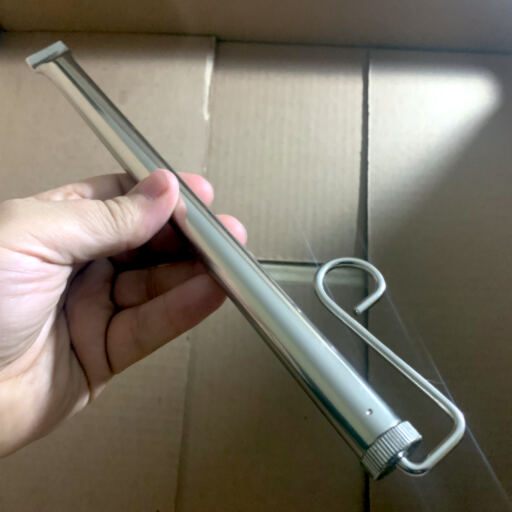
Amazon has approved my review for the American Song Whistle today. The following is how it how it appears:
★★★★★ The Slide Whistle That Didn’t Become a Chew Toy
Reviewed in the United States on January 13, 2026
Verified Purchase
If you want a slide whistle that actually plays melodies instead of just making noise, this is the one.
The American Song Whistle lives in a strange place between novelty and instrument. Most people hear a slide whistle and think of cartoons, pratfalls, and comic exaggeration. That association is so strong that it’s easy to forget the device underneath it is a real wind instrument with a real vibrating air column.
I came to this whistle for practical reasons. My dog, Gwinn, had destroyed several toy slide whistles, and replacing them was turning into an endless loop of cheap plastic and disappointment. I wanted something that would last, but also do more than just squeak. The American Song Whistle, with its nickel-plated brass body and longer tube, felt like it might finally cross that line.
It does.
From the first few minutes of fun playing, the difference is obvious. The plunger’s range is longer and smoother, and the instrument responds to breath in a way that feels more like a recorder or a flute than a toy. Notes don’t just happen by accident; they can be aimed for. After a short adjustment period, I was able to play Yankee Doodle with recognizable pitch centers and a consistent tone, something that is difficult to achieve on most short, plastic whistles.
What makes this especially interesting is that the improvement isn’t just subjective. When I recorded the whistle and analyzed its output, it showed a stable fundamental pitch that sweeps smoothly as the plunger moves. In practice, that usable range runs from about 300 to just over 1,000 hertz, corresponding roughly to D4 through C6, which is close to two full octaves. That alone places it firmly in melodic territory.
Even more revealing is the harmonic structure. Above the fundamental pitch, there are clear, evenly spaced overtones that track along with the note as it moves. That pattern is what you see in properly tuned wind instruments: the air inside the tube vibrates in an organized way, producing stable, predictable tones instead of turbulent noise. The whistle functions and behaves like a real aerophone, not a noisemaker.
Comparing this to a typical toy slide whistle makes the difference stark. Shorter whistles tend to have limited range, unstable pitch, and weak or broken harmonics. They swoop and squawk because the airflow never really settles into resonance. That is why so many slide whistles sound funny even when you try to play something straight.
This explains the cultural problem the instrument carries. The slide whistle is so strongly coded as a joke that playing emotional music on it almost feels forbidden. Although it’s fun to play, a love theme or a soulful ballad can instantly turn into a parody. The sound itself undermines the intent. It is possible to soften that effect, though, by using technique rather than brute force — gentle breath, careful piston movement, and small jiggling motions that keep the pitch centered instead of letting it wobble.
Where the slide whistle really shines is when it commits fully to seriousness. Performers who play classical pieces with deep concentration turn the instrument into something oddly compelling. The humor never disappears, but it transforms into something warmer — a tension between expectation and effort that makes people smile and then applaud.
The American Song Whistle lives right in that space. It will always sound like a slide whistle, but it gives you enough control, range, and stability to decide what that sound means. Whether it is used for slapstick, folk tunes, or unexpectedly sincere classical lines, it responds like a genuine instrument.
For me, that makes it more than a novelty. It is a valuable, durable, expressive, dog-resistant little aerophone that quietly proves even the silliest sounds can have real musical bones underneath.