Today, I’ve been deeply involved in restructuring our website’s architecture to align with evolving requirements. A key challenge was the convoluted process of incorporating slugs into API queries for identification. To streamline this, I implemented a decoupled approach, separating slug management from the core icon functionality.
By introducing dedicated Slugs and SlugTypes tables, I’ve established a centralized repository for slug-related information. The router now intelligently interprets non-numeric patterns in API paths as slugs, querying the Slugs table for corresponding identities. The SlugTypes table provides a structured framework for managing slug data and ensuring consistency across the system.
To maintain historical context and enable seamless redirects, I’ve implemented a SlugHistory table. This records changes to slugs, allowing for redirects when slugs are modified or deleted. By returning a 410 Gone status code for deleted slugs, we provide users with accurate and informative feedback.

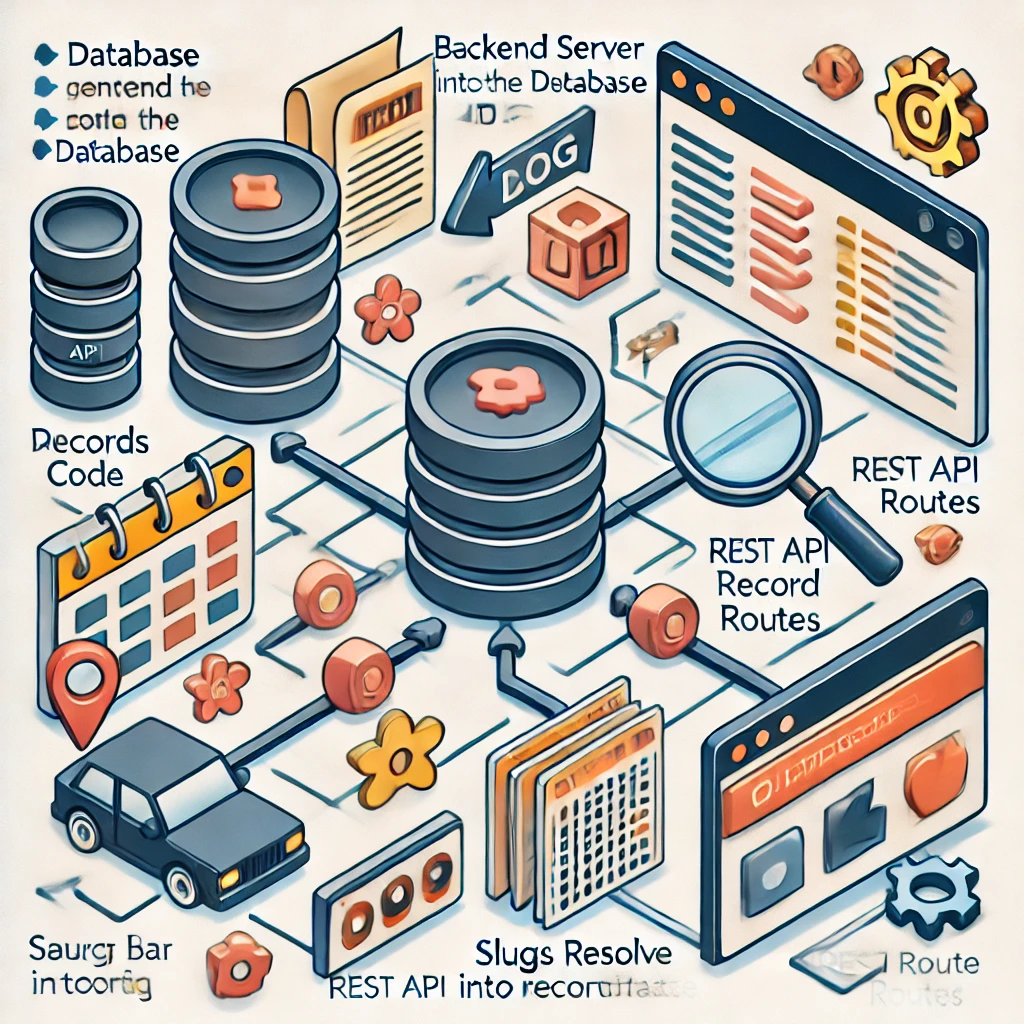
ChatGPT: Dall-E Image Prompt
create an image prompt that will create a feature image for a blog post. it should demonstrate the cohesion between a database, the server code that interacts with it, the REST API route to access the server, resolution from slugs into record ids, and a website that lets someone search through a list of icons that has tabs, filters, and a search box.
Note: It actually generated an image for me. This is the first time I’ve seen this happen.
The decoupling of slugs has significantly enhanced the flexibility of our API. I’ve now opened up the potential for a powerful endpoint that intelligently suggests available slugs based on user-provided text. By automatically appending numeric suffixes or incrementing existing ones, the endpoint ensures data integrity and prevents conflicts arising from duplicate slugs.
To further safeguard against potential issues, I can integrate a comprehensive check against our slug history. This feature could identify any conflicts with deleted or renamed slugs that were previously associated with other records, ensuring a robust and reliable slug generation process.
After navigating through multiple layers of code—spanning from database interactions to API routes, backend scripts, and even generating code to seed the database—I’ve made steady progress. Along the way, there was extensive verification and troubleshooting to ensure everything functioned as expected. Eventually, I brought the work to the UI level, where I ran into some architectural challenges, such as infinite nested rendering issues. To address this, I split the rendering of icons into its own component and updated the InfiniteScroll component to export a React context hook that manages the data offset & limit, while providing a callback to update the total row count.
The journey has been meticulous, with attention paid to each small detail. When I finally got everything working, it almost felt like an early victory—but here we are. The icon picker is now successfully calling the API, using slugs for identifiers, and while there are still some issues to resolve, the foundation is solid. Next, I’ll focus on editing icons and potentially incorporating drag-and-drop functionality to organize icons or adding a menu for more flexibility.
I’m pleased with how far it’s come and excited for the next steps.

Studio 330 Ribbon Cutting
A video of the ribbon-cutting ceremony for our library’s new Maker Space and Memory Lab, Studio 330, is now available on the Royal Examiner’s YouTube channel. You can spot me on the far left, holding the ribbon, and later receiving the bow as it was passed to me.
The Northern Virginia Daily recently published an article titled “County pulls the plug on maintenance projects at Samuels Library” regarding the emergency board meeting that took place later that same day. The library is currently dealing with pressing concerns, particularly the halt of county maintenance services, which affects crucial property improvements. While I have personal opinions on the matter, as a Trustee, I believe any public statements should come directly from the Library. I encourage everyone to stay informed by reviewing coverage in local media, community feedback, statements from County Supervisors, and official responses from the Library.