I once had a job that stuck with me for years. At the recommendation of my mother, I applied for a job at a chicken plant. I worked on a Live Haul crew, moving chickens from growing facilities to egg-laying operations. My official job title was “Pullet Catcher”. A pullet is a hen that’s about 14 weeks old, just before she starts laying eggs.
Growing up in Westminster and Whitmarsh, Maryland, I had some experience with chickens—feeding them, collecting eggs, hatching chicks, and witnessing their processing, including watching one run around headless after slaughter. We also had rabbits and a goat when I was younger, but for the most part, I remember the chickens.
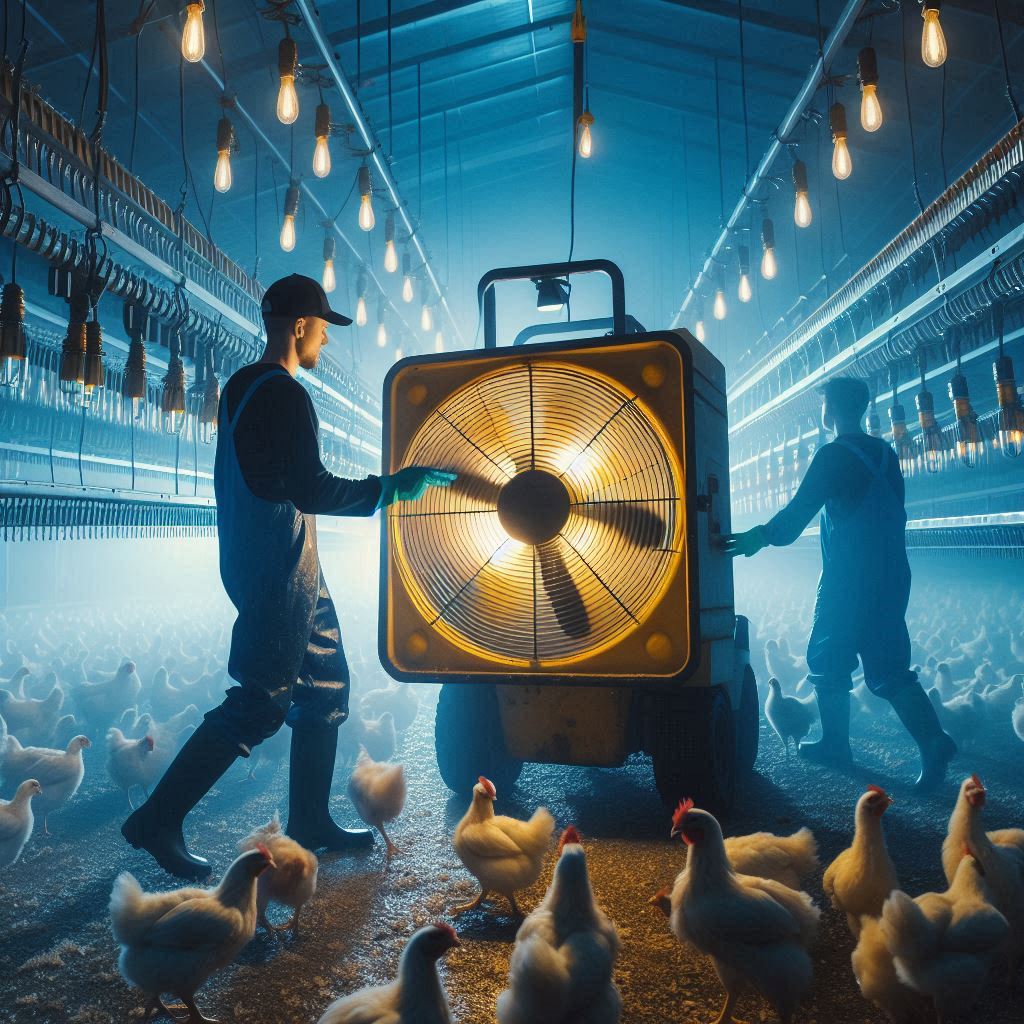
Initially, it didn’t seem too bad since these chickens weren’t headed for slaughter, and I wasn’t directly involved in that part. I still remember the first night as the large doors opened up to a view of thousands of chickens, dusty air, and the overwhelming stench of ammonia. The transport was done at night to reduce stress for the chickens, with most lightbulbs unscrewed partially and some replaced with blue bulbs to help keep the chickens calm. Large, noisy, diesel-powered fans, taller than me cleared the dust, but it was still a dark, dusty, noisy environment.

Microsoft Designer: Image Creator Prompt
Catching chickens in a growing house at night to reduce stress, with all lightbulbs removed and blue ones installed. Its hard to see anything in the dim blue light. A forklift carries a large, noisy fan inside the bar taller than the workers to clear the dust. The fan is in a big yellow square frame that sits upright. Men are in dark blue overalls wearing black rubber boots, and gardening gloves. All of the feeders and water droppers are raised to the ceiling above the workers so they can more around. A net to the side has roosters that were separated from the flock. A cage with many compartments on its side is outside the door where 21 hens are placed into each compartment. Chickens are on the ground every from wall to wall. The barn is so large, the walls disappear into the dust. You can make out some of the workers further back in the dust. One of the workers is bending over to catch chickens. It’s very dark that you can hardly see anything.
I remember that the job requirements mentioned that you needed to count to seven, and I was simply told to start catching seven at a time and toss them into the side of a cage with with many gates that flipped open. There were 21 openings in 3 columns, and 7 rows, and each could hold 21 pullets or 15 roosters. There wasn’t much training. You leaned how to catch and carry multiple chickens at a time, and identify the genders in the dark by feeling for the talons, in which the roosters had previously had theirs removed. The point of a roosters beak was also cut off. Additional training was simply through observation and being chastised if you did something different.
The chickens faced a lot of stress. Before our crew arrived, food & water was removed. When we came, they were starving, caught, crammed into tight spaces, hung upside down by their legs, handled roughly, slid across tables, inoculated, and tossed into a new location that was much different than where they came from. Roosters also had plastic pins punched through their beaks as part of the process.
Not all survived (Warning: Sadistic Animal Cruelty)
A lame chicken was killed on the spot, such as having an injured leg, throwing up, or overly dirty. Roosters sometimes broke their legs when tossed because of their top-heavy bodies. We had to go fetch, kill, and add it to a pile of dead chickens. Sometimes there were so many, we had two piles.
Some workers vented their frustration on the chickens, often in cruel ways, which deeply disturbed me. If a chicken fluttered while being drug in front of the person inoculating them, they would slap the side of the chickens head or bring their fist down on top of it, sometimes killing it. Sometimes they would grab the chickens head, pull it towards them, raise and then snap its neck against the edge of the table, only to then throw it against the wall behind them to fall to its death. Some chickens would continue to flap their wings for a few moments after they had died.
Sometimes it was purely sadistic. One guy liked to lay a chicken upside-down on its back and put its head under its wing and watch it suffocate itself to death. He would kick a chicken in the butt, causing its anus fall out and eventually die.
The job was exhausting. You had to carry seven hens or five roosters at a time so that we could keep an accurate count of how many of each gender were transported. The ratio was about one rooster for every seven hens, and were tossed into a segregated area behind a net while we caught the hens first. The net had to be moved often to prevent suffocation and stay close to where we were currently working. I recall seeing people both kicking and swiping the chickens away from the edges.
We each handled 700 to 1,000 chickens at each stop. Fatigue was a constant issue, and while the company discouraged it, some workers turned to stimulants. I got by on Mountain Dew Soda.
Horseplay and practical jokes were common, from cigarette butts in coffee to chickens being thrown at someone, knocking them over, for not working quick enough. The floor of the growing houses was covered in manure. On some occasions, your clothes were covered and drenched in excrement, but you still had to work through the shift.
Driving on the small, rural, back roads late at night was nerve-wracking. Drivers sped through, and I could only hope we made it to our destination safely as the vehicle felt like it went airborne over hills.
The job was also dangerous. Some workers brought their own earplugs, but they often fell out with all of the physical activity when I tried them. On double-decker grow houses, we worked on high, grated platforms in the dark with no railings. One of us fell and was run over by the forklift—he quit after a hospital stay. Accidents with inoculations were serious; if someone got injected by mistake, the swelling from the oil-based medicine was severe, requiring a hospital trip. Drug tests followed, and some workers didn’t pass.

Microsoft Designer: Image Creator Prompt
It is night time. Its hard to see. You are looking up at a hydraulic grated platform that is beside a two-story barn, on the second floor opening. You can see a metal cage at the end of the platform, opposite of the barn door opening. Men in dark blue overalls, gardening gloves, and black rubber boots are up there, running in and out of the barn, each carry seven hens upside down and placing them into the side of a cage with many compartments on its side. A fork lift is running over one of the workers who fell off as it is carrying another cage. A live-haul truck full of chicken cages can be seen off to the side.
Safety policies like cleaning our boots were rarely followed unless an inspection was expected. Resources to monitor every crew or enforce policies seemed lacking, and advance notice of inspections didn’t make sense to me.
We had music to help us work through the night. However, the noise was so loud, you only heard the radio as you passed near it. Humming or singing the song helped take your mind off of the physical stress. Inoculations were better to hear music as the fans were no longer running, and most of the chickens were loaded on the trucks. Everyone was closer together in a line to the table, and not running back and forth.
Sometimes we finished early and caught an extra shift with the broiler crew. The shifts were shorter but more intense—the chickens were smaller but heavy due to breeding, and you didn’t have to separate roosters. Although the chickens were able to walk about the area, there were so many of them that they tended to suffocate each other at the walls trying to get away from the crew. Broilers went straight to processing, so there was no need for inoculations or unloading.
On rare occasions, with no transport scheduled, we worked with chicks during the day. On some occasions, we had just come off our shift a few hours prior and didn’t have much time to sleep if any. We stood around, sometimes a bit dizzy, looking at a large metal cylinder spinning around, hooking chicks upside down for inoculation. It was light work, lasting only a couple of hours, but the pay was the same.
Since we were paid by the shift, not by the hour, there was little time for doing things “the right way” without getting criticism from the crew unless it shortened the shift. Going home ASAP was the primary focus. A shift was between four to six hours, but could go on indefinitely in some situations. I believe we made about $70 per shift at first. Once you made it past the probationary period, your pay was bumped an extra $20 per shift. Everyone was paid the same after that. You couldn’t get any more unless you had a commercial drivers license (CDL) to drive one of the trucks, or a license to operate the forklift. You had to go and get training on your own, and management didn’t encourage anyone to strive for those positions since we already had the guys that we needed.
For context, my prior job paid $72 per week, but was far less than minimum wage when dividing by the hours worked, so this felt like a lot of money with a steady company. Although it afforded me the ability to buy a used car and move out of my parents basement, I didn’t last a year in that industry.
I saw an ad offered once by the company looking for COBOL programmers. I don’t know anything about COBOL other than it seemed like an old, outdated language at the time. I wish I had mailed a letter expressing my willingness to learn, and my past experience with a few programming languages over the past decade. I would usually spend my free time building websites or creating software.
My brother helped me move to a city that had better job prospects, and I transitioned to working in restaurants before eventually finding my way into a professional career in information technology. People are sometimes surprised to learn that I once caught chickens for a living. Despite everything, I still eat chicken and eggs—though now with a better understanding of the process.

Microsoft Designer: Image Creator Prompt
A man thinking about a time when he was working on a Live Haul crew, transporting chickens in harsh conditions. The job was stressful for both the birds and workers, with unsafe practices, mistreatment, and constant exhaustion. After witnessing inhumane conditions, he eventually left for better job opportunities, transitioning from poultry work to a career in IT.
I’ve had nightmares about it for many years afterwards. Occasionally I see reports on cruelty in the poultry industry and the memories come back. I can still hear the noise of the birds and the giant fans. I’m unsure whether to wear that experience as a badge of honor, working in the agricultural industry and getting my hands dirty, or feel ashamed of its cruelty. I have a strong sense of empathy for what animals go through, and this experience just ripped both my heart and my conscience apart. Agriculture involves hard, dirty, and dangerous work—often unseen by the people it feeds.
Society is a bit different today as well. I don’t know how to explain it, but I get the feeling that my experience wouldn’t be appropriate in the industry today as being “normal”. I’m speculating that there are more regulations, enforcement, and care for both the animals and employees.
One response to “Pullet Catcher”
[…] See: Detailed Background […]