Podcast: Dreamy Audio
Episode: 58
Title: Border Crossing
Host: Lewis Moten

Release Date: Circa November 4, 2005 – May 5, 2006
Restored Date: January 17, 2026
Duration: 8:38
Channels: 1 (mono)
Sample Rate: 44.1 kHz
Encoding: MP3, VBR (~130 kbps)
File Size: 2.1 MB
Summary

In this dream, the narrator finds himself stranded in a foreign country with no identification at all, relying on a small group to help smuggle him back to where he belongs. One companion uses a strange, temporary economic loophole—becoming fantastically wealthy for seconds at the cost of future ruin—to quietly purchase bulk goods that double as a covert request for false papers. As plans shift, Customs becomes too risky, and the escape route turns increasingly improvised.
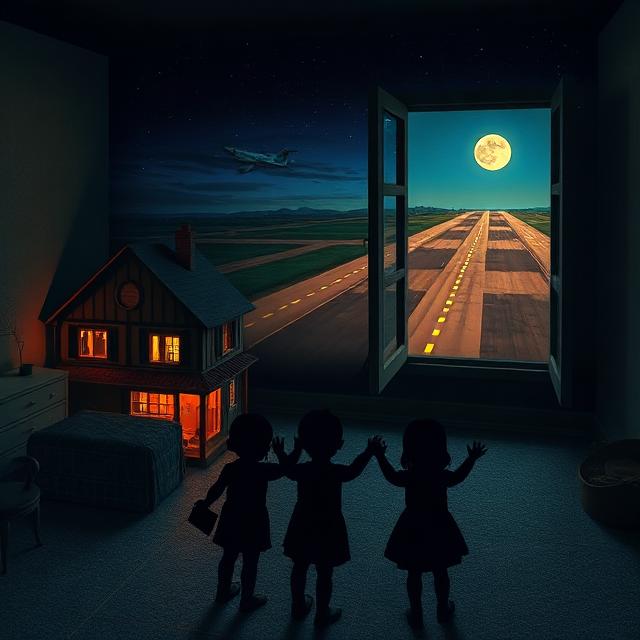
The dream slips into a childlike back room filled with toys and a dollhouse, where the narrator realizes he must be put to sleep to travel. Outside the window, runway lines blur past, revealing they are already landing and about to be caught. In a final moment of urgency, the group escapes through a window, where rescuers recognize him and pull him to safety, leaving the meaning unresolved but the tension intact.

Analysis
This dream strongly reflects anxiety about belonging, legitimacy, and control. Lacking identification suggests fear of being unrecognized or invalidated, while the temporary wealth symbolizes risky shortcuts taken under pressure. The child’s room and forced sleep hint at vulnerability and loss of agency during transitions.
Related Dreams
This episode echoes #29 (authority figures and unavoidable judgment), #39 (rescues from containment or capture), and #52 (altered realities imposed without consent). Together, they form a pattern of escape narratives where systems are opaque and trust is conditional.
Similar Dreams in History
Dreams of lost passports and border crossings were frequently reported by Carl Jung’s patients during major life transitions, and Franz Kafka wrote of characters trapped in bureaucratic limbo where identity papers determined reality—mirroring the same unease of belonging without proof.
Transcript (auto-generated)
So in this dream, I was somehow in another country.
And I was supposed to come back afterwards, but I did not have my identification to say that I belonged in the other country. And I started out with… in fact, I had no identification at all. So, man, a few other people were working on trying to figure out ways to pretty much smuggle me out of the country. And we figured that by the time we got to where I belonged, that everything would be okay.
So, one of the things we did was we went into… I guess it’s like a store of… It’s not a mall, but there’s many stores inside. Almost like a house of stores. Very, very small shops. Some stores were not even in stores.
They were like people sitting out in the hallway with shelving with glass casing. The main guy that was with me found somebody to make a deal. And he asked for a few things.
Actually, there was something before we walked into the store. And the thing was, he could do something to make himself rich for a very small amount of time. Within seconds, I guess, like 15 seconds, his accounts would be way, way, way rich beyond anything he could buy anything he wanted to. But after that time period, he would be the poorest man in the country, pretty much.
So, I don’t know if it was like a hack in the economy or what, but this was just something that everybody knew that you could do. And it wouldn’t just affect him, it would affect his whole family. But I guess the cause was great enough. So, he started the process.
We went to the store and I know we took one at 15 seconds. But he was still rich or what not. So, he meets up with somebody and asks for, it’s mostly like bulk amounts of food. But there was pretty much a wink, wink, nudge, nudge here that everybody understood what he was really asking for was some papers to get into another country.
So, somehow, I’m not sure. I’m at the Customs counter and getting ready to board an airplane or something. And so I decide to turn the shopping cart around.
People notice me but they don’t do anything. And from that point on we all figure we should not go through Customs to get on to the plane. I end up getting into a back room. Apparently it’s a child’s room. It’s like a dollhouse, a bed, all sorts of little things and toys. But we don’t see anybody in the room. And it turns out that you have to give me something to knock me out or put me to sleep because I can’t go on airplanes.
And the guy feels I have anything. And I look out the window of the girl’s room and I notice that I’m pretty much looking outside the window of an airplane because the yellow lines on the runway are passing by. Or they’re more like the broken yellow lines in a passing area, a passing zone, on a too lean road. Somehow it didn’t feel like an airplane or at least I don’t think it did. Of course I’ve never been in an airplane so I can tell you. But anyway, I realize that we’re actually landing. And there are people that are waiting for us to send us back.
So we all open up this window and jump out. And two guys catch me. And apparently they know who I am. And the guy who rescued me pretty much helped me get out of there. They’re pretty much escorting him with me as well. And they realize that he’s got their great effort to do so. And I think that’s about it.
Of course what it means, I have no clue. It’s just interesting. Some of the things, I’m still thinking of things. I’m remembering parts that I left out. Yeah, that’s the way dreams work I guess. Alright.