

| Metric | From: 57 Gail Street Fort Ashby, WV | To: 5441 Baywood Street Pittsburgh, PA |
| Occupants | Family of 6 + Pets | 5-7 Roommates + Dog |
| Type | Rural | City |
| Population | ~1,000 300/sq. mi. | ~350,000 6,000/sq. mi. |
| Commute to AIP | 125 Miles / 2h 26m | 5 Miles / 13m by car 30-45m by bus 1h 40m by foot |


Page 374: Checking out Pittsburgh
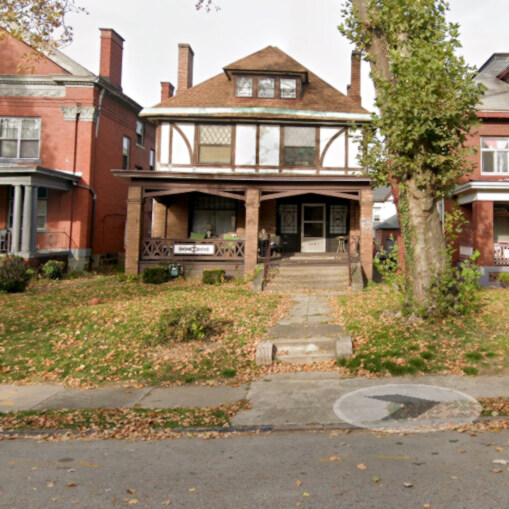
In 1994, my mother and I stood on the sidewalk of Highland Park, clutching a “Rooms for Rent” clipping from the newspaper. We were in town to tour the Art Institute of Pittsburgh (AIP) and had spent what felt like an eternity waiting for a cab, calling a second one before we realized we simply didn’t know how to hail one. It was my first cab ride, a long trek that ended in front of 5441 Baywood Street, a towering Victorian that would become my home for the next year.


From: Mr. & Mrs. Lewis Moten
P.O. Box 582
Fort Ashby, WV 26719
To: Lewis Moten
5441 Baywood Street
Pittsburgh, PA 15206
Postmarked: July 6, 1994
How much is a 29 cent postage stamp?
[backwards] Frog crossing (Ribbit)
Your request for credit was not ignored.
This request for payment should not be.
Sealed With Official West Virginia Spit
De-Liver De-Letter De-Sooner De-Better
The Layout of a Student Commune
The house was built for a different era, boasting eight bedrooms spread across three floors. It reminded me a little of my grandmother’s house. The architecture felt mysterious; a “split” staircase led to the kitchen via a set of incredibly narrow steps. In our youthful imagination, we assumed these were “servant stairs,” and we puzzled over odd holes in the dining room floor, envisioning a pulley system used to summon help.
It was a revolving door of roommates, most of us AIP students who caught the 71A Negley bus downtown every morning for a 30-45-minute commute. I did not have a vehicle. When money was tight, the walk was about two hours, and my portfolio was bulky and weighed a ton. I started in the cramped basement but gradually worked my way up the social and physical ladder of the house. I eventually landed in the attic—a spacious, slanted-ceiling sanctuary with twice the footprint of the rooms below. It reminded me of my aunt’s old room at grandmas house. I loved the room. Just outside the two bedrooms in the attic was a shared bathroom with a clawfoot tub, though the lack of a shower meant I still had to trek down to the second floor to get ready for class.
“Straight Edge” in a Psychedelic House
The reality of the house set in once my mother headed home. I quickly realized I was the “straight edge” outlier in a house of extremes. While I focused on my studies, my roommates were living a different experience:

Page 381: Lewis Art Institute Pittsburgh
- The Wolverine: One roommate WO would describe drug trips that convinced him he was a member of the X-Men. The first question he asked me was whether I had seen a movie called “The Crow” that had just come out. I wouldn’t see it until it came out on video. He was friendly, but soon moved out.
- The Cook: The most grounded guy DN lived up in the attic. He was a chef at Hooters and had his own car. He left after a few months.
- The Basement Garden: SH showed off a complex hydroponic setup of pot plants hidden beneath the basement stairs. As the senior resident, he acted more like a house manager but usually kept to himself. He also organized big house parties and was into heavy metal with a notable Pantera poster as you came down the basement steps towards his wall, and the constant blaring of songs, most notably “Walk”. The guy knew everything about metal musicians and how they criss-crossed between different bands and had some of it graphed out.
- The Twin Peaks Obsession: SH spent his days watching bootlegged Twin Peaks episodes with his roommates in his bedroom. Because they were recorded near a faulty broadcast antenna, the screen was a constant wash of static. He and his friends would sit, tripping, pointing out “skulls” hidden in the fuzz that I could never see. Other movies he liked watching were Naked Lunch, Clockwork Orange, Eraserhead, The Shining, Pink Floyd: The Wall, Videodrome, Blue Velvet, and Jacob’s Ladder.
- From The Hood: Later on, VD arrived with a head full of stories and survival rules. He was tall and thin, with plenty of advice and street smarts. His back was covered in massive scarring from a shotgun.
One thing I recall is a large wooden spool that people on the road used to unwind wires for telephone lines. The spool was being used as a table, but everyone seemed to have left their creative mark on it with psychedelic mushrooms, cartoon characters, local bands, and more.
The place was a bit chaotic at times. One of the roommates would be on the phone in the kitchen every now and then, arguing. One day, he punched a hole in the wall next to it. The hole remained for months, still there when I left. We had a beanbag chair of some kind, and I was warned never to sit in it, or I would fall asleep. I took that to heart and avoided it. We had a TV and a VCR, but eventually someone cut the wires so they couldn’t be used.
People came and went into the house as roommates. It was pretty sad to see DN, who lived in the attic, leave. He seemed pretty well-grounded compared to everyone else, and he was a cook at Hooters. SH eventually got an inside dog and named him Cooper after the main character, Agent Dale Cooper, in Twin Peaks. I’d never had an inside dog before, but Coop always stayed by SH’s side, so I never saw or heard him unless I went down to the basement to do laundry and passed SH’s room while the door was open. I’d listen to him talking to his dog, saying in an odd voice, mimicking one of the other characters, “Cooper… Agent… Dale Cooper…”
There was one thing my roommates wouldn’t put up with – hard drugs. I’ve seen girls turned away from parties because they were caught with crystal meth. Anyone with hard drugs was trouble, not to be trusted, and we didn’t want anything to do with anyone into it.
The house had a reputation, too. A heavy metal band called Crayon Death—comprised of Music Video Production (MVP) students—had lived there previously. They’d return for parties, hauling in kegs and playing loud sets. The cover art for their debut album appeared to be an original painting, about 18×18 in, when I saw it in the kitchen.
- Gridlock
- Catholic Boy
- Angel of Night
- Easier to Die
- Nicotine
- Twice Upon A Time
- Hell, My World
- Cocaine (not our song)
Some of the band members would talk to SH about their progress and problems producing the album. I recall them having a “Gold CD” that they treated as a delicate, fragile object. It wasn’t gold at all, so I took it as a term.
The Night of the Firecracker
One of my roommates (VD) and I went to the “girls’ house” on Chislett Street for a party they were hosting. It was something… first, he told me when the party started. I arrived first, and to my surprise, I learned about the expectations for arriving on time to a party. No one was there except the girls. I sat on the couch forever, waiting for people to come. This was before mobile phones, and no reading material was available.
Eventually, the party started as people arrived, including VD. The music started, and people began to talk. One of the girls was throwing a birthday party for her boyfriend. VD convinced me to relax and have my first beer. He said something about a firecracker, but I had no idea what he meant. It was disgusting, but I drank anyway. I drank a lot. I was pretty drunk.
Eventually, a stripper came, sat the girl’s boyfriend on a chair in the middle of the room, and did more than just strip. There was a bit of a dance and a lot of teasing. She then put a condom on him, and there was a happy ending for everyone watching. The stripper and the guy’s girlfriend were in on it. It was just — shocking.
Eventually, I made it home. I drunkenly talked on our porch when I got home, unaware that I was under the influence of more than just alcohol. I talked incessantly on the porch with a few of my roommates present—not talking to them, but just rambling. I was alert enough to hear SH complain to VD that he wasn’t a fan of my rambling and that VD shouldn’t encourage me to drink. So I kept everything to myself from that point on, and for years to come.
While my mind was trapped in that cycling, hallucinatory loop when trying to sleep—the hard-shelled spider roller coaster and the pulsing colors—I found myself obsessed with a letter I had written to my mother. It was a raw, angry document detailing how I felt she was being controlling and manipulative, and all of her focus on making sure we kids were independent enough to take care of ourselves had not prepared me for the situations I’ve been in, and what I’ve seen.
In that altered state, the attic stairs felt like a mountain. I remember running down those flights to the mailbox, driven by a desperate need to “send” my independence and cut the cord. But then, the weight of the decision would hit me, and I’d scramble back down the stairs to retrieve it. I must have made that trip four times—laced with something I hadn’t asked for, my heart racing, physically exhausted, but mentally unable to stop the loop.
It was a fever dream of a night. I was fighting two battles at once: one against the roommate who had violated my trust by dosing me, and one against the lifelong influence of my mother. By the time the sun came up, I was drained of everything. I figured, why not try a joint that SH handed me? VD made a big spectacle, calling me out, going from a hard-edge kid to drinking and smoking within 24 hours.
On top of that, VD later revealed what the “firecracker” beer was: he’d dosed me and assumed I knew. After that, something fundamental between us snapped. I was still living in the same house, but any feeling of safety I’d had with him was gone.
The Party Raid
The house’s chaotic energy eventually took a dark turn. During one massive party, I retreated to my attic room to sleep, only to be jolted awake by a commotion after the music was cut. I walked downstairs to find police officers swarming the foyer.
At the time, VD had recently shaved my head bald with a razor. I remember the sweet, heavy smell of a Swisher Sweet blunt between his lips as he leaned in, staring just above my eyes, and shaved my head. I was young and didn’t understand the racial and cultural weight of that look or how I might appear to others, and to this day, I don’t know why he, of all people, chose to shave my head like that unless he genuinely didn’t understand what it meant either.
As I sat there in front of the police—bald, exhausted, and confused—the officers mocked me, accusing me of lying about my involvement and acting like I was running the party. The night ended with SH in handcuffs, charged as the host for taking money at the door. He later returned furious, convinced the police had taken the cash from his fanny pack and even tampered with his kegs. From that night on, his anger at law enforcement was constant and loud.
The Fight Over Money
The end appeared to come when a coworker, RH, moved into the attic. Some time later, my mom sent some extra money for a deposit so I could find a new place to stay. VD wanted to take the money and buy pot to resell and “double it.” First, he tried to convince me he could teach me how to do it; I refused. Then he asked me to lend him the money so he could do it himself; I refused again.
Eventually, the money went missing. VD took “justice” into his own hands, finding RH’s hard drug paraphernalia in his bedroom, and accusing him of stealing the money, and cutting the power cable to the TV and VCR. VD confronted RH that night, yelling at him and then beating him. RH was crying, denying everything, and VD kept shoving him so hard that RH stumbled backward, eventually falling to the ground. Then VD dragged him into the middle of Baywood Street as the neighbors watched in stunned silence. I stood there, shocked and powerless to stop it, angry at what VD had discovered.
RH was already bloody, terrified, sobbing, and ashamed, but VD had to go further, turning violence into humiliation. He forced him on all fours and staged a crude, sexualized mockery while shouting homophobic taunts, determined not just to hurt him, but to break him in front of the neighborhood.
The Economics of Survival

I was embarrassed and ashamed. I never returned to work. I didn’t want to face RH, or whatever he may have told the boss.
I had no vehicle, and without a job, I quickly began to struggle. I became a clinical research participant, checking into a facility for three weekends to take experimental medication while they monitored my vitals. I left with a check that kept me afloat for a few more weeks.
I found ways to stretch every cent. I discovered a beauty school downtown where I could get a haircut at a deep discount if I let the students practice on me. I had a credit card my mother had set up, tied to a bank account she would occasionally supplement.
I remember the ATM on the corner adjacent to the school—one of the few that would dispense as little as five dollars. I would stand there praying the card would work. If it did, I’d head into the 7-Eleven for hot dogs and a drink.
On better days, I’d visit the Chinese restaurant, Chinatown Inn, across the street. They didn’t speak English well, so it was easier to just order by number from the menu. The Art Institute was located in the heart of Pittsburgh’s Chinatown, and the neighborhood’s smells were a constant reminder of the world beyond my cramped attic room.
On one of my two-hour walks home, it was dark and snow was everywhere. I found myself on a small, quiet road that felt like an old-timey main street, lined with decorated old storefronts. There were no footprints. It was calm and peaceful. I never found that street again, but I’ve had dreams about it ever since.
Losing that deposit meant my plans to move out fell through. VD left, RH vanished, and I eventually found a solo apartment closer to school with a new group of roommates, finally leaving the strange, beautiful, and violent world of Baywood Street behind.
Reflection: From Baywood Street to the Boardroom
Looking back at Baywood Street thirty years later, it feels like a lifetime ago—and in many ways, it was. At the time, I was just a kid trying to survive art school while navigating a living situation that felt like a cross between a David Lynch film and a cautionary tale. I was “straight edge” not because I was judging anyone, but because I was trying to keep my compass pointed north while the world around me was spinning in a haze of bootlegged tapes and basement parties. Eventually, my boundaries were forcibly stripped away, and I found myself participating in a lifestyle I had spent months resisting out of peer pressure.
That elusive ‘vibe’ from the snowy, dream-like street didn’t return to me for nearly thirty years. It finally surfaced in Front Royal as I sat on a town square bench with my corgi, Teddy, watching a Whoville-themed Christmas unfold. I was still ‘alone’ in the literal sense, but for the first time since 1994, I was enveloped by a community that felt like the dream I’d been chasing. Belonging didn’t happen overnight; it was a slow, intentional harvest. It grew from quiet walks in the park and becoming a familiar face to local shopkeepers, eventually blooming into a business of my own. That business became my bridge to the Chamber of Commerce and to a life of service—through Rotary, the Masons, and, eventually, public office. I realized then that a ‘real’ home isn’t something you find in a Hallmark movie; it’s something you build and recognize in the people and community around you, one handshake and one committee meeting at a time.
Today, I look at those memories through a different lens. My time in that house taught me things that a quiet, sheltered life never could:
- Empathy for the “Invisible”: When I see others who seem a bit lost, or young people who are clearly struggling with their environment, I don’t see “problems.” I see myself in that foyer on Baywood Street. I understand that everyone has a story happening behind closed doors.
- The Value of Safe Spaces: Living in a house where your deposit can vanish, and your peace is constantly disrupted, has made me a fierce advocate for public institutions. They are one of the few truly “safe” spaces left where anyone—regardless of their roommates or their bank account—can find quiet, resources, and dignity like that snowy main street.
- The Complexity of Community: That house was a microcosm of the world. It was creative, violent, confusing, and vibrant all at once. It taught me that community isn’t always perfect or pretty; it’s a group of people trying to coexist.
In hindsight, the “paraphernalia” found in RH’s room felt too convenient. I now suspect VD may have been removing a witness or a rival for my trust. VD may have been trying to see how far he could go and how gullible I was. It may have been him who stole my deposit. RH could have been an innocent bystander who was beaten, since RH and I got along well at work to the point that I invited him to live with us. RH was possibly a threat to VD and my relationship, or exposing what VD was doing. VD also had this #1 rule that you should never smoke pot alone, and #2, weird things will always happen when you smoke. I rarely smoked because I never had anyone around to smoke with me, and didn’t know where to get it. I think he was just trying to make sure there was an excuse to always share with him. I’ve gained enough wisdom to know that in chaotic environments, “justice” is often just another form of manipulation.
I share this as a warning: beware of those who try to “prove” their loyalty by staging others’ downfall. Of course – how do you know that they are doing that, if you don’t suspect it? The answer is: you don’t. Not until years later, when the static clears, and you realize that the most dangerous person in the room is often the one claiming to be your protector and/or encouraging you to get out of your comfort zone.
We often think of our “wild” or “unconventional” years as something to hide once we enter the world of boards and public service. But I’ve found the opposite to be true. Being a leader isn’t about having a perfect past; it’s about having a deep understanding of the human experience. The “fuzz” on those old Twin Peaks tapes has long since cleared, but the lessons I learned in the attic of that Victorian house remain the foundation of how I serve my community today.
One response to “Moved to Baywood Street, Pittsburgh, PA”
[…] There was a coworker with whom I got along really well. He had an accent—possibly Swedish or Russian—and he’s the one who first introduced me to Yanni. Eventually, he even became my roommate on Baywood Street. […]