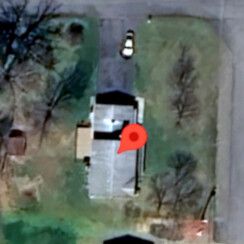
Viewed: Labor Day weekend: September 1-3, 1990
Purchased: November 16-26, 1990
Moved during Mineral County schools hunting week: November 19-23
Moved from: White 5409 Ebenezer Road, Marsh, MD 21162
Moved to: 57 Gail Street, Fort Ashby, WV 26719
Note: Including pages from my mother’s memoir for context, and her opinion on a few issues. She wrote the memories at my request in the year leading up to her passing.

162 Miles, 3 hours

Page 316: Lew Domiciled to Cumberland 1990
For most of my childhood, I only knew one home: 5409 Ebenezer Road in White Marsh, Maryland — thirteen miles from the Baltimore city line. That was normal. That was childhood. Westminster and anywhere before that barely existed in memory. Then, just before my freshman year at Eastern Vocational Technical High School, my parents announced we were moving closer to Delray, West Virginia.
The official reason was that my dad had been transferred to a better job in Cumberland, Maryland, and that we’d be closer to the 5.5 acres of land in Delray where he’d been slowly building a house. Years later, I’d learn there were deeper emotional reasons — suspicion, fractured trust, and human pain that families sometimes can’t hide from forever. But at fifteen, I only knew my life was being uprooted.
We toured four houses over Labor Day weekend (September 1-3, 1990) and settled on one in Fort Ashby.

Page 317: Labor Day Weekend 1990
The Real Beginning of the 90s
Fort Ashby is when the 90s truly began for me. Movies stopped feeling childish. Music wasn’t innocent. Life suddenly carried weight. Responsibility stopped being theoretical. I was fifteen when everything shifted—and that heaviness never fully left.
Some memories come with soundtracks. For me, the move will always sound like Suzanne Vega’s “Tom’s Diner”—the DNA remix. Wind. Boxes. Highways. Uncertainty. That beat looping like a heartbeat while everything familiar slipped into the rearview mirror. To this day, hearing it stitches me right back to that moment of transition.
One Day, One Trip, One House
We only made one house-hunting trip. It was a long day bouncing from town to town looking for somewhere big enough for four kids and a dog. There was a fixer-upper near the LaVale Mall with an unbelievable backyard playhouse that almost hooked us. But then we saw the house in Fort Ashby — perched near the top of a hill in a quiet neighborhood — and it felt like stepping into the future.

Mineral Daily News-Tribune
Nov 30, 1990, page 14
A dishwasher. A laundry chute. Air conditioning. A fireplace you could load from the garage. A NuTone intercom. Fresh carpet. A real foyer. Central vacuum. Electrostatic dust filtration. A basement with a door you could walk into from the ground level in the back. The house was said to have been built initially or adapted for the neighbor’s daughter across the street, who wore leg braces, which gave the house an unexpected sense of humanity. Nobody debated. That was the house.
First Kindness, First Chaos

Page 323: Boys Helping To Move
We moved during hunting season, when West Virginia schools have the week off. This meant my brother and I didn’t have to go to school, and we could help with the move. My sisters were still in school in Baltimore at the time.
Our family rented a truck, but when they went to pick it up, the company had a problem with some busted windows and only gave us one that was half the size. After unloading the truck at the new house, my dad drove back to Maryland for another load, leaving my brother and me alone in the house that first night. A neighbor came to the door with his daughter and handed us a welcome pie. That didn’t happen in Baltimore. Suddenly, we weren’t just moving — we were being noticed.
The first chaos arrived thanks to the dishwasher. None of us knew you couldn’t use regular dish soap inside one. Soon the kitchen floor disappeared under rolling waves of bubbles, creeping toward the vents as we scrambled around stopping the foam invasion. Instead of disaster, it felt like initiation.
The house came with a heat pump, but it started blowing cold air in the winter. Although the living room had a built-in fireplace, it was more for show than for warmth, and could hardly hold enough wood to warm the house. Dad put a wood stove in the basement and set up fans to move heat through the house. He said that cold didn’t exist, but that heat can move.
A House Bigger Than Childhood

Page 321: Fort Ashby
This house felt enormous. There was a dining room separate from the kitchen. The kitchen had a breakfast nook where mornings were cereal, rushing, and unfinished conversations. Mom had an office with her roll-top desk, LCD-screen electric typewriter, and printing calculator. My brother split the cost of an IBM PS/2 with Mom after getting a paper route, and that computer became the center of our universe. My brother built a desk for his desktop computer.
The basement wasn’t for storage — it was a workshop. I had a scroll saw, a router, a jigsaw, and tools everywhere. One of my proudest creations was a heavy-duty workbench I designed and built in high school from thick lumber and 4×4 legs, one that felt like it could outlive us all. That house didn’t just give us space. It gave us the capability.
A Ceiling Full of Coffee Mugs
One of the strangest and most charming features of the house wasn’t architectural — it was something we did. Our family collected mugs. Too many. So Dad mounted long white boards to the dining room ceiling, screwed in hooks, and hung the entire collection overhead. Meals happened under a floating canopy of ceramic cups. It was absurd. It was practical. It was absolutely ours.
Life on the Hill
Three bedrooms. My brother and I shared one. My sisters shared another. My parents had theirs with dual sinks and a walk-in closet that Mom partially turned into a sewing space. The backyard had a wooden deck with a trellis that always suggested future grapevines that never came. The yard was smaller than Maryland’s, and the woods weren’t ours to roam, but the hill defined our lives.
We walked down it to catch the bus, and fought gravity on the way home. In winter, it turned into a thrilling, dangerous sled chute. Baltimore cancelled school over a whisper of snow. West Virginia chained buses and said, “Get in.” Our bus driver owned his bus with a flat front, kept it pristine, and, depending on where you were in the morning, you could catch it early or late, depending on which direction it looped.
A House Without an Address
For years, we didn’t even have a street address. No mailbox. Just “the house on top of the hill.” Mail meant a P.O. Box at the Fort Ashby post office. But my mom wasn’t just someone annoyed with the inconvenience — she was a mail carrier herself. She knew the system, the people, the processes, and how stubborn bureaucracy could be… and she also knew how to work with it.
Eventually, a few years after I left, she rallied the neighbors, pushed through the paperwork, and navigated the red tape with a kind of persistence only someone who delivers mail in every type of weather could muster. Bit by bit, she helped secure our neighborhood’s formal recognition and placement on a delivery route. Today, the house has a number: 57 Gail Street, but to me it will always be “the house at the top of the hill.”
Neighborhood Characters
We didn’t talk to the neighbors much, but they still became part of the landscape. My mother nicknamed the man next door “Mr. 409” because she constantly saw him on his roof spraying it down with bottles of Formula 409 cleaner. Whether he was actually cleaning or just performing some ritual only he understood, it became an ongoing joke.
Once, while selling chocolate bars or fruit for a school fundraiser, I looked behind them and saw a giant rear-projection TV—red, green, and blue beams casting onto a massive screen. It felt futuristic. Tiny glimpses into other people’s lives often feel surreal like that.
Shopping in Someone Else’s World
Almost everything felt like an alternate-brand universe at first. IGA instead of grocery chains. Hills instead of Ames & K-Mart. True Value instead of big retail. Fox’s Pizza Den instead of Pizza Hut. No fast food — just 7-Eleven and Fox’s. Eventually, those places stopped feeling foreign and became “ours.”
Hanging Out Meant Belonging
In Fort Ashby, entertainment wasn’t purchased — it was joined. One of the most prominent anchors was the fire station. I became a Junior Fireman, listened to radios, dried and rolled hoses, went out once on the brush truck, helped drop suction hoses into the river at the fairgrounds for night drills, and once wore full turnout gear. It felt like taking responsibility. The oxygen mask didn’t breathe for you — it breathed against you.
From Baltimore Freedom to Stillness
Gen X kids roamed. In Baltimore, that meant rail lines, delis, long walks, and the freedom to explore. Fort Ashby was quieter, slower, sometimes painfully still. I found Fox’s Pizza, hardware aisles to wander, and the octagon-shaped library where I copied my drawings. If you wanted stimulation, you built it.
Finding Friends and Laughter
Eventually, friendships found their way in. My brother had two friends who were brothers who lived above their family’s restaurant and had a Sega Genesis, a TurboGrafx-16, and a computer. That alone made the older brother legendary, as he was around our age. We played Bonk’s Adventure, Ecco the Dolphin, and laughed endlessly at Leisure Suit Larry. A video rental store opened with a pool table, arcade machines moved into town, and later, another upstairs arcade would house Mortal Kombat II, one of the first games that felt like rebellion, identity, and belonging all wrapped in flashing pixels.

Fireball Arcade
Years later, life had carried me far from Fort Ashby, but that love never really left. In Front Royal, I eventually purchased a Mortal Kombat II arcade cabinet from another person who had it hosted at the Fireball Arcade—and instead of taking it home, I left it there so the community could play. The kid who once searched for places to belong now owned one small piece of an arcade and made sure it stayed where others could find joy, friendship, and maybe a little refuge like I once did.
Rocket Science at Midnight
My brother and I loved model rockets, which naturally meant launching them in the middle of the night while narrating like a police reality show into my mom’s camcorder. We chased rockets across darkness, laughing breathless. Our tiny rocket “The Mosquito” eventually lost a fin — we launched it anyway. Somewhere, that camcorder tape still exists.

Shoveling Toward a Dream

October 1992, page 54
I desperately wanted a program I found in a Computer Gaming World magazine — “Game Maker,” something that promised I could build and sell my own games. It was $89 plus shipping. That was a lot of money. This was the 90s — kids didn’t have credit cards. Debit cards didn’t behave like them yet. If you wanted something, you earned money and mailed a payment.
One winter buried the town in about three feet of snow in December, with high winds (Nor’easter of 1992).

Mineral Daily News-Tribune
December 11, 1992
Pages 1, 3

While most kids saw snow days as an opportunity, I saw an opportunity. So I grabbed a shovel and cleared driveway after driveway in freezing air until I had enough for a money order—the magical paper currency of the era—purchased from the post office or 7-Eleven, stuffed in an envelope and mailed, while unbeknownst to me, the county was in a state of emergency, asking people to stay home. When it finally arrived, it wasn’t just software. It was proof that work could turn into a possibility.

Looking back at history, the software was advertised for $89 in issue #99 and $129 in the next issue. Today, you can run the software for free in your browser or download it to run on an old PC or virtual computer.
- RSD Game-Maker (DOS Games)
- Game-Maker Manual (Internet Archive)
- Source Code (GitHub)
Chain Letter
I don’t recall how we got it, by my brother and I came across a chain letter once. It included instructions on how to make money – lots of money. We mailed a letter back with a dollar money order, and then ordered a list of addresses. While we waited, we had everything under our beds, preparing to mail the same letters we received. Once the addresses came, we sent them out.
As kids, we had big dreams. We could buy anything our hearts desired. A white Lamborghini Countach was probably at the top of the list, along with a Nintendo and some video games. In reality, we would quickly learn a hard lesson. Only one envelope came back with a dollar. Not everyone falls for a chain letter.
It wouldn’t be until much later in life that I would learn about pyramid schemes and chain distributions through the mail. Mind you, our parents both worked at the post office, as did our grandmother. Go figure.
Summer At Grandmas
One summer, my mother sent my brother and me back to Baltimore to live with her mother. She signed over guardianship for the summer. The purpose was to expose us to better job opportunities, since Fort Ashby was in a remote area. My brother and I both worked at McDonald’s. Grandma was charging us rent as long as we had jobs. My dad got upset because he purchased us a case of soda, and Grandma was rationing it. Eventually, my brother was kicked out for not paying rent, so he stayed with his girlfriend at the time. Many things happened, but in the end I worked with Mom, and we snuck all our things out of Grandma’s house and made it home.
Now, here is where things got a bit mischievous. Mom was angry. Mom knew how to work systems – and she knew the postal system. She knew how to weaponize systems rather than people, in a passive-aggressive way. She purchased a stack of different magazines. She had my siblings and me sit at the big walnut table in the dining room. We would tear out all the mailers for various products and fill in my grandmother’s contact information. It was a small-scale bureaucratic retaliation, flooding Grandma with junk mail, solicitations, and hassles.
I remember the laughter we all had. We were all tired of the “bad” grandma. She always did and said nasty things. Even her friends would sometimes make comments to us kids about it. It was time that she had gotten a taste of her own medicine.
Understanding Systems
But today, I see that night in a different light. It was the first time I saw paperwork used like a weapon – and the first time I felt what power looks like when it’s quiet. Years later, I would recognize the same pattern on a larger scale: not face-to-face conflict, but coordinated pressure, repeated forms, and a kind of crowd confidence that grows when everyone believes when they’re “in the right.”
Mom taught me that when you feel ignored, mistreated, or powerless, you don’t scream into the void or at people – you push on systems. You use forms, processes, rules, mail, and paper trails. The difference is intent: she used those tools to hurt someone in private, while I’ve tried to use them in public to keep people from being hurt.
The Mystery Stomach Years
School mornings were sporadically miserable. I believed toothpaste was making me sick. Years later, a girlfriend noticed the truth: I was lactose intolerant, and every cereal breakfast had been a sabotage disguised as routine. Suddenly, a decade of misery made sense, including my aversion to breakfast.
Learning Not to Panic
Once at the Tri-State Fair, it hit without warning. I couldn’t stop it. I walked home with humiliation literally inside my clothes. No one commented — maybe out of kindness, maybe out of mercy, or perhaps because I hid it well. I learned that panic doesn’t fix reality. You walk home. You clean up. You keep going.

Page 334: Mineral County Fair
Learning to Drive

Page 353: Test Day
Mom taught me to drive in the Chevy Astro Van. I often gripped the wheel too tightly when I first started learning. Dad taught me in the Gremlin to look where the car is coming from at night when you can’t see the yellow lines. When I went to get my license, they asked about driver’s education. One of the state troopers who knew my mom said that we were taught by our mom.
I failed the written test once, studied harder, and passed. The driving part just repeated what I had already learned and went to the same three-point-turn spots I had practiced at, so I passed. Under-18 licenses were sideways with yellow borders. It still meant freedom.
Programming, Plastic Bricks, and a War Over Music
Most of my free time was spent programming, building LEGO on my bedroom floor, or escaping into music with my state-of-the-art 6-disc CD player. I signed up for the infamous Columbia House / BMG “8 CDs for a penny” deal, completely forgetting you had to decline future shipments — so the music kept coming, and so did the bills. But those albums shaped something in me. They were louder, edgier, and unapologetic in a way life rarely allowed.
The earliest ones I remember?

Take any 8 CDs for only 1¢
Columbia House Advertisement
- Metallica: …And Justice for All
- Mötley Crüe: Dr. Feelgood
- Guns N’ Roses: Appetite for Destruction
- Madonna: I’m Breathless
- Modonna: The Immaculant Collection
- MC Hammer: Please Hammer, Don’t Hurt ’em
- Faith No More: The Real Thing
- Enigma: MCMXC a.D.
- Janet Jackson: Rhythm Nation
- Warrant: Cherry Pie
- Prince: Batman
- INXS: Kick
- Millie Vanilli: Girl You Know It’s True
- Yes! I intentionally purchased this album, and the lip-synching scandal broke the month that my family had moved.
Growing up a Jehovah’s Witness meant I mostly heard oldies in MD. West Virginia meant endless country music, which constantly annoyed me. My dad always said, “You can take the boy out of the country, but you can’t take the country out of the boy.”
One day, he stormed into my room, furious about the music I was playing (Dr. Feelgood). He flipped through the lyric booklet as if it were evidence, demanding to know if this was who I wanted to become. He stood too close as his face turned red from yelling. I snapped. I punched his arm. I had never crossed a physical boundary like that with him before.
And then came the strangest part. He didn’t yell. He didn’t hit back. He didn’t even argue. He just stared at me for a moment… then turned and walked out of the room. No lecture. No punishment. No resolution. Just quiet – and a heaviness that sat between us after that. Something shifted that day, and neither of us acknowledged it out loud, but it lingered.
The Crash
Later in high school, I was the family driver for school in my mom’s van after she got a 4×4 Ford Explorer for the snow. My brother often went home with his girlfriend, so it was just my two sisters and me on the way home.
On a pretty rainy day after school, traffic bunched too close, too fast. Someone stopped abruptly to make a left turn, and in the span of seconds, everything shifted from ordinary to slow-motion chaos. Tires. Water. Metal. Shattered taillights falling like red glitter. A multi-vehicle chain collision. Because the back of our van wasn’t damaged, they said it was only three vehicles, and I was charged with failing to reduce speed to avoid a collision.

Page 366: Lewis Accident

Page 367: Lew Came Along
Nobody was seriously hurt. Everyone was shaken. I don’t recall how I got home, but Mom’s journal said that the state trooper wouldn’t let me take my siblings home because of my age (17 at the time). Dad eventually came along on his way home from work, stopped to bring everyone home, and Mom arrived home after following a tow truck hauling her van.
Life did that strange thing where it pretends nothing happened. The girl I’d hit — Michelle Guynn — sat near me in science class. In our next class together, she turned and asked if she could borrow my homework, like this accident had already been archived under “life happens.” It was surreal how quickly trauma dissolved back into routine.
The legal part didn’t feel routine. I went before the magistrate alone — just a quiet little room, a serious man, a giant book complete with outcomes, and fines I couldn’t afford. Somehow, it got worked out. But the whole episode didn’t just live in our home or my head. It became public record. This was small-town West Virginia: your mistakes are printed into the town’s history. The paper ran the accident first, headline and all:
“Speed contributes to wreck.“
A three-vehicle accident on Route 28. My full name. The time. The weather. Michelle’s name. Christina’s name. Even the cars we drove — my mother’s 1986 Chevy Astro, forever documented in newsprint.

October 15, 1993
A few days later came the magistrate report under another headline:

October 22, 1993
“Magistrates give some jail time, others get fines.”
There I was on the docket, listed alongside far more serious cases: Lewis E. Moten III, Fort Ashby, pleaded guilty to failure to reduce speed to avoid a collision, ordered to pay a fine and costs.
A line of ink. A permanent little scar. But the deepest bruise didn’t come from the court or the paper. It came at home.
It was my mother’s beloved 1986 Chevy Astro that was towed home — the vehicle she talked about with pride. I sat in my room afterward. Mom arrived. I heard the truck door shut. Then came the scream.
Raw, guttural grief…
For the van. Not for me. Not relief that I wasn’t dead. Not fear for my safety or my sisters. Just loss — for the vehicle.
I locked my bedroom door and sat against it while it echoed through the house. She didn’t come to talk to me. See how I was taking it. She didn’t even come upstairs or call up to me. She was absent. What stayed wasn’t the wreck. It was learning what — and who — mattered most in that moment.
The Breaking Point

Page 369: Bonnie’s 8th Grade Dress
By senior year, home no longer felt like home. The arguments in the hallway behind my bedroom door between my mom and my oldest sister spiraled into something dangerous and constant. She was causing problems with everyone. My brother was usually hanging out at his friend’s house. I tried to hang out when I could or visit places around town. At home, I spent most of my time on the computer. Social services dropped by. My sister learned that once I turned eighteen, she could press charges if I defended myself against her.
My sister used that knowledge like a weapon. She would often hit me and laugh about it. I was getting tired of it. I couldn’t do anything. My parents wouldn’t do anything. I would graduate on May 26, two days before my 18th birthday, and then leave for Pittsburgh in June. Those weeks felt like survival. She’d hit me, taunt me, dare me to fight back.

Page 370: Abusing Her Brother

Page 371: Incorrigible Teenager
Knives had always been her weapon of choice — for years. One day, she chased my younger sister with one, and something in me broke. I didn’t care about my safety anymore. I didn’t care about consequences. I went into the hallway leading to the refrigerator, where she was standing. When she turned it on me, I stepped forward and grabbed it bare-handed.
Police came. She was taken away.
My mother reached her breaking point, too. She understood how to navigate bureaucracy when she needed to, and she began the legal process to relinquish my sister to the state to keep herself and my youngest sister safe after my brother and I left for college. My sister was placed in a group home. My dad visited often. Every glimpse of progress eventually collapsed into a setback.

Page 375: Bonnie Moves Out 4/94
Years later, I saw my older sister standing outside in the cold near my car, telling strange, unsettling stories about life in the group home and things kids were doing to a dog. She still carried chaos like weather. I loved her. I couldn’t save her. I barely had enough strength to save myself. It would be a decade before I saw her briefly, and then another before we could reconnect.
That truth stays with you.
Leaving
Fort Ashby wasn’t just a move. It was kindness and chaos. Quiet mornings and screaming storms. Programming and pizza. Rockets and snow shovels. Ceiling mugs and fire engines. Fear. Growth. Laughter. Hurt. Survival. Becoming.
It’s where resilience took root.
And eventually, it’s the place I longed to escape.