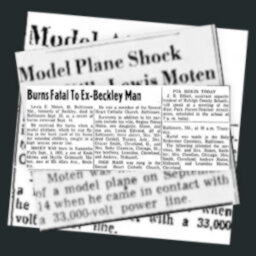
My grandfather passed away when my father was a child, and his sister was a newborn baby. He often flew model airplanes in demonstrations and shows for various groups and children. He was electrocuted while flying a model airplane in his backyard in preparation for an event later that afternoon at Rosewood Training School (a mental health facility for children). A bunch of the neighborhood kids were there, including my father, who was watching. This was before R/C airplanes, and a long metal wire connected the wooden controller in his hand to the aircraft, which was reported to have come into contact with live electrical lines.
My grandfather flew model airplanes regularly and would have been familiar with the wires. My grandmother, who visited him every day at the hospital, explained to my father that the electricity had arced, rather than the plane physically contacting the wires. Simply touching a wire with metal is not the only way to be electrocuted.
These were large, high-voltage transmission towers with lines running behind the house in Owings Mills, Maryland. My father said he later went back to look at the big metal towers with wires drooping down over the yard and realized it was a higher voltage when I read the newspaper articles to him, which only reported 33kV, still a high-voltage distribution line running behind residential properties.
The hand-wound control made of wood may have reduced the severity of the current, possibly preventing a more immediate or catastrophic event. He survived for nine agonizing days after the accident. He was immediately taken to the hospital. I only learned much later, as an adult, that half of his body had been badly burned. He was in constant pain, and large fans were placed by his bed to keep his skin dry and cool, helping regulate his body temperature. He later died from complications related to his burns, including pneumonia.
Dad said he turned around and asked his mom once when his father was coming home, but she didn’t give an answer.
Dad said that years later, around 1986, he and his mother visited a coworker of his father’s, who was a really old German man named Otto. After introducing themselves, he remembered just about everything about his father. Otto stated, “I told him not to use piano wire for that airplane”.
Dad stated that his father’s death had driven him to study electricity and how it worked to better understand what had happened and be aware of it. He received formal training in industrial electricity, developed a strong awareness of electrical hazards, and built a career in which knowledge of electricity was a major part of his job at the post office.
My father also revealed another memory about his father and his model airplane. He had taken my father to Westminster Airport to fly or demonstrate it there the previous summer. My father recalls a specific type of grass that he is certain doesn’t appear until August. The first house he purchased was out in Westminster, when my grandparents lived 10 miles from Baltimore city.
Observations from April 11 & 24, 2026
A few things of note from my childhood are that my dad had purchased a sparkling blue 1957 Chevy and restored it over a few years. The year held great significance for him, as he often collected loose change from the same year, but I didn’t make the connection because I didn’t know when my grandfather had died. Reflecting back, I thought he may have been trying to literally restore the year his life fell apart. However, he simply acknowledged that he loved 50’s cars, restoring them, and had a 1956 Chevy before that one. Whether intentional or not, 1957 became a year that he returned to. Dad was also prohibitive of playing with model airplanes. We got into model rockets and R/C cars, but planes were somehow off limits. Even as an adult, visiting him while demonstrating a quadcopter drone flying about brought up a few quiet reflections on the past.
Looking at newspaper articles, Rosewood Training School in Owings Mills was originally established in 1888 as the Rosewood State Training School for the Feeble-Minded (an asylum). It helps explain why reports place him both in his backyard and preparing to demonstrate the plane for children who, by their description, may have been from the school. It’s not too far a stretch to guess that he would have taken the bus over to the school for the demonstration later that day. One article reported that he was a 25-year-old “boy”, despite being married with children.
My father’s later revelation that my grandfather often put on shows for different groups, and my research into the history of Rosewood Training School, led me to realize that my grandfather was interested in helping people as a charitable effort. It’s not something I remember seeing in my family or in our religion growing up.
When I began getting involved in my own community in my late 40s, my father questioned my actions. At the time, I assumed it was because of his religious views against getting involved with the government and my appointment to the board of zoning appeals.
But my involvement grew beyond that. I found myself serving in other ways: on a nonprofit library board, feeding the homeless, helping at community events, visiting the senior center, and becoming active through the Rotary Club, Chamber of Commerce, Masons, and church. I also began advocating before government officials as a third party on behalf of the people who rely on those services.
It filled a void in my life: a need to care for others. It became rewarding for both my mental and spiritual health. I found a kind of joy in seeing others benefit from that work, a reward more meaningful than financial gain alone. It was something I hadn’t experienced growing up, where celebrations and the spirit of giving and charity felt largely absent.
Looking back, he may have been questioning something else entirely: my natural tendency to care for others; something I now see reflected in my grandfather. Perhaps he recognized a parallel, a quiet reclamation of his father’s spirit, and felt a lingering unease about where that path might lead.
Dad never talks about my grandfather unless I ask. Without that context, I was more guarded about raising a religious disagreement and steered the conversation away from it.
The one story I know is of Dad and his father coming home from the store with a watermelon. My dad wanted to carry it inside, but his father warned him he might drop it. He tried anyway. The watermelon fell, and his father was upset—an “I told you so” moment that stayed with him.
Dad was only two and a half when his father died, so I sometimes wonder whether it’s a true memory, a story he was told, or something shaped over time from both. It may explain why so little remains. From my own early years in Westminster, I remember only fragments—places, feelings, moments without context. Then again, it may have been a story about his stepfather, remembered more clearly.
I’ve seen a few clippings over the years, but I started gathering them together and found a few more that give more details on what had happened – or at least, what had been reported. The story’s headlines on their own grab people’s attention. I can only imagine what my grandmother had been going through, hearing how far the news had traveled, and caring for a toddler and a baby daughter to raise on her own.
Newspaper Articles
Man Is Burned As Model Plan Hits Power Lines
The Baltimore Sun, Page 41
Sunday, September 15, 1957
Baltimore, Maryland
Newspapers.com

Man Is Burned As Model Plan Hits Power Lines
An Owings Mill man was critically burned yesterday when a model airplane he was flying became entangled with high tension power lines carrying an estimated 33,000 volts.
Baltimore county police said Lewis Moten, 25, of the 100 block Willgate road was taken to Union Memorial Hospital with first and second degree burns of the left side.
Mr. Moten was flying the miniature aircraft, controlled by a wire running from it to a reel in his hand, when the accident occurred about 4 P.M., Patrolman Samuel Gore said.
He had planned to exhibit it before patients at Rosewood Training School later in the afternoon and was testing the craft in his back yard.
Becoming entangled in the power line, the plane and its control wires served as conductors for the massive current which raced toward Mr. Moten’s body.
Apparently only the fact that the control wire was attached to a wooden rather than a metal handle saved the victim from even more serious injury, Patrolman Gore said.
Shock Burns Are Fatal To County Man
The Evening Sun, Page 5
Monday, September 23, 1957
Baltimore, Maryland
Newspapers.com

Shock Burns Are Fatal To County Man
A 25-year-old Owings Mills resident died early today at Union Memorial Hospital, nine days after he was severely burned by a powerful bolt of electricity from high tension wires at the rear of his home.
The victim, Lewis E. Moten, of the 100 block Wilgate road; suffered serious burns about his face, arms, legs and torso in the September 14 accident.
Mr. Moten had been flying a model airplane outside his home when the plane struck a 33.000-volt high-tension power cable about 100 feet off the ground. A strong current of electricity passed through the plane, down the cable connecting the model craft to a reel held in Mr. Moten’s hand, and into the body of the victim.
The body has been removed to the city morgue, where the victim’s wife. Regina, will claim it later today.
Boy Dies Of Burns
The Cumberland News, Page 3
Tuesday, September 24, 1957
Cumberland, Maryland
Newspapers.com

Boy Dies Of Burns
BALTIMORE, Sept. 23 AP-Burns suffered while he was flying a model airplane took the life today of Lewis E. Moten, 25, of Owings Mills.
Moten was holding the cable of a model plane on Sept. 14 when he came in contact with a 33,000 volt power line.
Model Plane Shock Kills Lewis Moten
The Baltimore Sun, Page 27
Tuesday, September 24, 1957
Baltimore, Maryland
Newspapers.com

Model Plane Shock Kills Lewis Moten
Burns suffered while he was flying a model airplane took the life yesterday of Lewis E. Moten, 25, of Owings Mills.
Moten was holding the cable of a model plane on September 14 when he came in contact with a 33,000-volt power line.
Model Air Fan Fatally Burned
The Herald-Mail, Page 24
Tuesday, September 24, 1957
Hagerstown, Maryland
Newspapers.com

Model Air Fan Fatally Burned
BALTIMORE, Sept. 23 AP-Burns suffered while he was flying a model airplane took the life today of Lewis E. Moten, 25, of Owings Mills.
Moten was holding the cable of a model plane on Sept 14 when he came in contact with a 33,000 volt power line.
Burns Fatal to Ex-Beckley Man
The Raleigh Register, Page 12
Tuesday, October 1, 1957
Beckley, West Virginia
Newspapers.com

Burns Fatal to Ex-Beckley Man
Lewis E. Moten, 25, Baltimore Md., Formerly of Beckley, died in Baltimore Sept. 23, as a result of burns received Sept. 14.
He received the burns when a model airplane, which he was flying in the back yard of his home for retarded children, caught in a high tension power line.
MOTEN WAS born in Kanawha Falls Sept. 5, 1932, a son of Kode Moten and Myrtle Grimmett Moten, now of 221 Allen Ave., Beckley.
He was a member of the Sacred Heart Catholic Church, Baltimore.
Survivors in addition to his parents include his wife, Regina Reese Moten, one daughter, Diane, and one son, Lewis Edward, all of Baltimore; three sisters, Mrs. Mildred Cordell, Tucson, Ariz., Mrs. Grover Smith, Cleveland, O., and Mrs. Ruby Claussen, Chicago, Ill.; two brothers, Leonidas, Cleveland, and Andrew, Mabscott.
HIGH MASS was sung in the Sacred Heart Catholic Church, Baltimore, Md., at 10 a.m. Thursday.
Burial was made in the Holy Redeemer Cemetery, Baltimore.
The following attended the services, Mr. and Mrs. Moten, Beckley; Mrs. Claussen, Chicago; Mrs. Smith, Cleveland; Andrew Moten, Mabscott, and Leonidas Moten, Cleveland.