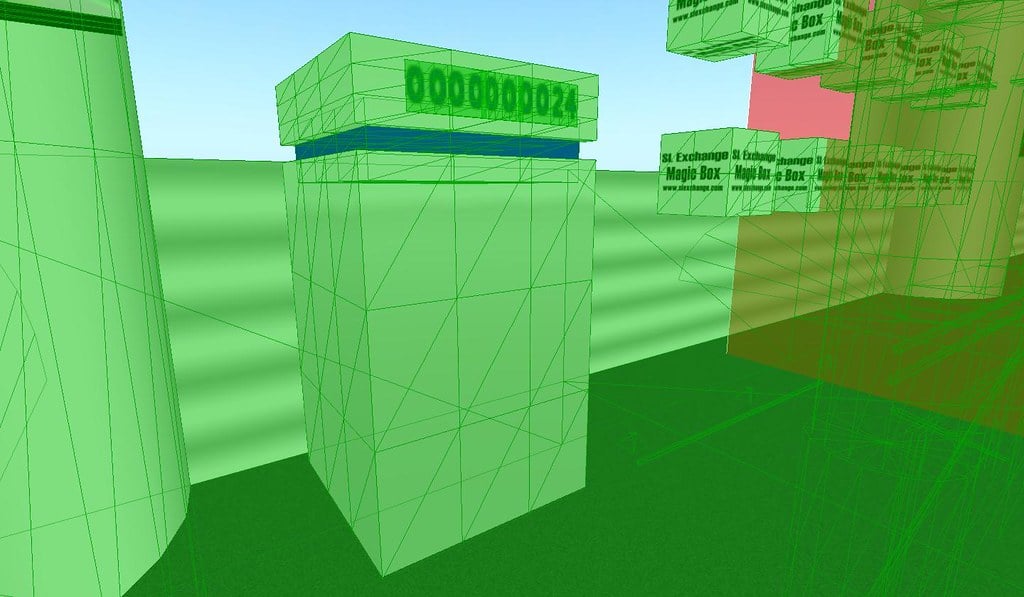
One of the tings that can slow down renduring time is the amount of faces, edges, and points that a card has to render. A point is where the lines meet up. An edge is the line between each point. A face is the triangle that appears when you have three edges connect three points. A square at minimum will have four points, and five edges, and two faces. A cube would end up having eight points, 18 edges, and 12 faces. Turning on Occlusion in my Rendering Info Displays revealed that this is not the case. Cubes appear to be split in a 3×3 grid on each side resulting in 56 points, 162 edges, and 108 faces. The interesting part is when I turned the mesh detail down to the bare minimum, the cube I was looking at went down to the basic 8 points, 18 edges, and 12 faces. This is great except any round prims, flexi's or sculpties looked horrible. Turning the mesh detail up to the max resulted in the 3×3 subdivision of the side mesh. Cylindars are the same way. I can understand the need to have the edge of the circle to be subdivided for a smoother surface. What I can not understand is the subdivision along the height of the cylindar. I believe that the mesh for our prims can be further optimized. I had always assumed that they were in their most simplest forms. I wonder what the benefit is for subdividing the side up like this is. <strong><em>Posted by Second Life Resident <a href="http://profiles.slbuzz.com/dedric-mauriac" rel="noreferrer nofollow">Dedric Mauriac</a>. <a href="http://map.slbuzz.com/sim/Woodbridge/81/75/699/" rel="noreferrer nofollow">Visit Woodbridge</a>.</em></strong>
Original Details
- Original on Flickr: https://www.flickr.com/photos/dedric-mauriac/2190719229/
Text Found Within Image
- SL Exchange Magic Box http://www.slexchange.com